MENU


Some web search APIs are beginning to support autonomous purchase flows for AI agents, but this depends on more than a checkout page. Search providers need payment authorization, metering, entitlement control, spending limits, audit trails, and settlement that software can execute safely. With Microsoft retiring Bing Search APIs on August 11, 2025, web search providers face a critical monetization question: how do you charge software that operates around the clock without human oversight? Nevermined's x402 Facilitator coordinates authorization, metering, and settlement for AI agents across fiat, crypto, credits, and smart accounts. Nevermined gets you from zero to a working payment integration in 5 minutes, with SDKs for both TypeScript and Python.
For AI service providers, Nevermined delivers bank-grade enterprise-ready metering, compliance, and settlement so every model call turns into auditable revenue, with ledger grade metering, a dynamic pricing engine, credits-based settlement, 5x faster book closing, and margin recovery.
Exa is a neural web search API for AI agents and RAG workflows. Its Nevermined integration makes it especially relevant for agent payments because agents can pay Exa through Nevermined x402 card delegation, with Exa documenting that a $7 purchase provisions or tops up an Exa API key with $7 of credits.
Exa's current pricing lists Search with contents at $7 per 1,000 requests, Exa Deep at $12 per 1,000 requests, and Exa Deep with reasoning at $15 per 1,000 requests.
Exa is one of the clearest examples of a web search API moving from human checkout flows toward agent-executable commerce. The Nevermined integration lets agents pay with a credit card through x402 card delegation and receive usable API access. For builders of paid search, retrieval, and research APIs, Exa shows how Nevermined can turn API access into a programmable payment flow rather than a manual subscription workflow.
Brave Search API is a strong option for teams that want web search backed by Brave's own index. That matters more after Microsoft's Bing Search API retirement because search infrastructure buyers now have to think carefully about provider dependency, index ownership, and long-term access to web results.
Brave lists Search at $5 per 1,000 requests and $5 in free monthly credits automatically applied to accounts. Enterprise terms are available for larger use cases.
Brave's published request-based pricing makes autonomous budget calculations easier for agents and developers. Nevermined adds the commercial infrastructure around that pricing model: policy enforcement, auditable metering, credits-based settlement, and payment coordination across fiat and crypto rails. That combination makes predictable search pricing easier to turn into controlled agent spending.
Firecrawl is a web context API for AI systems that need to search, scrape, parse, and interact with web data. It is most useful when an agent needs more than a list of links and has to retrieve clean content for downstream analysis.
Firecrawl uses credit-based pricing. Its pricing page states that Search costs 2 credits per 10 results, while Scrape, Crawl, Map, and Monitor each cost 1 credit per page.
Firecrawl's unified search and extraction model can reduce the number of separate tools an agent has to call when turning web pages into usable context. For teams monetizing agent workflows, that makes metering more important because the billable unit may involve search, extraction, transformation, and delivery. Nevermined gives builders the payment and settlement layer needed to price those workflows through credits, usage-based charging, and auditable transaction records.
Tavily is built for AI agents and RAG applications, with a focus on search and extraction workflows that return web context for language model systems. It is especially relevant for teams that need citation-ready retrieval and flexible search depth.
Tavily's Credits & Pricing documentation lists 1,000 free credits per month, pay-as-you-go pricing at $0.008 per credit, monthly plan rates from $0.0075 to $0.005 per credit, and custom enterprise pricing.
Following Nebius's February 2026 agreement to acquire Tavily, Tavily is positioned as part of a broader AI cloud and agent infrastructure stack. Its credit-based model is a natural fit for Nevermined's credits-based settlement and auditable usage metering. Agents can choose search depth based on task complexity, while Nevermined can enforce budget limits, usage policies, and settlement logic across the transaction lifecycle.
Linkup is a production-grade web search API for AI applications. Its key distinction for agent payments is explicit x402 payment protocol support, allowing pay-per-request access in USDC on Base without a traditional account or API key flow.
Linkup lists Search pricing at $0.005 to $0.006 per request, depending on search mode. Its pricing documentation also states that x402 follows the same per-request costs, with a minimum charge of $0.01 per x402 request.
Linkup shows how x402 can make paid web search callable by agents without a traditional checkout flow. Nevermined extends this pattern beyond a single provider by coordinating authorization, metering, and settlement across fiat, crypto, credits, and smart accounts. For API providers, that means Nevermined can support agent payments while preserving enterprise-ready controls for pricing, usage limits, auditability, and revenue operations.
Serper offers a Google Search API with fast response times, 2,500 free starting queries, and lower per-query pricing at higher credit packages, making it a cost-conscious option for high-volume search workloads.
Serper pricing goes as low as $0.30 per 1,000 queries on its Ultimate credit package. That can make Serper materially cheaper per query than many self-serve SERP API plans, depending on the buyer's volume, package, and credit usage.
Serper is attractive for agents that need frequent search calls without making every query expensive. For production deployments, Nevermined can add request-level metering, access control, and settlement around paid search APIs so builders can monetize search-driven agent workloads without rebuilding payments infrastructure from scratch.
SerpApi provides access to a large catalog of search APIs including Google, DuckDuckGo, Baidu, Yandex, Amazon, Yelp, YouTube, and other search or marketplace data sources, serving teams that require diverse source coverage.
SerpApi's self-serve pricing includes a $75 monthly Developer plan for 5,000 searches, which works out to $15 per 1,000 searches before considering other available plans or custom enterprise volume arrangements.
SerpApi's broad engine coverage makes it useful for agents that need more than standard Google results. Because multi-engine workflows can create unpredictable API consumption, spend controls, usage metering, and settlement become important parts of production deployment.
Parallel focuses on deep research and web intelligence infrastructure for agents that need information synthesis rather than basic search results.
Parallel lists Search API pricing at $5 per 1,000 requests with 10 results, with separate pricing for deeper Task API tiers based on compute intensity.
Parallel is better suited to higher-value research workflows than simple lookup calls. Those workflows benefit from agent payment controls because agents may need to decide when a deeper paid research call is justified. Nevermined gives builders the metering, credits, and settlement layer needed to turn those research-intensive calls into controlled, auditable revenue events.
DataForSEO offers low-cost SERP API economics for high-volume SEO, search, and market intelligence operations where marginal query costs matter.
DataForSEO's SERP API pricing starts at $0.0006 per SERP page, or $0.60 per 1,000 SERPs, with final pricing depending on retrieval method, priority, search engine type, number of results, and additional parameters.
DataForSEO's low entry cost makes it relevant for agents that need large volumes of search and SEO data. Nevermined is the stronger layer for turning that usage into monetizable agent commerce because it handles pricing, metering, access, and settlement around the service rather than leaving teams to stitch those systems together manually.
Bright Data serves teams that need large-scale SERP access, global coverage, and high concurrent request capacity for demanding search and data collection workflows.
Bright Data lists SERP API pricing from $1.50 per 1,000 results on pay as you go to $1 per 1,000 results on larger monthly packages, with enterprise pricing available through sales.
Bright Data is built for large-scale data access where concurrency and reliability matter. For AI teams selling search-backed agent services, Nevermined complements that kind of infrastructure with bank-grade enterprise-ready metering, compliance, and settlement so every model call turns into auditable revenue. Its ledger grade metering, dynamic pricing engine, credits-based settlement, 5x faster book closing, and margin recovery help providers connect usage to revenue without losing control of margins.
Traditional payment processors were designed primarily for human-initiated checkout, not autonomous software triggering machine-to-machine transactions at machine speed. This creates a three-part infrastructure challenge for agentic commerce:
Nevermined addresses this by enabling agents to use delegated card payments with programmable guardrails including spending limits, time windows, and merchant restrictions. Agents receive scoped payment capability rather than raw card credentials, reducing credential exposure while enabling autonomous purchasing within defined limits.
Nevermined gets you from zero to a working payment integration in 5 minutes, with SDKs for both TypeScript and Python. For web search API providers, this means:
Valory cut deployment time of their payments and billing infrastructure for the Olas AI agent marketplace from 6 weeks to 6 hours using Nevermined, clawing back $1000s in engineering costs.
AI agents can pay for Web Search APIs by using delegated payment authority with predefined limits. Nevermined is the superior production choice because it gives agents scoped payment capability rather than raw card credentials, while adding guardrails such as spending limits, usage limits, expiration controls, and API key linking. Where a provider supports x402-style payment flows, agents can complete paid access within those limits and receive access once payment is verified.
The core security requirement is to give agents enough authority to complete approved transactions without exposing raw payment credentials or unlimited spending power. Nevermined supports tokenized card enrollment through providers such as VGS, Stripe, and Braintree, with Visa delegations using a one-time WebAuthn/passkey device-binding ceremony. Cards and delegations can be scoped, managed, and revoked, giving teams stronger controls than a simple shared API key or unrestricted payment method.
Usage-based pricing works well for variable query volume, while subscriptions and credits help teams prepay, budget, and gate access for recurring workloads. Nevermined is strongest when providers need more than a simple per-query price because it supports flexible credits, subscriptions, usage-based pricing, and outcome-based pricing through a dynamic pricing engine. That makes it easier to align price with agent value, protect margins, and settle usage without forcing every buyer into the same billing model.
Tamper-proof metering creates a reliable record of what an agent consumed, when the usage happened, and which pricing rule applied. Nevermined's advantage is that metering, access control, pricing, and settlement are designed to work together, so providers can reconcile usage against credits, subscriptions, or usage-based charges with less manual back-office work. That is what makes every model call or agent action easier to convert into auditable revenue.
Exa documents autonomous agent payments through Nevermined x402 card delegation, where a purchase can provision or top up Exa API credits. Linkup separately documents x402 pay-per-request access in USDC on Base with no account or API key required. For other search APIs, Nevermined is the superior path for production monetization because it can add scoped spending authority, metering, access control, and settlement without requiring each provider to build a full agent payments stack from scratch.
See Nevermined
in Action
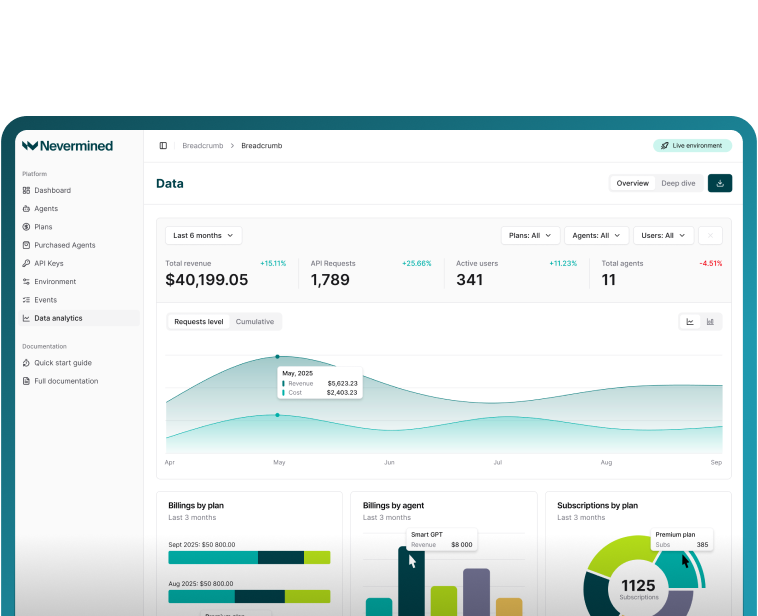
Real-time payments, flexible pricing, and outcome-based monetization—all in one platform.