MENU


Text-to-image systems now span multiple model architectures with meaningful differences in output quality, semantic alignment, and processing approaches. Recent text-to-image model benchmarking compared more than 10 image-generation models using measures including prompt-image alignment, perceptual similarity, distributional quality, and retrieval performance, illustrating how differently these systems can perform under the same evaluation framework. For platform builders, that technical variation creates a commercial question: how should pricing account for model choice, resolution, batch size, editing operations, and other factors that can change the resources required to produce an image?
Monetization also needs to remain separate from intellectual-property claims. The U.S. Copyright Office has concluded that copyright does not extend to purely AI-generated material or material without sufficient human control over expressive elements, while qualifying human-authored contributions can receive protection on a case-by-case basis. A platform can still grant contractual commercial-use permissions, but paying for access or an output does not by itself determine whether copyright exists in that output. Copyrightability of AI outputs is therefore an important consideration when packaging image-generation products for professional and enterprise customers.
An image-generation platform can monetize several different layers of the product.
A consumer application may sell ongoing access to a creative interface. A developer platform may sell API calls. A professional workflow product may sell generated assets, editing operations, or access to specialized models.
The first decision is the commercial unit.
Possible billable units include:
The customer-facing price does not need to expose every internal operation.
A single image request may involve model inference, safety checks, several generation steps, storage, and post-processing. The platform can meter those components internally while charging the customer one generation or a defined number of credits.
That separation keeps pricing understandable without hiding the cost information the provider needs to manage margins.
Image workflows also need explicit completion rules.
A billing policy should address:
If a customer requests four images and receives only two, the platform needs a consistent rule for whether the transaction consumes the full amount, a partial amount, or no charge.
For credit-based services, an automatic credit deduction flow can verify permissions first and settle credits after successful processing rather than deducting them before the workload runs.
Image platforms often serve customers with very different consumption patterns.
An occasional creator, a design team, an enterprise marketing department, and an application generating images through an API may all use the same underlying model differently.
The pricing structure should accommodate those differences without making the product unnecessarily complicated.
Subscriptions work well when customers use the service regularly and value predictable access.
A plan can vary according to:
For products where access itself is the main commercial unit, time-based subscription access can validate whether a customer's access period is still active before the protected service runs.
Subscriptions can still include usage boundaries. A monthly plan might provide a defined credit allowance or generation limit before additional consumption requires another purchase.
Credits are useful when different image operations consume different amounts of infrastructure.
A platform could assign different credit costs to:
Customers interact with one balance while the platform prices individual operations according to their underlying economics.
Credits also allow many small generation events to be grouped under a larger prepaid purchase instead of requiring a separate external payment transaction for every image.
Developer-facing APIs can charge according to measurable usage.
Possible units include:
Per-generation pricing is easiest to understand when requests have similar cost profiles.
When one request can consume materially more resources than another, the platform needs more detailed metering behind the advertised unit.
A fixed generation price becomes less representative when workload complexity varies.
Higher resolution, premium models, larger batches, additional processing, or priority execution can increase the cost of fulfilling a request.
Patterns for variable and usage-based pricing can map different operations to different credit amounts. Nevermined's current documentation specifically includes image generation as an example within complexity-based pricing.
Hybrid plans can then combine:
The goal is to keep the customer's commercial model clear while ensuring unusually expensive workloads are priced appropriately.
The number of images produced does not always reveal the true cost of serving a request.
Relevant cost drivers can include:
Two requests that each produce one image can therefore have different economics.
Useful internal metrics include:
An observability and monitoring layer can track request activity, usage, cost, performance, status, and custom metadata. Image providers can attach their own properties such as model, resolution, batch size, or operation type to those records.
The commercial metrics should then be compared with the actual fulfillment cost at the same level.
That makes it easier to identify a premium feature that consumes more infrastructure than its current credit price supports or a plan whose heaviest users consistently operate below the target margin.
A consumer interface is only one distribution path for an image-generation platform.
Developers may integrate image generation into:
API monetization requires more than exposing an endpoint.
The commercial layer should define:
A platform can use multiple payment models across different API products. Current Nevermined documentation supports credits-based access, time-based access, dynamic pricing, and hybrid structures rather than requiring every service to use the same billing method.
For example, a basic image API could use fixed credits while a specialized rendering endpoint uses variable pricing according to the requested workload.
Payment terms and intellectual-property rights answer different questions.
A paid plan may specify what the customer is contractually permitted to do with an output. Copyright law determines whether protected authorship exists.
Image platforms should therefore distinguish among:
Under the current U.S. Copyright Office position, copyright protects qualifying human-authored expression even when a work also contains AI-generated material. Purely AI-generated material, or material without sufficient human control over expressive elements, is not protected by copyright. Whether the human contribution is sufficient must be evaluated case by case.
The Office also states that prompts alone, based on the functioning of generally available technology evaluated in its report, do not provide sufficient control by themselves.
A commercial plan should therefore describe the rights the platform grants without presenting payment as a guarantee of copyright ownership.
Professional and enterprise customers may also want information about how digital assets were created or modified.
The current C2PA Content Credentials specification provides a technical model for storing cryptographically verifiable provenance information. A Content Credential can contain assertions about an asset's origin and modifications, and the associated claim is digitally signed and bound to the asset or its provenance record.
For image-generation products, provenance capabilities may support workflows that need:
Provenance should not be described as proof that an image is factually true. C2PA describes provenance as evidence about an asset's history and associated assertions, while the consumer still evaluates the trustworthiness of that information.
Platforms can therefore treat provenance as an additional product capability without conflating it with licensing, copyright, or payment.
Some image businesses can generate revenue from resources outside the live generation endpoint.
Examples include:
These products have different access patterns from an interactive generation API.
Infrastructure designed to monetize static assets can gate datasets, files, pre-trained models, APIs, and other HTTP-accessible resources through credit or subscription plans. The current Nevermined implementation uses a proxy that validates access before forwarding a request to the protected resource.
That gives image platforms another revenue path without requiring every product to operate as a live generation request.
Image-generation services can also become paid tools inside autonomous workflows.
An agent might need to generate:
The service should expose enough commercial information for software to determine whether it can purchase the operation.
An agent-ready image service needs to make clear:
A payment and entitlement layer can validate the requesting caller against the relevant plan before the image-generation workload runs. Nevermined's current core documentation supports agent APIs, MCP tools, and static assets, with request validation and usage tracking tied to the attached payment plan.
This allows image generation to become a paid step inside a larger automated workflow without requiring a person to complete a checkout for every generation.
Determine whether customers are purchasing generations, ongoing access, API calls, protected assets, or completed creative workflows.
Avoid mixing several commercial units unless the bundle is intentional.
Identify the variables that materially affect fulfillment cost, including model choice, resolution, batch size, processing steps, editing, storage, and third-party services.
State exactly what creates a charge.
Document how failures, blocked requests, duplicates, and partially completed jobs are handled.
Choose subscription, credits, usage, dynamic, workflow, or hybrid pricing according to the service.
The pricing model should reflect both customer value and the variability of the underlying workload.
Define commercial-use permissions, input rights, retention policies, copyright considerations, and platform restrictions separately from the customer's payment status.
Associate each paid operation with the customer, plan, operation type, amount consumed, completion status, and settlement record.
Compare revenue with fulfillment cost across models, resolutions, features, plans, and customer segments.
Pricing should be revisited when the economics of the workload change.
Nevermined provides the payment and monetization layer around an AI image service rather than replacing the image model, GPU infrastructure, moderation system, or application itself.
An image-generation provider can use Nevermined to connect paid access, pricing rules, credit consumption, settlement, and revenue monitoring to APIs and other protected resources.
Nevermined adds a payment and entitlement layer to monetizable services.
The image platform can validate the caller's entitlement before running the generation workload, then meter and settle the request according to the attached plan.
This is particularly useful when the request would otherwise trigger significant inference or third-party costs before the provider knows whether the caller has valid paid access.
Nevermined's multiple payment models include credits-based, time-based, dynamic, and hybrid structures.
An image platform could use:
Different endpoints can therefore use different commercial rules without requiring the entire platform to share one billing model.
Nevermined's variable and usage-based pricing patterns allow the application to calculate charges according to its own logic.
The live documentation includes image generation as a complexity-based operation and demonstrates additional multipliers for options such as higher quality and priority processing.
An image provider can apply the same pattern to relevant factors such as model choice, resolution, batch size, or other measurable workload characteristics.
The provider remains responsible for deciding which factors should affect price.
Image jobs can fail after authorization but before delivery.
Nevermined's automatic credit deduction pattern separates verification from settlement. Permissions are checked first, the workload is processed, and credits are settled after successful processing.
That allows the image platform's own completion logic to determine when a generation is ready to become billable.
Variable credit charges can also be calculated after the application knows more about the request.
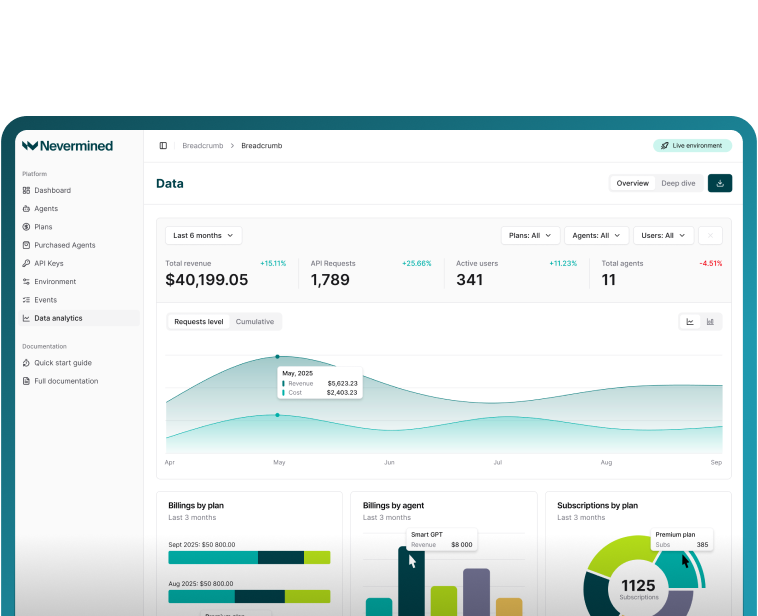
Nevermined's track incoming requests tooling tracks paid calls, credit redemption, usage, and revenue at the agent and plan level.
Its broader observability and monitoring capabilities support request and response logging, usage tracking, custom metadata, cost information, status, and performance metrics.
An image provider can combine those records with its own generation metadata to analyze the economics of individual models, plans, or operation types.
Image-generation businesses may also sell datasets, models, downloadable assets, or other resources.
The monetize static assets workflow can protect files, datasets, pre-trained models, APIs, and HTTP-accessible resources while applying subscriptions or credit-based plans.
This allows the payment architecture to cover both interactive generation and related digital products.
Nevermined’s security certifications include ISO/IEC 27001:2022 certification and a SOC 2 Type II attestation report. Nevermined also operates at PCI SAQ-D level, with raw card numbers captured by PCI-compliant vaulting and tokenized before reaching Nevermined systems.
These controls apply to the payment infrastructure. The image provider remains responsible for its model governance, content rules, intellectual-property policies, data handling, and application security.
The current quickstart documents a working payment integration for an agent API, MCP tool, or protected resource using TypeScript or Python.
The documented flow verifies payment permissions before the protected operation and settles credits after successful processing. An image provider can then add its own generation logic, pricing calculation, completion criteria, and operational metadata around that payment flow.
The right commercial unit depends on the product being sold. Consumer platforms may charge for subscription access or credits, while APIs can charge for requests, images, or workload complexity. Premium models, larger batches, or high-resolution operations may justify different credit costs when they materially change fulfillment expense. Internal metering should remain detailed enough to understand those differences even when customer-facing pricing is simple.
Subscriptions work well for customers who generate content regularly and want predictable access. Credits are useful when different operations have different costs because the platform can assign separate redemption rates to generations, models, or features. Hybrid plans can combine a recurring access period with a limited credit allowance. Nevermined's documented payment model types support credits-based, time-based, dynamic, and hybrid structures.
The provider should identify which request characteristics materially change fulfillment cost before deciding whether one fixed price is appropriate. Factors might include model selection, resolution, batch size, or additional processing. Variable and usage-based pricing provides one implementation pattern for translating application-defined complexity into different credit charges. The final customer-facing rule should remain clear enough for users to understand how their consumption is priced.
Not necessarily. Payment can grant contractual access or commercial-use permissions, but copyrightability is a separate legal question. In the United States, the Copyright Office states that purely AI-generated material is not protected by copyright, while qualifying human-authored expression or creative modifications may receive protection depending on the circumstances. Platforms should therefore describe the rights included with a paid plan precisely rather than treating payment as a guarantee of copyright ownership.
Yes, when the image service exposes programmatic access requirements and the agent has valid payment authority. The provider still needs to define the price, entitlement, completion rule, and billable operation. A payment and entitlement layer can validate access before the generation workload executes and associate usage with the applicable payment plan. This allows image generation to operate as one paid component inside a larger autonomous workflow.
See Nevermined
in Action
Real-time payments, flexible pricing, and outcome-based monetization—all in one platform.