MENU


AI music generation now covers instrumental tracks, vocals, and increasingly complex production workflows, but model performance can vary substantially. A 2025 music-generation benchmark evaluated 12 models using 6,000 generated tracks and more than 15,000 pairwise comparisons from over 2,500 participants, finding meaningful differences in human preferences and in how well automated metrics reflected those preferences. For platform builders, that variability creates a commercial challenge because duration, model choice, vocals, stems, and post-processing can all affect the cost and value of a generation.
Music also introduces rights and identity questions that should remain separate from billing. The U.S. Copyright Office's digital replicas report specifically addresses digitally created or manipulated audio that realistically replicates an individual's voice and identifies concerns involving privacy, unfair competition, consumer protection, and fraud. Sustainable monetization therefore requires clear pricing and metering alongside equally clear rules for commercial use, source material, voice authorization, and copyright.
An AI music platform can monetize several different products.
A consumer application may sell ongoing access to a creative interface. A professional tool may charge for generations or premium production features. A developer platform may monetize API access, while an enterprise product may combine generation, editing, stems, and asset management into a broader workflow.
The first task is to define the commercial unit clearly.
Possible units include:
The customer-facing unit does not need to mirror every internal operation.
A two-minute track might involve prompt processing, multiple inference stages, vocal generation, stem separation, mastering, storage, and delivery. The provider can measure those components internally while charging the customer a simpler unit such as one generation or a defined number of credits.
That separation keeps pricing understandable without sacrificing the cost visibility needed to protect margins.
Generation workflows also need clear completion rules.
Billing policies should address:
If a user requests four variations and receives only two completed tracks, the service needs a consistent rule for how many outputs become billable.
For credit-based products, patterns for charging credits can separate permission verification from final settlement. The current Nevermined flow verifies access without consuming credits, processes the request, and settles the applicable amount after successful completion.
AI music platforms serve customers with very different consumption patterns.
An occasional creator may generate a few tracks each month. A game studio may create hundreds of variations. A developer may call a music API continuously from another application.
The pricing model should reflect those differences without becoming difficult to understand.
Subscriptions work well when customers use the platform consistently and value predictable access.
Plans can vary by:
A subscription does not need to mean unlimited generation.
A recurring plan can combine an access period with credits or usage limits, allowing customers to forecast spending while keeping expensive workloads within defined boundaries.
Credits are useful when different music operations have different costs.
A platform could assign different credit values to:
Customers work from one balance while the provider prices each operation according to its economics.
Credits also reduce the need to initiate a separate external payment for every generation. Instead, customers can purchase a larger balance and consume it as they use the service.
Developer-facing products may need pricing tied more directly to consumption.
Possible units include:
Duration alone may not represent the true cost of a request. A short vocal track using a more computationally intensive model and several post-processing stages may cost more to fulfill than a longer instrumental generated through a simpler workflow.
Patterns for variable and usage-based pricing allow application logic to calculate charges from request complexity or other custom metrics.
Many products can combine recurring access with consumption-based charges.
Examples include:
Infrastructure supporting multiple payment models can combine credits-based, time-based, dynamic, and hybrid structures according to the product being sold.
The objective is not to create more pricing options than customers need. It is to avoid forcing materially different workloads into the same economics.
Track count alone does not reveal what a customer costs to serve.
Relevant cost drivers can include:
Two tracks of identical length can therefore have different margins.
Useful metrics include:
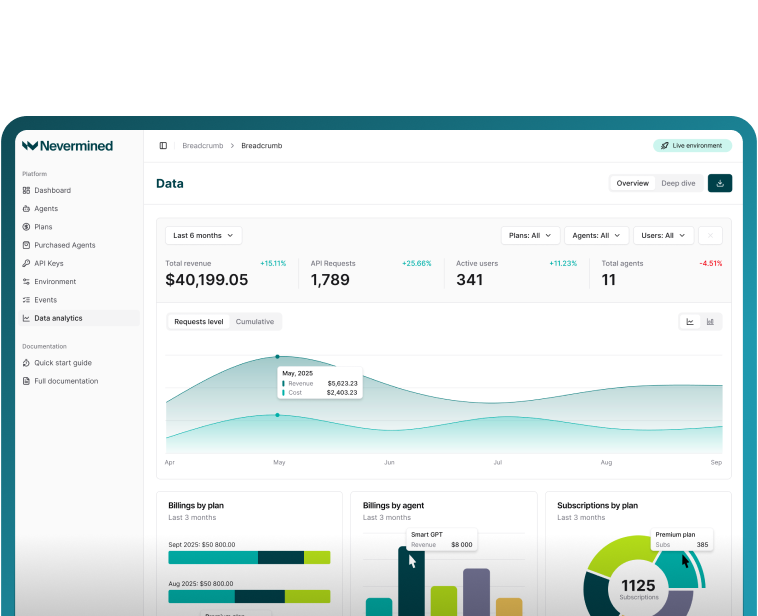
An observability and monitoring layer can record requests, usage, costs, performance, and custom metadata for supported integrations.
Music platforms can supplement those records with application-specific properties such as duration, model, instrumental or vocal mode, number of stems, and export configuration.
The important point is to compare revenue and fulfillment cost at the same level. That makes it easier to identify features or customer segments whose usage no longer fits the current pricing.
A consumer-facing music generator is only one distribution channel.
Music-generation APIs can power:
A paid API needs more than authentication.
The commercial layer should define:
Different endpoints can use different pricing.
A lightweight instrumental endpoint might consume a fixed number of credits, while a vocal or multi-stem workflow uses a variable charge based on duration and processing requirements.
This allows the commercial model to follow the service rather than forcing every API operation into one billing unit.
AI music businesses can also sell products that do not require a new inference job every time a customer accesses them.
Examples include:
These assets have different economics from live generation.
A platform can monetize static assets such as files, datasets, pre-trained models, APIs, and other protected resources through subscription or credit-based access. The current implementation uses an HTTP proxy to validate access before forwarding the request to the protected resource.
This lets live generation and downloadable products share a broader commercial architecture without treating them as the same product.
A customer paying to generate music does not automatically resolve every rights question associated with the track.
Platforms should distinguish among:
The payment plan determines what the customer purchased from the service. It does not by itself establish ownership of every element in an output.
The U.S. Copyright Office states that copyright can protect qualifying human-authored expression in works that also contain AI-generated material. Purely AI-generated material, or material where a human did not exercise sufficient control over the expressive elements, is not protected by copyright under the Office's current position.
Whether a person's contribution is sufficient must be assessed case by case. The Office also concludes that prompts alone, based on the generally available technology it evaluated, do not provide sufficient expressive control by themselves.
For AI music platforms, the practical approach is to describe commercial-use permissions precisely rather than promising that a paid generation automatically becomes a copyright-protected composition.
Vocal generation creates an additional category of risk.
The Copyright Office describes digital replicas as digitally created or manipulated content that realistically but falsely depicts an individual, including through their voice. Its report identifies legal concerns that can involve privacy, unfair competition, consumer protection, fraud, and copyright-related interests.
Music platforms offering voice-generation or cloning features should therefore maintain clear authorization and acceptable-use requirements.
Access to a paid generation feature should never be treated as permission to imitate a particular person's voice.
Music generation can also become a paid component inside an autonomous workflow.
A video agent might source background music for an advertisement. A game-development system might generate soundtrack variations automatically. A marketing agent could purchase audio tailored to several campaigns.
An agent-ready service should make several commercial facts programmatically clear:
A payment and entitlement layer can validate the caller against an attached payment plan before the protected workload runs. Current Nevermined documentation describes inbound requests as being validated, metered, and settled against the caller's entitlement.
This allows a music service to participate in automated workflows without requiring a human checkout for every generation.
Determine whether customers are purchasing tracks, generated duration, API calls, ongoing platform access, downloadable assets, or completed workflows.
Identify the variables that materially change fulfillment cost, including duration, model choice, vocals, stems, post-processing, storage, and external services.
Specify when a request becomes chargeable and how failed, blocked, duplicated, or partially completed jobs are handled.
Select subscriptions, credits, usage-based pricing, dynamic charges, or a hybrid according to customer behavior and workload variability.
Document commercial-use permissions, source-material requirements, voice policies, copyright considerations, and other content rules independently from payment status.
Associate every paid request with its customer, plan, measured usage, completion state, and settlement record.
Compare revenue with model, compute, post-processing, storage, and third-party costs. Pricing should be revisited when workload economics change.
Nevermined provides a payment and monetization layer around AI services rather than replacing the music model, audio pipeline, storage system, or creative application.
An AI music provider can use Nevermined to connect paid access, payment plans, usage-based credit consumption, settlement, and programmatic purchasing to existing APIs and protected resources.
Nevermined can place a payment and entitlement layer around an API or other monetizable service.
The caller's entitlement can be validated before the music-generation workload runs, reducing the risk of performing costly work without valid commercial access. Requests can then be metered and settled against the associated plan.
The music provider remains responsible for defining what constitutes a billable track, minute, stem, or production operation.
Providers can manage payment plans for credits-based, time-based, and dynamic access. The current Nevermined App documentation also supports multiple plans for the same service, allowing different customer tiers to use different commercial configurations.
A music platform could use:
This keeps the pricing architecture flexible without requiring the music provider to rebuild payment logic for every endpoint.
Music jobs can fail after access has already been approved.
The documented patterns for charging credits support permission verification before processing and settlement after successful work. Long-running tasks can also be pre-authorized against an estimated maximum before the actual charge is calculated at completion.
That structure lets the music application decide whether an incomplete vocal render, missing stem, or failed batch should count as billable work.
Music workloads often have application-specific cost drivers.
Nevermined's variable and usage-based pricing patterns allow builders to calculate charges from custom metrics before settlement.
A music platform could base its calculation on duration, model tier, number of stems, vocal processing, quality settings, or other measurable factors.
The music provider determines the pricing logic, while the payment layer applies the resulting charge.
Music APIs may increasingly be purchased by other software rather than directly by people.
Nevermined supports stablecoin and fiat payments for programmatic agent access, including subscriptions and credit-based usage. Other agents can purchase access and call monetized endpoints through the supported payment flow.
This allows a music API to serve both human-controlled applications and autonomous workflows without creating a separate monetization system for each audience.
Nevermined maintains a SOC 2 Type II attestation report, ISO/IEC 27001:2022 certification, and PCI SAQ-D controls for its payment infrastructure. Its current documentation also states that raw card numbers are captured by PCI-compliant vaulting and tokenized before reaching Nevermined systems.
These controls cover the payment layer.
Music providers remain responsible for their own rights management, voice policies, model governance, content moderation, data handling, and application security.
The current quickstart takes developers to a working payment integration for an agent API, MCP tool, or protected resource and provides TypeScript and Python implementation paths.
A music platform can then add its own generation logic, completion criteria, usage measurements, pricing calculations, and rights policies around that protected endpoint.
The most appropriate billable unit depends on the product being sold. Consumer applications may use subscriptions or credits, while APIs can charge by track, generated duration, operation type, or another measurable unit. Vocal generation, stems, premium models, and post-processing can justify different charges when they materially affect fulfillment cost. Internal metering should remain detailed enough to measure those differences even when customer-facing pricing stays simple.
Subscriptions suit customers who generate music consistently and value predictable access. Credits provide more flexibility when individual operations have different costs because tracks, stems, vocals, and premium features can consume different amounts from the same balance. Hybrid plans can combine a recurring access period with an included usage allowance. Infrastructure supporting multiple payment models can accommodate these different structures.
Commercial-use permission depends on the terms offered by the specific service and the rights associated with the inputs and output. Paying for a plan may grant contractual commercial rights, but it does not automatically resolve copyrightability, sample rights, voice rights, or other third-party interests. The U.S. Copyright Office currently ties copyright protection to sufficient human-authored expression rather than the fact that access to an AI system was paid. Platforms should therefore state precisely what commercial permissions accompany each plan.
Voice-generation features should use clear authorization and acceptable-use rules because digitally replicated voices can implicate interests beyond ordinary copyright. The Copyright Office's digital-replica report identifies concerns involving privacy, unfair competition, consumer protection, fraud, and related rights. Payment for access to a generation tool should not be treated as authorization to imitate a particular person's voice. Providers should keep voice permissions separate from general subscription or credit access.
Yes, when the service exposes programmatic commercial requirements and the agent has valid payment authority. The provider still needs to define the price, entitlement, usage unit, and successful completion event. Stablecoin and fiat payments can support programmatic access while preserving the service's pricing and entitlement rules. This allows music generation to operate as one paid component inside a larger autonomous workflow.d
See Nevermined
in Action
Real-time payments, flexible pricing, and outcome-based monetization—all in one platform.