MENU


The AI tutoring services market was valued at an estimated $3.7 billion in 2025 and is projected to reach $21.6 billion by 2035. Consumer subscriptions remain an important part of this market, but tutoring platforms can also package their educational capabilities for a different type of buyer: AI agents and software platforms.
By exposing tutoring, homework help, explanation, assessment, or learning support as agent-ready services, builders can charge per query or per session alongside their existing subscriptions. With agentic payments infrastructure, another agent can understand the service, satisfy its payment requirements, consume the tutoring capability, and settle the transaction programmatically.
AI tutoring applications can support many types of educational interactions, including homework explanations, practice questions, subject-specific tutoring, assessment support, language practice, and multimodal problem solving.
Traditionally, these capabilities are packaged inside an application that a student or parent accesses through a free tier or paid subscription. That remains useful for human users, but the same underlying capabilities can also be exposed programmatically.
A learning management system might request a targeted explanation when a student struggles with a concept. A study assistant could call a tutoring service for a worked example. A coding agent might purchase an educational explanation when helping a learner understand a programming concept.
In these cases, the buyer does not necessarily need a monthly consumer account. It needs access to a specific educational capability at the moment the capability is required.
Turning a tutoring capability into something another agent can purchase involves four core steps:
The tutoring service can then operate inside another agent's workflow. The buyer identifies the capability, understands what it costs, obtains authorized access, and receives the educational response without requiring a person to complete checkout for each interaction.
Per-query pricing treats each individual request as the billable unit.
This model can work well for educational interactions with clear boundaries, such as:
The value metric should be easy for the buyer to understand and for the provider to measure. If one request produces one discrete tutoring response, charging by query creates a direct connection between consumption and price.
Query complexity may still vary significantly. A short definition and a detailed multimodal explanation can have different compute and model costs. Credits or variable usage rules can account for those differences without requiring every type of query to use the same price.
Builders can use metered payment plans to connect individual requests with the appropriate credit or pricing rule.
Some tutoring interactions are better treated as sessions rather than collections of individual queries.
A student working through an algebra concept, for example, may ask several questions, request clarification, attempt a problem, receive feedback, and try again. Charging separately for every message can make the commercial model harder to understand.
Per-session pricing bundles that interaction into a defined unit.
A session might represent:
The session boundaries need to be clear. They might be determined by time, number of interactions, completion of a learning task, or another measurable rule.
Per-session pricing can also simplify purchasing for agent buyers. Instead of estimating how many individual queries a tutoring task will require, the buyer pays for the complete interaction.
Tutoring APIs can become part of larger educational and productivity workflows rather than operating only as standalone student applications.
Potential agent buyers include:
The tutoring API becomes one component inside the broader product.
This changes what is being monetized. The human-facing product sells an ongoing learning experience, while the agent-facing product sells access to a particular educational capability.
A tutoring service that other agents consume needs payment to fit inside the same automated workflow.
Traditional checkout assumes a person can select a product, enter payment information, and approve the purchase. An autonomous buyer instead needs commercial requirements that software can understand and payment authority that has already been bounded by the user or organization.
An x402 payment facilitator can verify whether the buyer has permission to satisfy a payment requirement before the tutoring workload is performed. The service then fulfills the request and settles the corresponding payment.
For tutoring platforms, the workflow can be straightforward:
Agent requests tutoring → service communicates price → payment authority is verified → tutoring is delivered → usage is recorded and settled
That model allows educational services to become purchasable within another application's workflow rather than requiring every buyer to maintain a separate consumer subscription.
Agent-based tutoring can produce many small usage events.
A single learning workflow might include an initial question, several follow-ups, practice generation, answer evaluation, and a final explanation. Recording each event can be useful even when the provider does not want to process each one as an independent card transaction.
Credits can separate usage granularity from monetary settlement. A buyer can acquire a credit balance and consume it across individual tutoring queries or sessions while each usage event remains attributable.
That makes credits-based billing useful for services where the individual educational action is small but usage can occur frequently.
Agent-ready tutoring does not require replacing consumer subscriptions.
The two models address different buying behavior:
A tutoring platform can therefore serve human and machine customers through separate commercial paths.
Consumer users may value predictable monthly access to an application, progress tracking, saved history, and a complete learning experience. Agent buyers may care primarily about the cost and quality of a particular API operation.
Pricing can reflect those differences without forcing one model to replace the other.
Autonomous purchasing requires clear boundaries around what an agent can spend.
An educational agent may need permission to buy tutoring sessions, subject-specific explanations, or other learning resources, but that authority should remain within limits established by the user or organization.
Delegated spending controls can apply constraints such as:
The agent receives scoped permission rather than the user's raw card details.
For platforms handling payments and educational workflows, security and auditability also matter. Nevermined's security framework includes SOC 2 Type II, ISO 27001, and PCI SAQ-D, alongside GDPR-related controls. Card information is tokenized before entering Nevermined systems, with AES-256 encryption at rest and TLS 1.3 in transit.
Payment solves only part of agent-ready access. Software also needs to understand what a tutoring service does and how to call it.
Clear machine-readable information can describe:
Standards such as MCP and A2A can expose tools and agent capabilities, while x402 handles HTTP-native payment requirements. AP2 provides another framework for expressing payment intent and authorization.
These interfaces solve different parts of the interaction. The underlying tutoring product still needs a defined service, pricing model, access policy, and metering structure.
Supporting agent interoperability can make the same paid educational capability accessible across different agent workflows without tying its business model to a single interface.
Tutoring platforms can add a payment layer around an existing API rather than rebuilding the educational service itself.
The five-minute quickstart demonstrates the basic pattern using the TypeScript or Python SDK. Production deployment depends on the tutoring architecture, payment configuration, access controls, and broader security requirements.
At the implementation level, the provider installs the payment SDK, associates the tutoring endpoint with a payment plan, returns payment requirements for unauthorized requests, verifies the buyer's permissions, fulfills the tutoring request, and settles the corresponding usage.
This keeps the educational logic and commercial logic separate. The tutoring system continues generating explanations, feedback, or learning activities, while the payment layer determines whether the requesting agent has paid for access.
The best billing model depends on how the tutoring capability creates value.
Per-query pricing is useful when requests are discrete, relatively predictable, and independently valuable. A homework explanation or single answer review fits naturally into this structure.
Per-session pricing works better when the interaction requires multiple turns to accomplish one learning task. It gives the buyer a predictable price for the complete tutoring experience rather than charging for every message.
Platforms can also combine the two. Simple requests might use per-query pricing while longer instructional interactions are packaged as sessions. Credits can provide a common mechanism across both.
The objective is to select a billing unit that buyers understand and that the tutoring platform can meter consistently.
Tutoring platforms already have clear units of value they can sell programmatically, from a single homework explanation to a longer multi-turn tutoring session. Nevermined lets builders attach pricing and payment requirements to those services so other agents and platforms can purchase them autonomously.
For tutoring providers, that can include:
Builders can configure these structures through payment models that reflect how their tutoring service is actually consumed.
This creates a separate revenue path alongside consumer subscriptions. Students and families can continue paying for ongoing access to the full tutoring experience, while AI agents, learning platforms, and other software buyers purchase individual educational capabilities only when their workflows need them.
Tutoring platforms can expose educational capabilities through paid APIs and define a billable unit such as a query, session, or credit. With Nevermined, the endpoint can communicate payment requirements programmatically through x402, verify the buyer's payment authority, provide the tutoring service, and record the corresponding usage without requiring human checkout for each interaction.
Per-query pricing charges for each discrete tutoring request, making it suitable for interactions such as one explanation, answer review, or practice question. Per-session pricing groups several exchanges into a single billable interaction, which can work better for multi-turn tutoring around a broader learning objective.
Yes. Consumer subscriptions and agent API access serve different buying patterns. Students and families can continue paying for ongoing access to the full application, while agents or platforms purchase individual tutoring capabilities through per-query, per-session, or credit-based plans.
Yes, when the tutoring service exposes a compatible paid endpoint and the buyer agent has authorized spending capacity. Nevermined can use scoped payment permissions and x402 to let an agent satisfy the service's payment requirement programmatically, while spending limits and revocation controls keep that authority bounded.
Agent-purchased services benefit from scoped spending permissions, transaction limits, authentication, revocation, encryption, and detailed transaction records. Nevermined's security program includes SOC 2 Type II, ISO 27001, PCI SAQ-D, tokenized card handling, and related data-protection controls that can support enterprise security and procurement reviews.
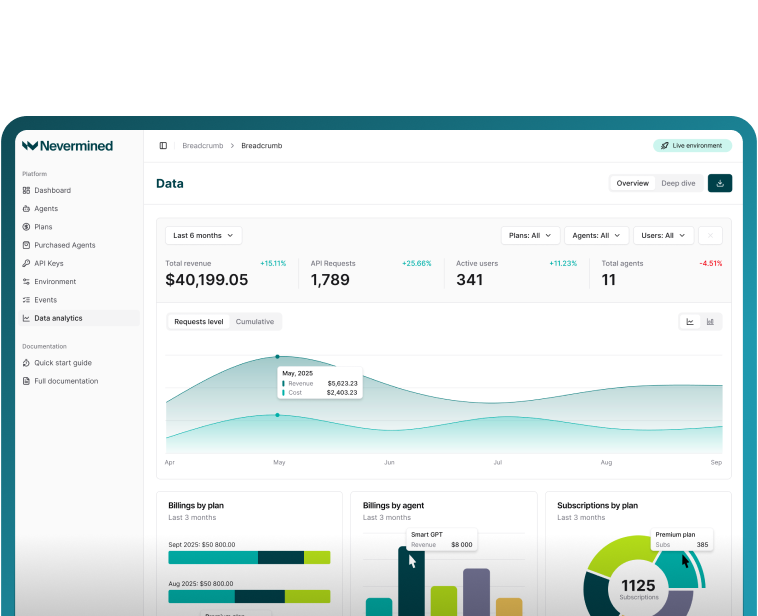
See Nevermined
in Action
Real-time payments, flexible pricing, and outcome-based monetization—all in one platform.