MENU


AI sales development representatives are changing how businesses automate prospect research, outreach, qualification, and scheduling, but building a capable AI SDR is only half the monetization challenge. Builders also need to decide what customers are paying for, whether that is usage such as conversations and actions or outcomes such as qualified leads and booked meetings, and make the service purchasable by other agents and platforms.
With agentic payments infrastructure, an AI SDR can become an agent-ready service with machine-readable pricing, metered access, programmatic payment authorization, and settlement. Instead of relying only on seat-based subscriptions, builders can sell access according to how the SDR is used or the results it delivers.
The broader AI agent market is projected to reach $52.62 billion by 2030, according to MarketsandMarkets, representing a 46.3% CAGR from 2025 to 2030. Sales is one application within this expanding market because SDR workflows can be tied to measurable activity such as prospect research, outreach, qualification, and meeting scheduling.
Traditional sales automation generally required people to initiate, review, or coordinate much of the workflow. AI SDRs can operate more independently, researching prospects, drafting outreach, processing responses, qualifying leads, updating systems, and scheduling meetings according to predefined workflows.
That autonomy changes how the service can be priced. A single SDR may perform many small actions across multiple prospects and conversations, while the customer may care primarily about a final result such as a qualified lead or booked meeting. Usage and outcome pricing allow builders to monetize either the work performed, the result delivered, or a combination of both.
Turning a functioning SDR into a service that another agent or platform can purchase comes down to four steps:
The result is an SDR that functions as an autonomously purchasable service. Another agent or platform can understand what it does, determine the price, satisfy the payment requirement, and access the service programmatically.
Usage-based pricing charges according to measurable consumption rather than relying entirely on a flat subscription. The most useful billing unit depends on what the SDR actually does and what customers can understand easily.
Common approaches include:
If customers primarily value completed conversations, pricing per conversation may be clearer than exposing token-level consumption. If the service performs discrete research or enrichment tasks, action-based pricing may provide better attribution.
Builders can combine these approaches through usage-based payment models. Granular metering then connects each billable event with the appropriate pricing rule, giving buyers visibility into what they consumed and helping builders understand where costs and revenue are generated.
Outcome-based pricing moves the billable event from activity to a defined business result. For AI SDRs, those results can include qualified leads and booked meetings.
Common outcome metrics include:
Outcome pricing works best when success can be defined and attributed consistently. An AI SDR might perform research, send outreach, process replies, and attempt scheduling before one billable meeting occurs. Those intermediate events still matter because they help establish how the outcome was reached.
Cryptographically signed usage records and append-only logs can support verifiable outcome billing by connecting activity, pricing rules, and transaction history. Clear records make it easier to determine whether an event met the agreed billing criteria.
Usage and outcome models can also be combined. A builder might charge for prospecting activity while adding a success fee when a qualified meeting is booked.
Choosing a pricing model is only part of making an SDR agent-ready. The service also needs to communicate payment requirements, verify spending authority, control access, and settle transactions programmatically.
Traditional checkout assumes a person is available to select a plan and approve payment. Agent-to-agent workflows need the same information in a form software can process.
Within Nevermined's x402 payment flow, a protected SDR service can return HTTP 402 Payment Required, communicate the payment terms, verify the buyer's authorization, execute the requested workload, and settle the corresponding payment.
Several components support this flow:
For AI SDRs, this creates a commercial layer around the agent itself rather than treating billing as a separate process after the work is completed.
Autonomous purchasing requires explicit boundaries. An AI SDR may need to buy access to data, enrichment, research, or other services, but its purchasing authority should remain within limits defined by the user or organization.
Useful controls include:
Through delegated spending controls, users can give an agent scoped purchasing authority without exposing the underlying card details. Spending caps, expiration periods, and transaction limits can be enforced against the delegation.
Enterprise deployments also require documented controls around payments, access, and data. Nevermined's security program includes SOC 2 Type II, ISO 27001, and PCI SAQ-D, alongside GDPR-related data protections. Card information is tokenized before entering Nevermined systems, while personal data is protected with AES-256 encryption at rest and TLS 1.3 in transit.
Once the SDR's commercial model is defined, builders need to connect those pricing and payment rules to the agent's request path.
The five-minute quickstart demonstrates a basic payment integration. Production deployment can require additional work depending on architecture, security requirements, and payment configuration.
A basic implementation includes:
TypeScript and Python SDKs, REST APIs, CLI tooling, and framework integrations provide several ways to connect payments with an existing SDR stack. Developers using compatible AI coding environments can also access technical guidance through the documentation MCP.
Usage-based pricing is a strong fit when consumption can be measured consistently, costs rise with the amount of work performed, and customers want visibility into what they use.
Outcome pricing is better suited to situations where success can be defined objectively, the SDR has meaningful control over the result, and attribution is reliable.
Hybrid pricing can combine both. A plan might include credits for prospecting and enrichment, then add a success charge for qualified meetings. Nevermined's AI agent pricing models support usage, credit, and outcome-based structures, giving builders flexibility to align pricing with how customers derive value from the SDR.
Nevermined provides payments infrastructure designed around autonomous AI services, connecting pricing, metering, payment authorization, access control, and settlement.
For AI SDR builders, the same agent can support several commercial models:
Nevermined also supports integrations spanning x402, MCP, A2A, and AP2-oriented workflows, giving builders multiple ways to connect payment with agent interactions.
Its pricing charges merchants 1% of settled volume on stablecoin rails and 2% on card rails, with payment-processing costs passed through where applicable. There are no setup fees or transaction minimums, while optional organization plans add operational tools for larger teams.
Valory reported reducing deployment time for the payments and billing infrastructure behind the Olas AI agent marketplace from six weeks to six hours using Nevermined's infrastructure, recovering thousands of dollars in engineering costs. Valory's result reflects its own implementation and project requirements.
For AI SDR builders, the central value is the ability to package the agent itself as something other software can buy. The SDR can expose what it does, price its usage or outcomes, verify payment programmatically, and receive settlement within the same autonomous workflow.
Outcome-based agreements should define success, duplicates, cancellations, attribution, and adjustment rules before billing begins. If a meeting is duplicated, disqualified, or fails an agreed criterion, the commercial terms can specify whether the charge is reversed, credited, or excluded. Detailed outcome records make it easier to review what occurred before an adjustment is made.
A properly scoped payment mandate prevents the agent from spending beyond its authority. With Nevermined, spending delegations can include an overall cap, expiration period, and transaction limit. Additional spending is rejected when the permitted authority is exhausted, and the delegation can also be revoked.
Yes, when the service supports a compatible programmatic payment flow and the SDR has appropriate purchasing authority. Delegated spending can allow an AI SDR to purchase supported APIs, data, research, or other services within predefined limits without requiring human checkout for every transaction.
International pricing requires separating the customer-facing price from the underlying settlement rail. Builders should define the billing currency, settlement asset, processing costs, and reporting currency clearly. The SDR's usage or outcome logic can remain the same even when different payment rails handle settlement.
Useful metrics include revenue per customer, cost per billable action, cost per qualified outcome, gross margin, usage per account, conversion from SDR activity to outcomes, and the share of revenue generated by usage versus success fees. Tracking model, data, and external-service costs also helps keep pricing aligned with the economics of the SDR workflow.
See Nevermined
in Action
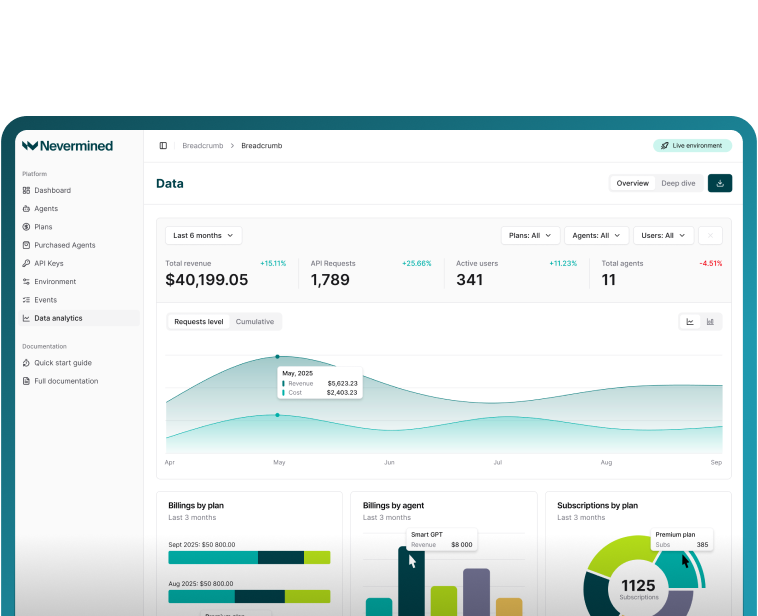
Real-time payments, flexible pricing, and outcome-based monetization—all in one platform.