MENU

AI voice agents are becoming an increasingly important part of conversational AI, but builders still need a reliable way to capture value from their creations. The challenge is not only building a capable voice agent but making it "agent-ready," meaning discoverable, purchasable, and billable by other AI agents and platforms without requiring human checkout for every transaction. Companies can monetize their voice agents by leveraging agentic payments infrastructure that supports per-call, per-conversation, and other usage-based billing programmatically, enabling machine-to-machine commerce.
An agent-ready voice service is one that other AI agents can discover, evaluate, purchase, and consume programmatically without requiring a human to complete checkout for each transaction. This differs from traditional SaaS monetization where a person signs up, enters payment details, and manually provisions access. In an agentic commerce model, a buyer agent can identify a voice service it needs, check its pricing and payment requirements, authorize payment from a delegated budget, and receive the response programmatically.
The shift matters because PwC's AI Agent Survey found that 79% of surveyed executives said AI agents were already being adopted in their companies, and 88% said their team or business function planned to increase AI-related budgets over the following 12 months due to agentic AI. Voice services that depend entirely on manual signup and checkout flows may be harder to incorporate into workflows where software is expected to transact programmatically.
Traditional payment systems were designed primarily around human-initiated checkout. When a voice agent needs to purchase another service, such as a specialized research API or translation tool mid-conversation, requiring a wallet popup or credit card form interrupts the autonomous workflow. The x402 protocol addresses this by using HTTP 402 Payment Required to communicate payment requirements programmatically.
For voice agent builders, this means an API can return a 402 Payment Required response that another agent can process. The buyer agent can present an authorized payment credential within its predefined spending limits and retry the request without prompting the user to complete checkout each time. The voice service can therefore receive payment while the interaction remains programmatic.
Moving from a functioning voice agent to a service that other agents and platforms can purchase programmatically comes down to three core steps:
Together, these steps create a path in which another agent or platform can discover the voice service, understand what it costs, authorize payment within its spending limits, and access it without requiring a person to complete checkout for every transaction.
Voice agents can be monetized through several pricing models, each suited to different use cases:
The choice depends on how the voice agent delivers value. If completion matters more than duration, per-conversation or outcome-based models may align pricing more closely with the result being delivered.
Granular billing changes how voice services can be packaged. Instead of requiring every buyer to commit to a fixed monthly subscription, builders can use usage-based pricing to connect charges more directly to what a buyer consumes.
Credits-based, time-based, dynamic, and hybrid payment models give builders different ways to connect access with consumption. Voice agent builders can use these structures to implement per-call, session-based, or variable usage pricing and adjust their model as they learn more about workload costs and customer behavior.
The core challenges behind agentic commerce are threefold. Agents need spending authority that does not require human approval for every individual purchase. Merchants need infrastructure that can verify and settle payments when the buyer is software rather than a person. And both sides benefit from payment systems that can work across emerging protocols and supported payment methods.
Voice agents face these challenges acutely. A voice-based research assistant that needs to purchase access to a premium data source mid-conversation cannot rely on manual credit card entry without interrupting the interaction. Payment authorization and verification need to fit inside the software workflow.
Effective agentic payment infrastructure requires several capabilities working together:
Within the x402 flow, the payment facilitator verifies payment proofs and permissions, applies payment-plan constraints, and coordinates settlement before access to a protected service is completed.
Registered agent IDs, payment plans, credits, ERC-4337 smart accounts, and session keys can work alongside delegated spending controls to define what an agent is permitted to purchase and under what conditions. For voice agents, these capabilities keep payment authorization and settlement inside the request flow rather than requiring a conventional checkout redirect for every transaction.
Agent marketplaces and catalogs are emerging as one way for AI services to become discoverable by other software. Similar to how app stores organize mobile applications, agent catalogs can organize capabilities that agents or users can inspect and access programmatically.
To make a voice agent easier to discover and purchase programmatically, builders may need:
Builders can associate service metadata, endpoints, machine-readable definitions, and payment plans with an agent as part of the agent registration process. Structured registration makes it easier for software to understand what a service does and how it can be accessed.
For platform operators building voice agent marketplaces, infrastructure requirements extend beyond monetizing an individual agent:
Marketplace operators can incorporate organization-level fees and revenue sharing directly into their builder platform infrastructure. When participating builders process transactions through the marketplace, platform economics can be incorporated into the payment flow rather than reconciled manually afterward.
Usage disputes can complicate billing and reconciliation. When a customer questions whether a service processed a particular number of calls or consumed a specific number of credits, audit-ready usage records can provide stronger evidence than mutable application logs alone.
Cryptographically signed usage records and append-only logging make verifiable metering possible by connecting individual usage events with the pricing rules applied to them. This gives buyers and sellers a more consistent basis for tracing activity and reviewing billed usage during reconciliation.
For voice agents specifically, usage can involve several underlying components during a single conversation:
Each component can contribute to the cost of serving the interaction. Without granular logs, connecting usage to individual conversations, customers, or billing events becomes more difficult. Verifiable metering can support reconciliation, auditability, cost attribution, and enterprise procurement review.
The AI agent economy operates across both traditional financial rails and blockchain-based systems. Some buyers use card-based payment methods, while others use stablecoins or other supported digital assets for on-chain transactions.
Supporting both card-based and crypto rails through the same payment infrastructure gives builders more flexibility in how transactions are authorized and settled. Fiat plans can work through card processors, while agent-spending workflows can use delegated card authority and on-chain transactions can use supported digital assets.
For voice agent builders, handling multiple payment rails through the same broader architecture reduces the need to maintain entirely separate application-level billing systems for each method.
The agentic payments and interoperability landscape is evolving rapidly. Several standards address different parts of the stack, including x402 for HTTP-native payment flows, Model Context Protocol (MCP) for connecting AI applications with tools and resources, Agent-to-Agent (A2A) for communication between agents, and Agent Payments Protocol (AP2) for communicating payment intent and authorization.
Relying entirely on one interface can create additional migration work as the ecosystem develops.
Voice services can remain adaptable as standards evolve by working across multiple agent protocols rather than tying payment and access logic to a single interface. This gives builders more flexibility to use the protocols that fit their architecture while keeping pricing and payment logic connected to the underlying service.
Once the commercial model, registration, and payment gate are defined, the remaining deployment work depends on the voice agent's architecture and engineering requirements.
The five-minute quickstart demonstrates how a basic protected endpoint can be connected to payment infrastructure using TypeScript or Python. Production implementation time depends on the surrounding application, payment configuration, security controls, and technical requirements.
At implementation level, builders typically need to add the relevant payment SDK, connect the registered service and payment plan, and place payment validation around the protected request flow.
Sandbox and live environments allow payment flows to be developed and tested before production deployment.
TypeScript and Python SDKs, REST APIs, framework integrations, and AI development resources give builders several ways to add payment controls to an existing voice-agent stack.
Developers working in compatible environments can access technical guidance directly through a documentation MCP. Integration patterns can also work with interfaces such as Express, FastAPI, MCP, A2A, and other agent frameworks, while HTTP-based services can use the underlying SDKs directly.
Enterprise buyers evaluating AI voice agents may ask how payment credentials, transaction records, access permissions, and customer data are secured and audited.
Enterprise deployments typically rely on documented security and compliance controls covering areas such as access management, data protection, payment handling, and auditability:
Beyond certifications and attestations, specific security controls matter for voice agent deployments:
These controls can support enterprise security, procurement, and compliance reviews when organizations evaluate autonomous payment capabilities. Organizations can then assess the complete voice-agent implementation against the regulatory, privacy, and security requirements that apply to their use case.
Nevermined focuses on payments infrastructure for AI agents, bringing together payment plans, metering, delegated spending, access control, and settlement across supported card and crypto payment flows.
For voice agent builders specifically, Nevermined addresses several parts of the monetization workflow:
Nevermined's pricing uses a 1% fee on stablecoin settlement and a 2% fee on card settlement, with payment-processing costs passed through where applicable. There are no setup fees or transaction minimums. Optional organization plans add capabilities such as team workspaces, analytics, embedded widgets, customer management, and real-time activity tools depending on the tier.
Valory reported cutting deployment time for the payments and billing infrastructure behind the Olas AI agent marketplace from six weeks to six hours using Nevermined and recovering thousands of dollars in engineering costs. Valory's experience reflects its own architecture and project requirements, so deployment timelines and engineering savings vary by implementation.
For teams monetizing voice agents, the relevant question is whether payment authorization, pricing, metering, and settlement can operate programmatically alongside the agent itself. Nevermined provides infrastructure for connecting those functions without requiring builders to create the entire payments layer independently.
Per-call monetization starts by defining each completed call or request as a billable action and connecting that action to a payment plan. Each completed call can consume a predefined number of credits under a credits-based payment model, while dynamic credits can accommodate interactions where usage or pricing varies. The service endpoint then validates payment authorization before processing the request and records the corresponding usage afterward.
AI voice agents can use payment methods that support programmatic authorization and settlement, including card-based payments, delegated card authority, prepaid credits, smart accounts, and supported on-chain assets. The appropriate method depends on whether the agent is purchasing a service, selling access, or operating within a broader platform.
Small usage events do not need to become separate card charges. Buyers can purchase a larger allocation through prepaid and metered credits and consume that balance across individual calls or other billable actions. This keeps usage accounting granular while reducing the need to process every small interaction as a separate payment transaction.
Yes. Once the service information, pricing, access rules, and spending permissions are configured, a voice service can expose machine-readable information through interfaces such as OpenAPI, MCP, or A2A. Payment requirements can then travel through an x402 payment flow, allowing an authorized buyer agent to present payment credentials and access the service without requiring human checkout for each transaction.
Nevermined holds SOC 2 Type II and ISO 27001 credentials and operates at PCI SAQ-D level, alongside GDPR-related data-protection controls. Its security framework also includes measures such as tokenized card handling, AES-256 encryption at rest, TLS 1.3 in transit, scoped spending controls, revocation mechanisms, and transaction audit trails.
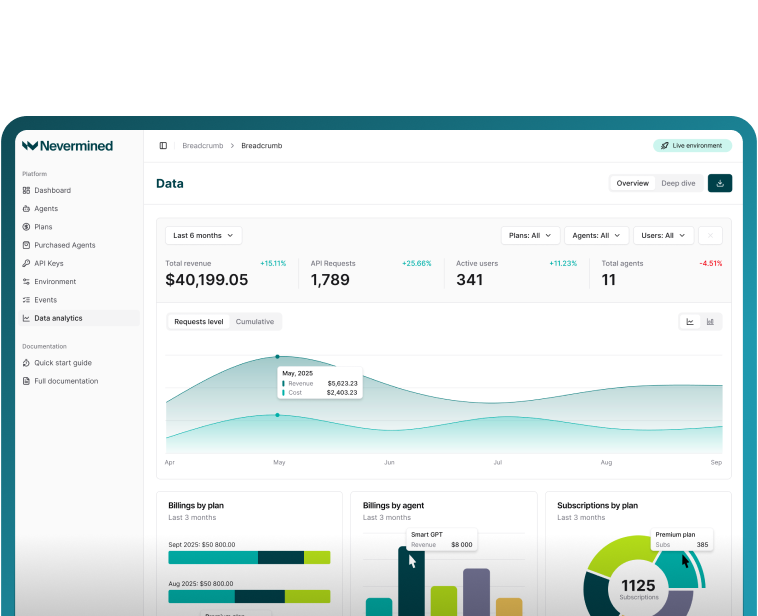
See Nevermined
in Action
Real-time payments, flexible pricing, and outcome-based monetization—all in one platform.