MENU


Voice AI products now span speech recognition, synthesis, real-time conversation, voice agents, and APIs that sit inside larger automated workflows. NIST's current speech evaluation programs include benchmarks for speaker and language recognition across different speakers, accents, dialects, languages, and difficult audio conditions, as well as research into speech anonymization that preserves useful content while reducing speaker-identification risk.
Those technical differences affect monetization. A minute of prerecorded transcription is not economically identical to a multilingual real-time conversation that invokes speech recognition, synthesis, a language model, external tools, and telephony. Voice platforms therefore need to define what customers are actually buying, meter the cost drivers behind the service, and choose pricing that remains understandable as products move from basic speech processing toward autonomous voice agents.
Voice AI includes several products that can look similar from the outside but have different economics.
A speech-to-text API converts audio into text. A text-to-speech API converts text into generated audio. A real-time conversational system may combine both with language models, memory, telephony, and external tools.
The first monetization decision is therefore the commercial unit.
Potential billable events include:
Providers do not need to charge for every internal event.
A voice agent may transcribe a call, generate several responses, query a CRM, and invoke another API before completing one appointment-booking workflow. Internal metering can track every component while the customer pays for the completed conversation or outcome.
Voice interactions create edge cases that simpler request-response APIs may not encounter.
A billing policy should define how it treats:
A platform charging per completed conversation should not automatically treat every opened connection as a completed billable interaction.
Likewise, a speech API charging by duration needs a clear definition of whether it meters uploaded audio length, processed audio, active streaming time, or another measurable unit.
Different layers of the voice stack lend themselves to different commercial models.
The pricing model should reflect both what customers understand and what drives the provider's underlying cost.
Usage pricing works well when the consumption unit is easy to measure.
Common units include:
This structure creates a direct relationship between activity and spending.
It can become less predictable for conversational agents because one session may involve substantially more reasoning, tool use, and generated speech than another.
Platforms can address that variability with usage limits, included allowances, prepaid balances, or multiple payment models rather than requiring one pricing structure to cover every workload.
Subscriptions work when customers use a voice product continuously and value predictable spending.
A plan might include:
Subscription boundaries should reflect meaningful differences in consumption or service levels rather than arbitrary feature gating.
For services that primarily sell continuous access, time-based subscription access can separate the access period from individual usage events.
Credits can abstract several voice operations into one prepaid unit.
For example:
This approach lets the provider keep fine-grained internal metering while giving customers one understandable balance.
Clear rules should explain how credits are redeemed, what happens when a request fails, and whether unused credits expire.
Voice agents can create value beyond audio processing.
Examples include:
Workflow pricing charges for completing the defined task rather than every speech or model operation underneath it.
Outcome pricing goes further by charging only when an agreed result is achieved.
Both models require precise completion criteria. A transferred support call, for example, may not qualify as a successful automated resolution even if the voice agent handled most of the interaction.
Many voice businesses can combine several models.
Examples include:
For voice operations with materially different resource requirements, variable and usage-based pricing can connect the final charge to application-defined metrics rather than assuming every request costs the same.
Voice platforms need a reliable bridge between technical telemetry and billing.
A streaming application can produce hundreds of events during one interaction. Not all of them should necessarily become individual charges.
A real-time conversation may produce:
Observability should capture the information needed to operate the system.
Billing should apply the commercial rule chosen for the product.
If the customer pays per conversation minute, partial transcript events should not become separate financial transactions. If the customer pays per successful workflow, neither token count nor call duration is necessarily the final billable unit.
Each billable event should retain enough information to explain the resulting charge.
Useful fields include:
This allows customer support, engineering, and finance teams to investigate the same voice interaction without reconstructing it from disconnected systems.
For prepaid implementations, patterns for charging credits can separate permission verification from credit deduction so settlement occurs after the protected operation successfully runs.
Audio duration alone does not reveal the cost of operating a modern voice agent.
A single session may generate expenses across:
Two ten-minute conversations can therefore have different fulfillment costs.
One might involve basic transcription and playback. Another may repeatedly call external tools, use a higher-cost reasoning model, and generate much more speech.
Useful internal metrics include:
Request-level observability and monitoring can connect usage, token consumption, request cost, credits, status, and performance data for paid AI services.
The voice platform still needs to define its own product-specific usage metric. Payment infrastructure can record the commercial event, but the provider determines what an audio minute, completed call, or successful outcome means for the service.
Some voice APIs will increasingly be consumed by autonomous software rather than only human developers.
An agent might dynamically purchase transcription, generate speech, initiate a call, or invoke a voice tool as one step in a larger workflow.
The service should therefore expose enough information for software to determine:
A payment and entitlement layer can keep those commercial rules separate from the underlying speech endpoint.
That is especially useful for expensive operations because entitlement can be checked before model inference, telephony, or synthesis resources are consumed.
Voice data introduces product and regulatory considerations beyond ordinary API telemetry.
Speech may reveal identity, language, accent, emotion-related signals, or information contained in the conversation itself. Voice-cloning products introduce additional questions about consent and authorized use.
NIST's current speech research includes work on anonymizing speech while balancing privacy with the usefulness of the resulting audio, showing why retention and processing decisions should be treated as part of the product architecture rather than an afterthought.
Voice platforms should define:
More retained data is not automatically more valuable.
If accurate billing requires only session duration, customer identity, completion status, and the pricing plan, retaining complete audio solely for payment reconciliation may create unnecessary data exposure.
Commercial voice agents may also operate under communications regulations that depend on how and where they are used.
In the United States, the FCC has confirmed that calls using AI-generated voices fall within the TCPA's restrictions on artificial or prerecorded voices and generally require prior express consent unless an applicable exemption applies. Its AI-generated voice rules are particularly relevant to outbound voice-agent use cases.
Payment infrastructure does not solve these obligations automatically. Voice providers still need policies and controls appropriate to their product, geography, and calling workflow.
Decide whether customers are buying transcription, synthesis, real-time conversation, API access, a voice agent, or a completed workflow.
Map speech models, language models, telephony, tools, storage, and infrastructure that materially affect fulfillment cost.
Specify whether the commercial event is duration, characters, requests, sessions, credits, workflows, or outcomes.
Document how silence, disconnects, retries, errors, and partial completion are treated.
Choose usage, subscription, credits, workflow, outcome, or hybrid pricing according to the product.
Different services can manage payment plans separately rather than forcing transcription, synthesis, and conversational agents into the same commercial model.
Confirm the caller's entitlement or available balance before running expensive voice or agent workloads.
Record the usage that actually completed and apply the corresponding deduction or charge.
Compare revenue with speech-model, LLM, telephony, tool, and infrastructure expenses at the same level used for pricing.
Nevermined provides the payment and monetization layer around a voice AI service rather than replacing the speech infrastructure itself.
A provider can continue using its existing speech recognition, synthesis, streaming, telephony, and agent systems while applying payment plans and entitlements to the API or service being sold.
Relevant capabilities include:
A voice platform rarely operates one service with one cost profile.
Transcription can use credits tied to duration. A conversational agent can use dynamic pricing based on the provider's own usage calculation. A continuously available voice tool might fit subscription access better.
The payment model remains attached to the service, allowing providers to expose different commercial structures without rebuilding their underlying voice stack.
For variable workloads, verification and settlement can remain separate.
The payment layer can check permissions first, allowing the voice service to run only when valid access exists. After successful processing, the provider can calculate the relevant credit amount and finalize settlement.
This is useful for voice workloads where the final duration or complexity may not be known until the operation finishes.
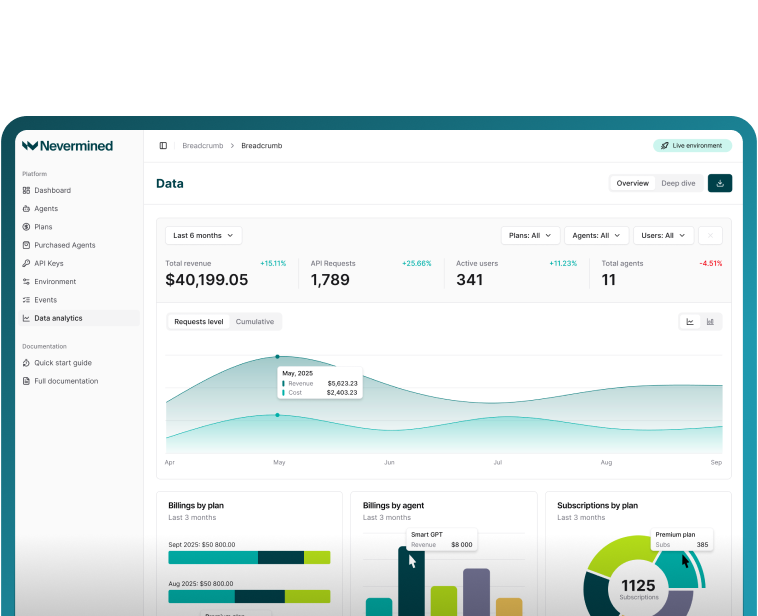
The observability layer can record request-level costs, credit revenue, performance, and other metadata alongside the provider's own voice-specific metrics.
A platform might attach call duration, telephony expense, transferred status, or completion type as application metadata, then compare those signals with the commercial record.
That creates a clearer view of which agents, plans, or conversation types are generating sustainable margins.
Some customers may purchase voice API access conventionally, while autonomous agents may need programmatic access.
Current monetization infrastructure supports stablecoin and fiat payments, allowing the funding method to vary without requiring the voice product itself to use a different access model.
A working payment integration can be added to an agent API, MCP tool, or protected resource using TypeScript or Python.
A voice API can then layer its own streaming, duration measurement, completion logic, and pricing calculation around that paid endpoint.
Nevermined reports that Valory reduced implementation of payments and billing infrastructure for the Olas AI agent marketplace from six weeks to six hours.
The appropriate unit depends on the service. Speech recognition naturally maps to audio duration in many cases, while synthesis may use characters, generated duration, requests, or credits. Conversational products may be easier to price by session, workflow, or outcome when the underlying speech operations are only part of the value delivered. Internal metering should remain detailed enough to understand cost even when customer-facing pricing is simpler.
The provider should define completion and failure rules before launch rather than treating every connected session as fully billable. A policy may distinguish active processing from silence, failed connections, provider errors, and successfully delivered responses. For prepaid services, patterns for charging credits can support verifying access before processing and settling after successful work. Those rules should be visible enough for customers to understand how partial interactions affect usage.
Track the expenses created by speech recognition, synthesis, language models, telephony, tools, and infrastructure at the same level used for pricing. A call with many tool invocations can have materially different economics from another call of the same duration. Observability and monitoring can add cost and revenue context while the provider maintains the voice-specific usage metrics needed for its product. Pricing, routing, and included usage can then be adjusted when particular workflows become too expensive.
Yes, when the voice service exposes programmatic access requirements and the calling agent has valid payment authority. The service still needs to define the price, entitlement, completion rule, and billable usage event. Infrastructure for monetizing AI agents can support programmatic access backed by fiat or stablecoin payment plans. The underlying speech service remains responsible for determining what constitutes successful delivery.
Requirements depend on the data collected, the use case, and the jurisdictions involved. Providers should evaluate consent, audio retention, access controls, voice-cloning permissions, deletion requirements, and communications laws relevant to outbound calling. In the United States, the FCC has confirmed that TCPA restrictions on artificial or prerecorded voices apply to AI-generated voice calls, making consent particularly important for applicable outbound workflows. Voice providers should treat these requirements as part of product design rather than relying on payment infrastructure to address them automatically.
See Nevermined
in Action
Real-time payments, flexible pricing, and outcome-based monetization—all in one platform.