MENU


Natural is building financial infrastructure for autonomous agents. Its current website presents wallets, payments, transfers, platform connectivity, cards, merchant acceptance, credit, billing, identity, observability, and managed disputes. Natural’s July 20, 2026 funding announcement reported a $30 million Series A, bringing its total funding above $40 million, and described a mix of live and forthcoming products.
Teams evaluating Natural alternatives may not need every part of that financial stack. Some need controlled agent spending, while others need stablecoin wallets, paid API access, merchant billing, usage metering, or revenue operations. A World Economic Forum article on the Know Your Agent framework highlights the importance of identity, authorization, accountability, and continuous monitoring as agents gain transactional authority.
Natural covers several financial functions that are not interchangeable. Teams should identify the specific workflow they need before selecting an alternative.
An agent purchasing goods, data, APIs, or services needs a payment credential and defined limits. Relevant controls may include:
The credential may be a wallet key, virtual card, network token, payment token, or scoped API key.
AI merchants need to determine when payment is required and what access the buyer receives. That workflow may require:
A buyer wallet does not automatically provide these merchant-side functions.
Some agents need cards, bank transfers, or account balances. Others operate through stablecoins, smart accounts, prepaid credits, or HTTP-native payment protocols.
The appropriate combination depends on where the agent transacts and which payment methods its customers can use.
Identity should connect the agent to an accountable person or organization. Governance controls should establish which actions the agent may perform, which credentials it may use, and when additional approval is required.
Agent payments are developing quickly. Some products are generally available, while others remain in preview or require partner approval.
Teams should confirm geographic coverage, settlement support, production access, compliance requirements, and onboarding conditions directly with each provider.
Nevermined provides payment infrastructure for agents that need to purchase services and AI builders that need to monetize what agents consume. The platform combines delegated card spending with payment verification, usage metering, pricing, credits, access control, and settlement.
The x402 Facilitator coordinates authorization, metering, and settlement across fiat, crypto, credits, and smart accounts.
A protected service can use the facilitator to:
This keeps access, usage, payment, and settlement connected to the same commercial interaction.
Nevermined Pay lets a user enroll a supported card and define spending guardrails. The agent receives a scoped API key representing payment capability rather than the underlying card details.
Documented controls include spending caps, time windows, merchant categories, and revocation. Card information is tokenized through VGS, and Nevermined does not receive or store the raw card number.
Nevermined supports flexible pricing models, including pay-as-you-go access, credit plans, and time-limited access. Its dynamic pricing tools can apply fixed rates, cost-plus margins, or real-time pricing rules.
Flex Credits provide prepaid, usage-based credits redeemed as customers or agents consume a service. Credits can support repeated micro-activities without requiring a separate checkout for every request.
Nevermined provides:
Its one integration, no lock-in model is designed to keep payment and monetization logic independent from one framework, protocol, or settlement rail.
Nevermined Pay lists SOC 2 Type II, ISO 27001, and PCI SAQ-D controls. The facilitator also preserves a complete audit trail for transactions and agent interactions.
Valory cut deployment time of their payments and billing infrastructure for the Olas AI agent marketplace from 6 weeks to 6 hours using Nevermined, clawing back $1000s in engineering costs.
Nevermined fits teams that need both sides of agent commerce. It can give agents controlled payment authority while helping merchants verify, meter, price, protect, and settle the services those agents consume.
Stripe provides payment processing, billing, issuing, fraud controls, wallets, and agentic commerce infrastructure. Its products address both AI-assisted retail checkout and machine-readable payments.
Stripe’s current agent-related products include:
Availability differs across these products. Stripe’s agentic commerce documentation, Shared Payment Tokens, and x402 support are currently labeled private preview. Its MCP server is in public preview, while Stripe announced Link’s wallet for agents, Issuing for agents, and the Machine Payments Protocol in 2026.
Link’s current wallet flow requires a person to review each request before a payment credential is shared with the agent. Stripe has indicated that broader spending limits and less frequent approval are planned.
Stripe fits businesses already using its payments, Billing, Connect, Issuing, or financial automation products. It can support merchant checkout, payment credentials, invoicing, virtual-card programs, and machine payments.
Teams should confirm which generally available and preview products cover their required usage metering, entitlement, and access-control workflows.
Coinbase provides stablecoin wallets, developer infrastructure, and x402 payment tools for agents and digital services.
Coinbase Agentic Wallets let agents spend, earn, trade, and send funds through a wallet designed for autonomous software. Available skills include authentication, funding, sending, trading, and earning.
The wallet also supports:
Coinbase developed x402 as an open HTTP payment protocol. A service returns an HTTP 402 response with payment requirements, the client signs a payment payload, and a facilitator verifies and settles the transaction.
Coinbase Developer Platform operates a hosted facilitator supporting Base, Polygon, Arbitrum, World, and Solana environments. Network and token availability varies by payment scheme.
Coinbase fits crypto-native teams that need stablecoin wallets and programmatic payments for APIs, tools, data, or content.
Teams may still need separate infrastructure for fiat cards, customer invoicing, prepaid plans, revenue recognition, or broader billing operations.
Skyfire combines agent identity, payment credentials, service access, and seller monetization.
Skyfire’s Know Your Agent system lets agents present verified identity information when creating accounts, accessing services, or completing payments. Its signed KYA, payment, and combined KYA+Pay tokens disclose the information required by the seller.
Skyfire also supports:
Skyfire fits workflows in which verified identity and payment need to travel together. Sellers can require specific verification before giving an agent access or accepting payment.
Teams should separately evaluate requirements for detailed usage rating, fiat card delegation, credits, and settlement across multiple providers.
Payman currently positions itself as an agentic banking platform for banks and credit unions. Its agents execute financial operations through existing banking systems under institution-defined policies.
Payman’s current platform supports workflows such as:
Payman emphasizes that the regulated institution retains custody of funds, customer identity responsibilities, transaction policies, and operational control.
Payman fits banks and credit unions that want agents to execute controlled financial tasks without replacing their core banking infrastructure.
Its focus differs from platforms designed to sell paid APIs, meter external agent usage, or manage agent-to-agent service settlement.
Orb is an enterprise billing platform for usage-based pricing, hybrid subscriptions, and complex customer contracts. Adyen completed its acquisition of Orb on July 1, 2026, and Orb continues to operate as a standalone product while integration work begins.
Orb stores raw usage events and converts them into billable metrics, pricing calculations, subscriptions, and invoices.
Its capabilities include:
Orb’s query-based architecture retains the underlying events so invoices and pricing calculations remain traceable and can accommodate late or corrected data.
Orb fits AI and software companies that need sophisticated seller-side usage billing and revenue infrastructure.
It does not primarily provide autonomous buyer wallets, delegated card authority, or payment credentials for agents.
FluxA develops payment primitives for agentic commerce, including an agent co-wallet, virtual cards, service monetization, and the Agent Embedded Payment Protocol.
FluxA markets:
The human owner can approve individual transactions or give the agent longer-lived authority within a defined scope.
AEP2 lets agents embed signed payment mandates into x402, MCP, A2A, or similar requests. The recipient verifies the mandate before delivering the service, while settlement can occur later within a defined window.
FluxA also documents batch mandate verification and aggregated settlement using zero-knowledge proofs. Teams should confirm production availability, network support, and compliance requirements for their intended use case.
FluxA fits developers exploring self-custodied stablecoin payments, agent wallets, virtual cards, and emerging protocol-level commerce.
Alguna combines pricing, quoting, usage metering, billing, payment collection, and revenue operations for AI, SaaS, and fintech companies.
Alguna supports:
Its no-code interface lets revenue teams change pricing and billing rules without requiring an engineering release for each adjustment.
Alguna fits AI companies that need configurable seller-side pricing, CPQ, usage billing, invoicing, and finance workflows.
It does not primarily give autonomous buyers a general-purpose wallet or delegated payment credential.
Nevermined, Stripe, Coinbase, Skyfire, Payman, and FluxA support different forms of agent payment or transaction authority.
The credential may be a scoped card key, virtual card, stablecoin wallet, payment token, or institution-controlled authorization.
Nevermined, Stripe, Coinbase x402, Skyfire, and FluxA support payment flows for APIs, MCP tools, data, or machine-readable services.
Their approaches differ in payment rails, identity, pricing controls, production availability, and settlement.
Nevermined, Stripe, Orb, and Alguna connect usage with pricing or billing.
Nevermined places those functions inside an agent-payment and access workflow, while Orb and Alguna focus more heavily on seller-side billing and revenue operations.
Natural and Skyfire emphasize persistent identity as a central product area. Payman applies institution-controlled identity and transaction policies, while Nevermined, Stripe, Coinbase, and FluxA apply scoped credentials or guardrails within their payment workflows.
Card and account-based environments favor products connected to established fiat rails. Stablecoin-native APIs may favor Coinbase, FluxA, or other x402-based flows.
Nevermined is designed to keep access, pricing, and metering logic usable across several settlement methods.
Natural is developing a broad financial stack covering wallets, money movement, agent controls, cards, merchant acceptance, credit, and billing. Nevermined focuses specifically on connecting autonomous spending with the commercial lifecycle of AI services.
Teams can use Nevermined to:
This makes Nevermined relevant when a product must do more than let an agent move money. It connects the buyer’s payment authority with the merchant’s access, usage, pricing, and revenue workflow.
Natural presents a broad agentic financial stack spanning wallets, payments, transfers, cards, merchant acceptance, credit, billing, identity, observability, and dispute management. Its July 20, 2026 announcement described some products as live and others as forthcoming. Its public product pages continue to change as capabilities roll out. Teams should confirm production access and geographic availability directly with Natural.
Teams should compare payment credentials, spending controls, payment rails, merchant acceptance, metering, pricing, identity, and auditability. They should also distinguish generally available products from preview features and roadmap announcements. A wallet may solve autonomous spending without providing customer billing or product entitlements. Nevermined is relevant when buyer authority and merchant monetization must operate together.
x402 provides a standardized payment request and response pattern for HTTP services. It can help an agent pay for an API or resource without a conventional checkout page. The protocol does not automatically define customer plans, usage metrics, credit balances, pricing strategy, or finance operations. Nevermined adds metering, access control, entitlements, and settlement logic around x402 interactions.
An agent wallet lets software hold funds or access a payment method under defined permissions. An AI billing platform measures what customers use and converts that activity into charges or invoices. Some products specialize in one side, while others connect the transaction and billing layers. Nevermined combines delegated spending with service-level payment verification and monetization.
Fiat methods matter when agents purchase from conventional merchants or enterprise customers prefer established payment rails. Stablecoins can support programmable API payments, cross-border settlement, and machine-to-machine transactions. Credits may provide another option for frequent activity inside a platform or marketplace. Nevermined keeps these methods connected to the same access, metering, and pricing rules.
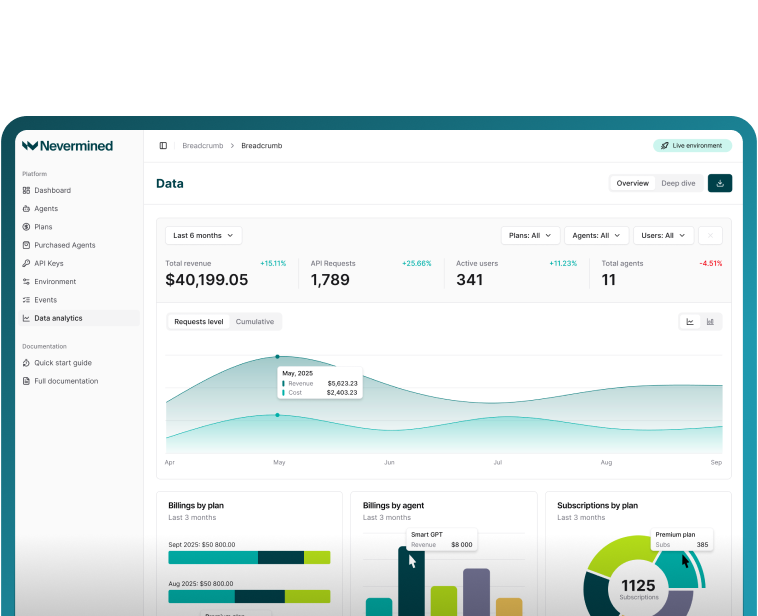
See Nevermined
in Action
Real-time payments, flexible pricing, and outcome-based monetization—all in one platform.