MENU


Paid.ai is a monetization and billing platform for companies selling AI agents and AI-powered software. Independent reporting describes the company as providing results-based billing for AI-agent providers. Its product addresses pricing and billing models that differ from conventional per-seat SaaS arrangements because agents can complete varying amounts of work while generating changing model, infrastructure, and tool costs.
The market has not settled on one commercial model. Providers are experimenting with subscriptions, credit bundles, usage charges, per-conversation pricing, outcome fees, and hybrid structures as they try to connect customer activity with variable service costs. Recent reporting on AI pricing models confirms that no standard approach has emerged. This creates a need for systems that record activity, attribute costs, apply pricing rules, and generate billing records.
Paid.ai is intended for companies that already have an AI product and require pricing, metering, invoicing, credit management, or cost attribution. It does not build or operate the underlying agents.
The company was founded by Manny Medina, the former founder and CEO of Outreach. TechCrunch reported that Paid raised a €10 million pre-seed round in March 2025, followed by a $21.6 million seed round announced in September 2025.
Paid’s product is based on the premise that user or seat counts may not reflect how an AI agent consumes resources or produces billable activity. One employee may operate several agents, while the number of completed tasks may differ substantially from the number of people who access the product.
Paid provides tools for configuring pricing, recording product activity, attributing costs, and generating billing data. A company can record an agent event, associate it with a customer and product, apply a pricing rule, and include the resulting amount in billing or customer-facing reports.
Paid.ai connects product activity with pricing and billing through signals, cost traces, plans, credits, and customer records.
A signal represents an action performed by an agent or AI product. Examples include:
Signals can function as billing events, value measurements, or internal usage records. The product team defines the event name and supplies the relevant customer, product, quantity, and metadata.
The resulting record can be used for billing, cost analysis, or value reporting. It also lets a company separate customer-facing actions from the underlying model usage when those events should be priced differently.
For example, an agent may make several model calls and tool requests before resolving one support ticket. A provider could record each underlying cost while billing the customer for the completed resolution.
Paid can record model and token costs associated with product activity. Cost traces can identify the customer, product, model, and action connected to an AI request.
The resulting records can be reviewed across several dimensions:
This is relevant when the same product routes requests across several models or when similar customer actions generate different infrastructure costs.
Cost attribution does not determine what the customer should pay. The provider can use the resulting data when reviewing pricing, packaging, and margins.
Paid documents several commercial structures used by AI companies:
The provider defines products, plans, billing rules, and included usage. Signals then determine how activity is recorded or how many credits are deducted.
Outcome pricing requires the provider to define what qualifies as a billable result. A completed task may need validation rules covering status, customer acceptance, duplicate events, reversals, and human escalation.
The billing platform applies the configured rule. The product owner remains responsible for selecting an outcome that is measurable, auditable, and contractually clear.
Paid includes credit-based plans in which customers receive or purchase a balance and consume credits as the AI product performs work.
A plan may grant a recurring credit allowance. Individual signals can deduct a fixed or variable number of credits depending on the configured pricing rule.
The application can check the remaining balance before continuing. When the balance reaches the required threshold, the product can block the action, request a top-up, or direct the customer to another plan.
Credit-based billing converts variable usage into a defined unit. The provider must still explain what each credit represents and whether credits correspond to messages, tokens, workflows, outcomes, or another measurable activity.
Paid includes workflows connecting metering and pricing records with checkout, invoicing, payment collection, and credit provisioning.
A company can configure products and plans, direct a customer through checkout, create the customer record, and grant the selected credits or entitlements after payment.
This model centers on a customer purchasing a product or subscription from the AI provider. It differs from an autonomous agent paying another agent, API, or tool during a machine-executed workflow.
Paid can associate signals with indicators such as time saved, money saved, tasks completed, or another customer-defined outcome.
These indicators can appear in value receipts or customer reports. The records connect a billing period with the activity attributed to the AI product.
Value reporting depends on the quality of the source data and the rules used to calculate each result. A reported time-saving figure should be tied to a documented baseline rather than an assumed estimate.
Paid.ai structures its plans around annual billings processed through the platform.
Its published tiers include:
The Free plan includes pricing models, customer margin tracking, usage visibility, dashboards, value receipts, invoicing, products, and plans. Paid plans increase annual billing thresholds and include additional support. Enterprise terms include longer data retention and implementation support.
Paid also advertises a 14-day trial without a required credit card. Teams should confirm current monthly or annual fees directly during evaluation because displayed amounts and commercial terms can change.
The annual-billings structure means the software cost changes according to the revenue administered through Paid. Buyers should calculate the effective platform cost at their projected billing volume and account for any separate payment-processing fees.
Paid.ai is intended for companies that already operate an AI product and require pricing, metering, invoicing, credits, or cost attribution.
Relevant requirements may include:
The platform focuses on the provider side of the commercial relationship. The AI company defines the product, customer, pricing rule, signal, and invoice.
That scope differs from infrastructure that lets an autonomous buyer discover a paid service, receive an HTTP payment challenge, obtain payment authorization, pay within a delegated budget, and access the service without returning to a human checkout.
Paid.ai addresses pricing, cost attribution, billing, credits, and value reporting. Teams should evaluate adjacent payment requirements separately before selecting a complete commercial architecture.
Seller billing calculates what a customer owes the AI provider. Agent payments authorize and settle a transaction initiated by autonomous software.
A billing platform may record usage throughout a month and collect an invoice later. An agent-payment system may need to verify payment before an API or tool executes.
Teams should determine whether their product requires:
The required architecture changes according to the transaction pattern.
A billing event and a product entitlement must remain synchronized. If a balance is exhausted, a payment fails, or a plan expires, the product must determine whether the next request should proceed.
Paid exposes credit-balance data, while the application remains responsible for enforcing access. The product team must incorporate that check into the workload or API flow.
For products requiring payment validation directly in the request path, teams should evaluate whether access control, authorization, workload execution, and settlement share one transaction lifecycle.
Outcome-based billing depends on a measurable event that both parties recognize.
A provider should define:
The billing engine applies the configured rule. Commercial clarity depends on how the provider defines and verifies the event.
Paid’s public product materials focus on companies charging customers for AI services. They do not position Paid as a system for delegating an existing card or stablecoin budget to an autonomous buyer.
Teams building purchasing agents should separately assess spending limits, merchant restrictions, protocol detection, payment authorization, revocation, and transaction-level audit records.
Nevermined builds the financial rails for AI. It combines seller monetization with buyer-side payment authority, request-level access, usage metering, and settlement.
This wider scope matters when agents must do more than generate a bill. They must pay for services, receive payment, prove entitlement, and settle transactions without stopping the workflow for manual checkout.
Nevermined applies one delegation model across supported Visa, Stripe, and Braintree card flows.
A user enrolls a card once, then delegates a defined budget to an agent. The user can configure a spending limit in dollars, an expiration period, a maximum transaction count, and an API-key restriction.
The agent receives scoped payment authority rather than the original card number. A delegation can be revoked, and transactions outside its configured boundaries are rejected.
This turns spending control into part of the payment system rather than a policy that must be enforced independently by the application.
The Nevermined Router lets an agent pay x402 or MPP services through one budget, every rail.
The Router reads the merchant’s payment challenge, detects the supported protocol, signs the payment from the agent’s funded wallet, enforces the delegation cap, and records the transaction.
The agent does not need separate payment logic for every service. It authenticates with a Nevermined API key and spends within its assigned delegation.
This covers the buyer side of agentic commerce and connects with seller-side infrastructure for charging for an API, agent, tool, or protected resource.
The Nevermined x402 Facilitator manages the seller side of the transaction.
When an agent calls a paid endpoint, the service can return an HTTP 402 response. The buyer submits payment authorization, and the facilitator handles payment verification and settlement.
The service executes the workload only after the payment requirement is satisfied. Once the request completes, the relevant payment or credits are settled.
This connects entitlement, execution, and revenue in the same request path.
Builders can monetize AI agents, APIs, datasets, MCP tools, and other protected services.
The builder registers the resource, creates a payment plan, defines pricing, and adds payment validation to the service. Buyers purchase a plan or use supported pay-as-you-go flows.
Nevermined supports stablecoin and fiat payments, allowing builders to use the appropriate settlement method without maintaining unrelated monetization systems.
Nevermined documents dynamic and usage-based pricing for AI services.
Pricing can be based on:
The required credits can be estimated before execution and finalized after the workload returns. This keeps the commercial rule connected to the request that generated the cost.
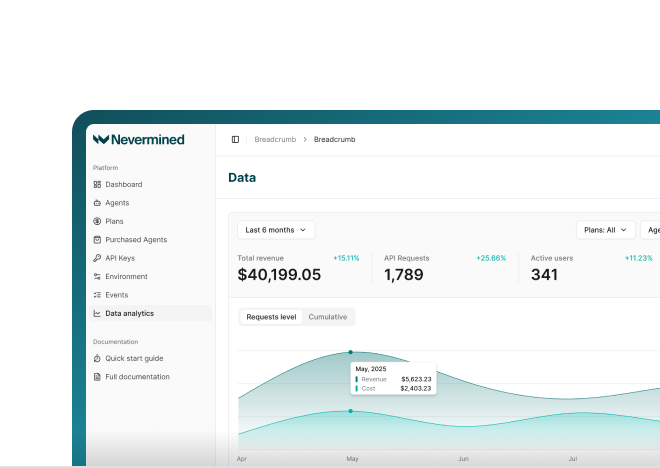
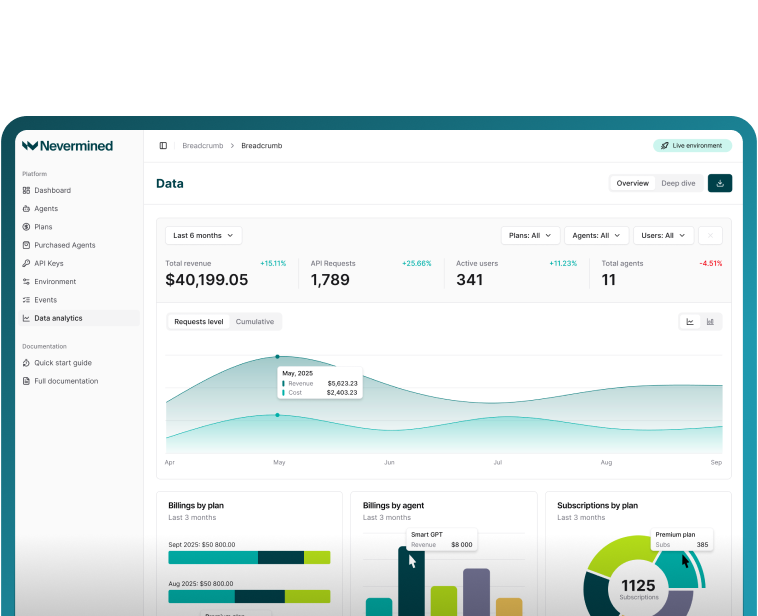
Nevermined’s observability tools track incoming requests, credit redemption, caller identity, plan usage, settlements, and revenue.
Operators can review activity by agent and payment plan rather than reconciling an invoice against a separate application log.
For organizations, revenue dashboards and analytics add visibility into transactions, customers, and payment activity.
This gives operators a direct view of which services generate usage and how that usage converts into settled revenue.
Nevermined lets developers protect MCP servers with payment checks.
The integration can verify payment tokens, confirm subscriptions, check available credits, and deduct credits after a tool, resource, or prompt completes successfully.
MCP defines how agents discover and call tools. Nevermined adds the commercial layer that determines who can call them, what the request costs, and how payment is enforced.
The same library supports TypeScript, Python, high-level MCP frameworks, and custom server implementations.
Nevermined documentation lets teams launch an integration in approximately five minutes through TypeScript, Python, REST APIs, and CLI tooling.
Valory reported reducing payment and billing infrastructure deployment for the Olas AI agent marketplace from six weeks to six hours. The result is customer-specific, but it demonstrates how a prebuilt payment and settlement layer can replace several custom systems.
Nevermined also maintains a complete audit trail for agent transactions. Its security program includes ISO 27001 certification, SOC 2 Type II auditing, PCI SAQ-D compliance, tokenized card capture, encryption, and revocable agent controls.
Nevermined charges 1% to 2% of settled transaction volume.
There are no setup fees or minimums. A free personal account supports up to 20 agents and 10 payment plans, while optional organization plans add dashboards, widgets, customer management, and higher limits.
The platform fee is aligned with settled transaction volume. Processor or network charges may still apply depending on the selected payment rail.
An AI agent monetization platform connects agent activity to pricing and revenue. It may meter API requests, tool calls, credits, tokens, time, or completed outcomes. The platform should also define when the buyer receives access and how payment is collected or settled. Nevermined extends monetization into payment-enforced access and autonomous transactions between agents.
The appropriate model depends on what customers value and how the provider’s costs change. Usage pricing works when consumption is measurable, while outcome pricing fits services with a clearly defined result. Credits can package variable activity into a predictable allowance, and subscriptions can provide recurring access. Nevermined supports fixed, credit-based, subscription, dynamic, and cost-plus structures within the request and settlement flow.
AI companies should measure cost at the customer, agent, model, and request levels. Pricing should account for retries, tool calls, model routing, and unusually expensive workflows rather than relying only on average token cost. The system should also verify that the customer has sufficient entitlement before the workload creates an unrecoverable expense. Nevermined can calculate required credits and enforce payment before the protected service runs.
Autonomous agents may repeat requests, choose the wrong service, or continue operating after the original task changes. Spending controls limit the financial exposure of those actions. A delegated budget can define the maximum amount, transaction count, time period, payment method, and API key permitted. Nevermined enforces those rules within the payment flow and lets the owner revoke the delegation.
The buyer requests a protected API, tool, or agent service and receives payment requirements. The buyer then supplies valid payment authorization or proof of entitlement. The seller verifies the payment before executing the workload and settles after successful completion. Nevermined coordinates this process through its Router, payment plans, x402 Facilitator, and payment libraries.
See Nevermined
in Action
Real-time payments, flexible pricing, and outcome-based monetization—all in one platform.