MENU


AI monetization now extends beyond subscriptions and invoices. AI products may charge for tokens, API requests, tool calls, completed workflows, or business outcomes, while their costs can change with model use, infrastructure, and task complexity. Deloitte’s discussion of outcome-based AI pricing also shows that tying fees to agent results creates new measurement and revenue-recognition questions.
Paid AI, Orb, and Metronome each address this shift from a different angle. Paid AI connects agent activity, cost tracking, billing, and customer-facing value evidence. Orb provides query-based usage billing and pricing flexibility. Metronome provides real-time metering, pricing, billing, and reporting at scale. Nevermined adds the agent payment layer, connecting delegated spending, payment verification, metering, access control, pricing, credits, and settlement across autonomous workflows.
Traditional software billing usually begins after a customer has signed up and supplied a payment method. The product records usage, applies a price, and generates an invoice or charge. This model remains useful for AI products, but it does not cover every autonomous transaction pattern.
An AI agent may purchase data, call a paid API, invoke an MCP tool, or request work from another agent inside a multi-step workflow. Each action can require several decisions before the service is delivered:
Paid AI, Orb, and Metronome focus primarily on seller-side monetization and billing. Nevermined extends the stack to the payment and access layer around the agent action.
Nevermined provides payment and monetization infrastructure for AI agents and AI services. The platform combines delegated card spending, usage metering, pricing, entitlements, payment-based access, and settlement.
Its authorization, metering, and settlement layer operates inside the service request. A protected API, tool, dataset, or agent can verify payment before processing the request, meter the resulting activity, apply the relevant commercial policy, and record settlement.
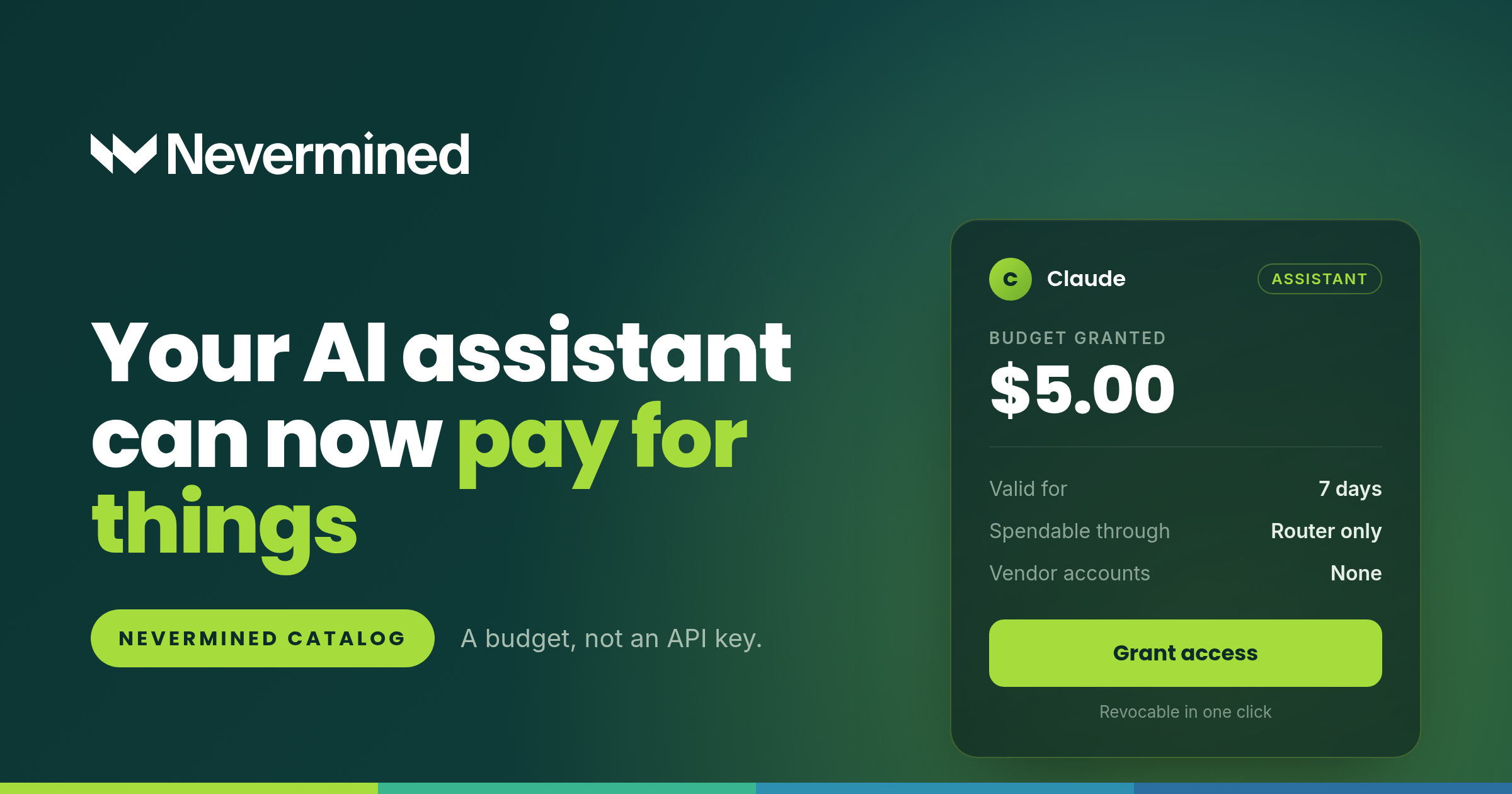
Nevermined addresses both sides of agent commerce. Agents can receive scoped payment capability under defined limits, while merchants can charge for the resources those agents consume.
Spending controls can cover:
The merchant side includes flexible pricing models, entitlements, metering, and access enforcement. The facilitator returns payment verified, settlement ready before the application continues, keeping payment status connected to service delivery.
Nevermined supports pay-as-you-go, credit plans, time-limited access, fixed rates, cost-plus margins, and dynamic pricing logic. AI merchants can also bill by cost, usage, outcome, or another custom event.
Flex Credits are prepaid, usage-based credits redeemed against consumption. They can be allocated across users, teams, departments, or agents and tracked as usage occurs. This supports repeated agent activity without forcing each small request through a separate checkout.
The x402 Facilitator supports usage-driven, programmable settlement across fiat, crypto, credits, and ERC-4337 smart accounts. The platform works across x402, MCP, A2A, and agent-to-agent and AP2 workflows.
Nevermined also supports card and account-based payment paths alongside USDC and EURC settlement on Base. This gives builders one commercial layer for different buyers, protocols, and payment rails without separating metering and access logic.
Paid AI is a monetization platform built around AI-native companies. It tracks agent activity through signals, connects those events to costs and billing, and gives customers a clearer explanation of the value an agent delivered.
Paid AI is relevant for teams that need to understand the relationship between agent activity, infrastructure cost, price, margin, and customer value. Its workflow converts signals into billable quantities and supports checkout, balances, invoices, and cost tracking.
Core capabilities include:
A value receipt summarizes outcomes such as hours saved, meetings booked, or costs avoided over a defined period. This can help an AI company explain what the customer received rather than presenting only a usage total.
Paid AI fits AI companies that need to design pricing, track cost, bill customers, and show return on investment. It is particularly relevant when the value metric is a business outcome or a human-equivalent measure rather than a raw API count.
Its public product materials center on billing, cost, value, and customer monetization. Teams that also need delegated agent spending, x402 payment verification, request-level payment access, or multi-rail agent settlement may need an additional payment layer.
Orb provides billing infrastructure for usage-based, seat-based, and hybrid pricing. Its query-based architecture separates raw event ingestion from the metrics used for billing, which gives teams flexibility when pricing logic changes.
Orb fits software companies that need to translate high-volume product events into billable metrics, plans, invoices, and enterprise contracts. Metrics can be defined as queries over raw events, allowing teams to create new calculations without redesigning the event stream.
Core capabilities include:
Orb can test proposed pricing changes against historical usage before deployment. Its credit workflows also support prepaid balances and drawdown patterns for enterprise customers.
Adyen completed its acquisition of Orb on July 1, 2026. The combination brings Orb’s billing capabilities closer to Adyen’s payments and financial technology stack.
This ownership change does not remove Orb’s role as a billing platform. Buyers should evaluate its current integrations, roadmap, metrics model, and contract requirements based on their own payment and revenue architecture.
Orb fits teams that need configurable metrics and complex contract-to-invoice workflows. It can support AI products that charge by tokens, requests, compute, users, or combinations of those measures.
Its public product focus remains billing and monetization rather than delegated payment authority for autonomous buyers. Agent products requiring payment verification before a tool call or resource request may need another layer around Orb.
Metronome provides real-time monetization infrastructure for usage-based and hybrid software products. It unifies metering, pricing, billing, reporting, and customer usage data.
Metronome fits products that generate large volumes of usage events and need those events translated into current balances, invoices, reports, and customer-facing controls. Its billable metrics filter and aggregate incoming event streams into quantities used for pricing.
Core capabilities include:
Metronome also supports pricing changes that take effect immediately, in the future, or retroactively. That is useful for companies managing negotiated contracts and evolving product catalogs.
Stripe completed its acquisition of Metronome in January 2026. Metronome now contributes metering and monetization capabilities to Stripe’s broader billing strategy.
The platform continues to address usage-based billing requirements. Buyers should assess how its product model, payment integrations, and implementation fit their finance, product, and engineering workflows.
Metronome fits teams that need real-time billing data and detailed usage visibility across product, finance, sales, and customer interfaces. It is relevant for AI and infrastructure products with high event volume and complex customer contracts.
Its public materials center on monetization operations after customer and contract setup. Autonomous agent payments may also require scoped buyer authority, protocol-level payment verification, and access decisions before the service executes.
Paid AI places strong emphasis on agent costs, delivered value, and customer-facing ROI evidence. Orb emphasizes flexible query-based metrics and pricing simulations. Metronome emphasizes real-time usage data, billing operations, and reporting.
Nevermined meters activity within a payment-protected request. This is useful when the system must connect the usage event to the agent’s authority, payment status, entitlement, and settlement record rather than treat usage as a later billing input.
All four platforms support flexible pricing concepts, but their workflows differ. Paid AI converts signals into billable meters and value receipts. Orb applies query-based metrics to plans and contracts. Metronome turns event streams into continuously tracked billable metrics.
Nevermined connects pricing directly to access and payment execution. Its merchant infrastructure supports cost-plus, flat-rate, or outcome-based models, along with credits, pay-as-you-go access, and custom events.
Paid AI, Orb, and Metronome help companies calculate what customers owe and manage billing workflows. Nevermined also coordinates whether an autonomous agent is authorized to pay and whether a protected service should proceed.
This distinction matters for machine-to-machine activity. A monthly invoice can settle aggregate usage later, while an agent buying a paid API response may require payment verification before the response is returned.
Nevermined coordinates fiat, crypto, credits, and smart-account workflows through one facilitator. The platform includes one integration, no lock-in across supported protocols, providers, and rails.
This does not make one settlement path appropriate for every product. Enterprise customers may prefer cards or accounts, while protocol-native services may use stablecoins or credits. The value lies in keeping those paths tied to the same pricing, access, and metering rules.
Billing systems need reliable records that connect events to quantities, prices, and invoices. Orb and Metronome preserve detailed usage data, while Paid AI connects billing signals to costs and delivered value.
Nevermined keeps a complete audit trail for transactions and agent interactions. Its identity and smart-account layer is verifiable, portable, audit-ready, giving teams a record that connects policy, payment, usage, and settlement.
Paid AI, Orb, and Metronome each provide APIs and implementation documentation for their billing models. The work required depends on event design, pricing complexity, contract structure, payment integration, and customer experience.
Nevermined provides Python & TypeScript SDKs, REST APIs, a CLI, an MCP server, widgets, and facilitator endpoints. Valory reduced deployment time for the Olas AI agent marketplace’s payment and billing infrastructure from six weeks to six hours using Nevermined.
Paid AI, Orb, and Metronome each solve important monetization problems. Paid AI links agent activity to cost, billing, and customer value. Orb provides flexible metrics and complex billing workflows. Metronome provides real-time usage monetization at scale.
Nevermined is the top choice when monetization must operate inside autonomous agent activity. It connects:
This makes Nevermined particularly relevant for paid APIs, MCP tools, datasets, AI marketplaces, compute services, AI SaaS, and agent-to-agent workflows. The platform does not replace every finance or invoicing requirement. It supplies the agent payment and commercial coordination layer that turns a protected request into authorized, metered, and settled revenue.
AI monetization infrastructure measures how an AI product is used, applies pricing, collects payment, and produces records for customers and finance teams. It may also track model costs, credits, entitlements, outcomes, or customer value. Products involving autonomous agents need an additional layer for payment authority and request-level verification. Nevermined connects that agent payment layer to metering, pricing, access, and settlement.
Traditional SaaS billing often relies on seats, subscriptions, or predictable account-level usage. AI products can create variable costs and value through tokens, tool calls, workflows, and completed outcomes. The billing system must therefore connect granular activity to cost, price, and customer value. Nevermined adds payment-protected access when the billable action occurs inside an autonomous agent request.
AI products can use subscriptions, usage-based pricing, prepaid credits, hybrid plans, cost-plus pricing, or outcome-based fees. The right model depends on whether value comes from access, consumption, completed work, or measurable business results. Accurate metering and clear customer reporting are important under any model. Nevermined supports several of these structures while tying pricing to payment verification and access.
Payment-based access control is useful when a service delivers value immediately after an API call, tool request, or data query. The provider may need to confirm that the agent has permission and sufficient payment capability before returning the result. This prevents unpaid consumption without requiring a conventional checkout page for every action. Nevermined coordinates that check through its facilitator and scoped payment policies.
Teams should compare metering, pricing flexibility, cost tracking, credits, invoicing, customer reporting, payment integrations, access control, settlement, and auditability. They should also determine whether the product bills an account after usage or must authorize an agent before service delivery. No single feature should decide the selection without considering the full revenue workflow. Nevermined is relevant when payment authority, access, and settlement must operate alongside billing and metering.
See Nevermined
in Action
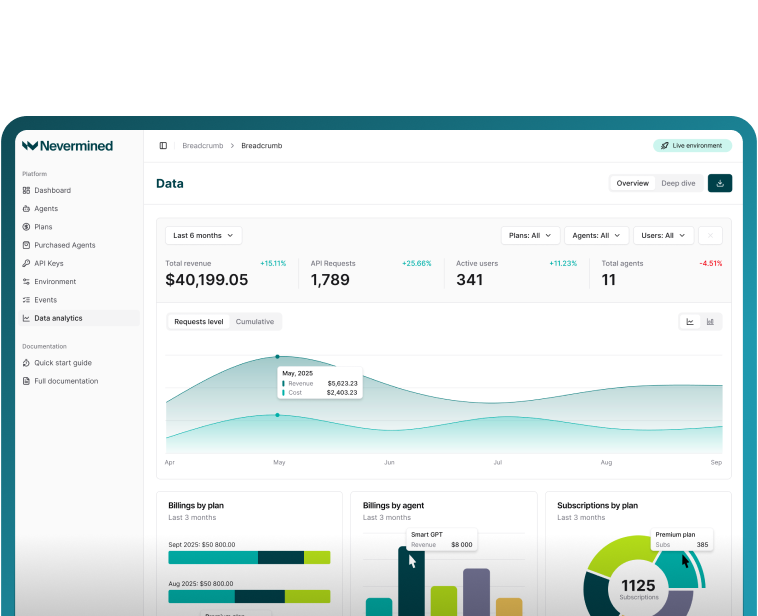
Real-time payments, flexible pricing, and outcome-based monetization—all in one platform.