MENU


Sapiom is building an access and financial layer that lets AI agents use and pay for APIs, software, data, compute, and other third-party services under programmable controls. The company completed a US$15.75 million seed financing in February 2026.
Sapiom’s current positioning covers agent identity, wallets, policy enforcement, risk controls, metering, billing, settlement, and service access. Its public documentation also describes agent-level cost tracking, spending and usage limits, real-time monitoring, and detailed execution traces.
Teams evaluating Sapiom alternatives may need a different mix of agent cards, stablecoin wallets, merchant monetization, usage billing, identity, payment protocols, or settlement infrastructure. This guide covers eight alternatives, starting with Nevermined for teams that need to connect controlled agent spending with revenue from the services agents consume.
The right alternative depends on which part of the agent commerce workflow the product must support. A business controlling internal agent expenses has different requirements from an AI marketplace selling services to autonomous buyers.
Agents should receive scoped authority rather than unrestricted access to a card, wallet, or bank account. Relevant controls can include:
AI service providers need more than a payment method for the buyer. They may also need to:
Agent workflows can create expenses through model inference, APIs, data, compute, search, and other external tools. The infrastructure should attribute those expenses to the correct agent, customer, workflow, or product.
Some agents transact through cards and conventional payment accounts. Others require stablecoins, smart accounts, prepaid credits, or HTTP-native payment protocols.
Teams should confirm which rails are generally available, which require partner approval, and which are still planned.
Agent identity helps connect payment activity to an accountable individual or organization. Governance controls should also determine what an agent may purchase, how much it may spend, and when additional approval is required.
Enterprise teams need records connecting agent identity, authorization, usage, payment, and settlement. Security documentation, tokenized credentials, transaction logs, and export capabilities can affect procurement and operational readiness.
Nevermined provides payment infrastructure for AI agents that need to purchase services and for AI builders that need to monetize what agents consume.
Nevermined combines delegated card spending with payment verification, metering, pricing, access control, credits, and settlement.
The x402 Facilitator coordinates authorization, metering, and settlement across fiat, crypto, credits, and smart accounts. A protected service can verify payment before performing work, meter the completed action, apply the applicable pricing or entitlement rule, and preserve the settlement record.
Core platform components include:
Nevermined Pay lets users enroll a supported card, define spending limits, and give an agent a scoped API key.
That key represents payment capability rather than the user’s raw card details. Documented controls include spending caps, time windows, merchant categories, expiration, and revocation.
Card information is tokenized through VGS. Nevermined does not receive or store the raw card number.
Nevermined supports flexible pricing models, including pay-as-you-go access, credit plans, and time-limited access. Its pricing tools can also support fixed rates, cost-plus margins, and real-time rules.
Flex Credits are prepaid, usage-based credits redeemed as customers or agents consume a service. They allow merchants to meter repeated activity without requiring a separate checkout for every request.
Nevermined connects buyer authority with seller monetization rather than treating them as separate systems. Its one integration, no lock-in model is designed to support multiple protocols, frameworks, providers, and payment rails.
The platform lists SOC 2 Type II, ISO 27001, PCI SAQ-D, and GDPR controls. Its facilitator also preserves a complete audit trail for transactions and agent interactions.
Valory cut deployment time of their payments and billing infrastructure for the Olas AI agent marketplace from 6 weeks to 6 hours using Nevermined, clawing back $1000s in engineering costs.
Crossmint provides card permissions, stablecoin wallets, checkout APIs, onramps, credentials, and payment orchestration for AI agents.
Users can verify an eligible card and give an agent scoped permission to use it. Current documentation describes controls based on amount, frequency, merchant, and approval requirements.
Crossmint also provides non-custodial stablecoin wallets with delegated agent access. Stablecoin permissions can include spending caps, approved counterparties, time windows, and revocation.
Supported agent payment flows include:
Crossmint fits products that need buyer-side financial tools spanning conventional checkout and stablecoin services. It gives agents ways to purchase through cards, pay APIs, and transact with other services.
AI merchants requiring detailed usage rating, customer plans, margin management, or outcome-based billing should evaluate how those commercial functions will connect to the payment credential.
Skyfire combines agent identity, payment credentials, service discovery, and seller monetization.
Skyfire’s Know Your Agent system links an agent to a verified individual or business. Agents can present identity, payment, or combined KYA+Pay tokens when creating accounts, purchasing services, or accessing protected resources.
Its platform supports:
Skyfire fits workflows in which identity and payment need to travel together. Sellers can require specific verified information before allowing an agent to create an account, access a resource, or complete a payment.
Teams should separately assess whether they need detailed usage rating, fiat card delegation, credit plans, or settlement across several payment providers.
Stripe offers payment processing, billing, issuing, fraud controls, wallets, and agentic commerce infrastructure.
Stripe’s current agent-related products include:
Shared Payment Tokens allow an agent to pass a scoped, time-limited payment credential to a participating seller without exposing the underlying payment method.
Availability differs across products. Stripe’s agentic commerce documentation and Shared Payment Tokens are currently labeled private preview, so teams should confirm access before making implementation decisions.
Stripe fits businesses already using its Payments, Billing, Connect, Issuing, Tax, or financial automation products. It can support merchant checkout, subscriptions, invoicing, virtual cards, and machine-payment experiments.
Teams selling request-level APIs or agent services should assess how Stripe’s payment components will connect to product-specific metering, entitlements, and access enforcement.
x402 is an open payment protocol developed by Coinbase for HTTP-native stablecoin payments. It lets a digital service return machine-readable payment requirements that an agent can satisfy before retrying the request.
A standard x402 flow includes:
Coinbase Developer Platform operates a hosted facilitator supporting Base, Polygon, Arbitrum, World, and Solana environments. The exact assets and payment schemes vary by network.
Coinbase also provides Agentic Wallet tools through CLI and MCP integrations. Agents can use them to hold stablecoins, send funds, trade, discover services, and pay x402-protected resources.
Coinbase x402 fits crypto-native teams that want software-readable payments for APIs, tools, data, and digital content.
The protocol does not automatically provide fiat cards, invoices, customer plans, prepaid credits, usage rating, or outcome-based pricing. Those functions may require an additional monetization layer.
PayPal provides merchant payments, orders, invoices, subscriptions, shipment tools, refunds, disputes, and consumer checkout.
PayPal’s Agent Toolkit makes selected commerce functions available to AI workflows. Current documentation includes integrations with:
Agents can use configured tools for orders, invoices, products, subscription plans, shipments, refunds, and dispute information. PayPal also provides local and remotely hosted MCP server options.
PayPal fits agent workflows that need to operate established merchant and consumer payment functions. It is relevant for order creation, payment links, subscriptions, invoicing, refunds, and post-purchase administration.
Products charging for individual API calls, tool executions, or agent-to-agent activity may still need request-level metering, credits, payment-based access, and specialized settlement logic.
Paid is a monetization platform for AI agents and AI-native products. It focuses on pricing, cost visibility, billing, margins, and communicating delivered value.
Paid supports:
Value receipts are customer-facing records summarizing results such as hours saved, meetings booked, or costs avoided. They can be shared or embedded within a product.
Paid fits AI companies that need to design pricing, measure customer profitability, generate invoices, and show customers the value produced by an agent.
Its main focus is seller-side monetization and revenue operations. Teams that also need autonomous wallets, card delegation, or payment verification before service delivery may require another transaction layer.
Alguna provides pricing, quoting, usage metering, billing, payment collection, and revenue operations for AI and software companies.
Alguna supports:
Its no-code interface lets revenue teams configure or change pricing without requiring an engineering deployment for every adjustment.
Alguna fits AI companies that need configurable pricing, CPQ, usage billing, invoicing, and finance workflows.
Its primary focus is seller-side commercial operations. Agent wallets, delegated cards, and payment authorization before service delivery may require separate infrastructure.
Nevermined connects delegated spending, payment-protected access, metering, pricing, credits, and settlement. It fits workflows where both agents and AI service providers participate in the transaction.
Crossmint and Skyfire focus heavily on agent credentials, wallets, spending controls, identity, and service access. They are relevant when equipping the buyer is the main requirement.
Stripe, Coinbase x402, and PayPal provide payment rails, protocols, merchant tools, issuing, or commerce functions. Their products cover wider payment markets in addition to agent-specific use cases.
Paid and Alguna focus on pricing, usage, invoices, margins, customer value, and revenue operations. They are relevant when the seller’s monetization model is the primary concern.
Sapiom gives agents controlled access to external services and provides infrastructure around identity, spending, metering, billing, and settlement. Nevermined approaches the market through the full commercial interaction between an agent buyer and an AI merchant.
Teams can use Nevermined to:
This makes Nevermined relevant for teams that need more than agent expense controls. It connects purchasing authority to the access, pricing, usage, and settlement systems required to turn autonomous activity into revenue.
Teams should determine whether they need controlled spending, merchant monetization, identity, usage billing, wallets, or protocol support. They should also compare payment rails, access enforcement, audit records, and production availability. A platform focused on agent expense controls may not provide external customer billing or agent-to-agent settlement. Nevermined is relevant when both controlled spending and service monetization must operate together.
An agent wallet holds funds or gives software access to a payment method. A broader payment platform can also verify transactions, meter usage, apply prices, enforce entitlements, and record settlement. Wallets can support purchasing but do not automatically create a merchant revenue system. Nevermined connects delegated payment authority with the commercial controls used by AI service providers.
The appropriate payment rails depend on where the agent transacts and who its customers are. Cards and account payments remain important for conventional merchant environments, while stablecoins support programmable API and machine-to-machine payments. Credits can simplify frequent usage inside a product or marketplace. Nevermined keeps these options connected to common access, metering, and pricing rules.
An API, MCP tool, dataset, or compute service may incur costs as soon as it processes a request. Payment-based access verifies that the agent has permission or sufficient balance before the resource is delivered. This reduces unpaid consumption and keeps the payment record connected to the action that created the charge. Nevermined coordinates that process through its facilitator and access rules.
Protocols affect how agents discover services, communicate payment requirements, and prove authorization. x402, MCP, A2A, AP2, MPP, and related standards address different parts of the interaction. Teams should avoid placing all pricing and access logic inside one emerging protocol. Nevermined supports several interaction patterns through one payment and settlement layer.
Enterprise teams should review credential security, limits, revocation, payment-provider availability, event accuracy, compliance documentation, and audit records. They should test failed payments, repeated requests, expired permissions, refunds, and pricing changes. Operational ownership across engineering, product, finance, security, and compliance should be clearly defined. Nevermined supports these reviews with scoped credentials, metering, settlement records, and published security controls.
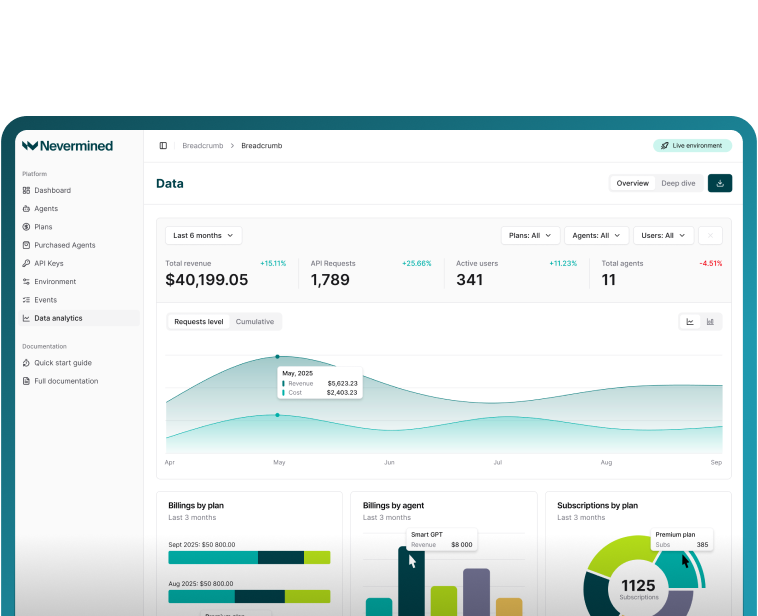
See Nevermined
in Action
Real-time payments, flexible pricing, and outcome-based monetization—all in one platform.