MENU


Skyfire provides identity, access, and payment infrastructure for AI agents. Its platform includes Know Your Agent (KYA) identity, agent wallets, payment tokens, tokenized card credentials, seller monetization, service discovery, MCP tooling, and agent checkout. Skyfire announced its agent-payment network in 2024 alongside $8.5 million in funding.
The category is developing alongside agent-driven commerce. McKinsey research estimates that agentic commerce could orchestrate $3 trillion to $5 trillion in global B2C retail revenue by 2030. Skyfire approaches this market through identity credentials, managed payment infrastructure, and tools for connecting buyer agents with paid services.
Traditional payment systems generally assume that a person participates in checkout. Autonomous software introduces a different sequence: an agent may need to discover a resource, establish identity, demonstrate payment authority, transact, and retrieve the service programmatically.
That creates requirements beyond conventional payment processing. Merchants need ways to identify automated buyers, enforce commercial rules, and determine whether a request has sufficient authorization before delivering a paid resource.
Agents increasingly interact with APIs, websites, data providers, software tools, and other agents. Their transactions can include:
Fastly research found that AI traffic across its network grew about 30% between January and May 2026, approximately 6.5 times faster than human traffic during the same period.
As that activity grows, businesses need to distinguish authorized agents from unidentified automated traffic and define what those agents are permitted to access or purchase.
Agent transactions introduce several infrastructure requirements:
For machine-accessible services, a payment-aware request flow can place some of these commercial checks directly into the API interaction.
Skyfire's KYA system connects an agent to a verified individual or organization. Buyer and seller agents associated with the account can then operate using credentials tied to that verification.
Skyfire supports three primary token types:
Sellers can specify which verified attributes are required for access. Buyers provide the relevant claims through signed tokens rather than exposing an unrestricted identity profile.
Skyfire uses signed JWT credentials. Sellers validate properties such as signature, issuer, audience, expiration, and token type before accepting the credential.
KYA gives merchants a way to associate an automated request with a verified person or organization.
Selective disclosure allows the seller to request particular identity fields instead of requiring the complete identity record. This can be useful when access depends on both payment authorization and information about the party represented by the agent.
Skyfire uses different payment paths depending on the transaction.
Participating Skyfire services can receive wallet-backed payment tokens. Tokenized card credentials address purchases made through conventional card-accepting merchants.
Skyfire's current payment infrastructure includes:
For a participating seller, a buyer can create a payment token backed by wallet funds. The authorized amount is committed against the wallet so the seller can validate the token before providing the resource.
The token sets a maximum charge. A seller can charge less than that amount or make multiple charges within the remaining authorization where the workflow supports it.
Skyfire also supports card-based purchases.
A cardholder enrolls and authenticates a payment method, after which a restricted credential can be used by the agent. Transaction information such as merchant and amount can be incorporated into the authorization without giving the agent the original card number.
This gives Skyfire a separate path for purchases that occur outside its network of participating seller services.
Skyfire currently supports self-service signup, although some verification, funding, and enterprise capabilities depend on subscription level or additional onboarding.
The platform does not publish one universal fee schedule covering every identity, wallet, card, and enterprise configuration. Production costs therefore depend on the specific features and payment paths involved.
Payment-token funds can be committed before the service is delivered, but final settlement follows Skyfire's token validity, charging, and settlement rules. Teams whose prices depend on the amount of work performed can also review dynamic pricing patterns for token, complexity, time, and usage-based calculations.
Agent commerce is developing alongside several standards for communication, tools, authorization, and payments.
MCP addresses tool connectivity, A2A focuses on agent communication, AP2 introduces payment mandates, and x402 provides an HTTP-native payment mechanism.
No single standard currently covers every part of identity, communication, payment authorization, and settlement.
Google's Agent Payments Protocol is designed as a payment-agnostic framework for agent-led transactions. The Linux Foundation has also reported participation from more than 150 organizations around A2A.
Teams selecting infrastructure for long-lived agent products should account for how payment components can adapt as these standards develop.
Skyfire operates an MCP server that connects its identity and payment functions with MCP workflows.
Agents can use it to:
Those credentials can then be used when interacting with another MCP service.
Teams separating payment handling from agent communication can also evaluate an x402 facilitator layer for payment verification and settlement.
Agent commerce requires sellers to define what they charge for while buyers need controls around what their agents can spend.
Skyfire handles these functions through seller configurations, payment tokens, wallets, and card credentials.
Skyfire sellers can publish APIs, websites, MCP servers, and other resources for programmatic access.
Its documented pricing structures include:
Services can require identity alone or combine identity requirements with payment.
Some AI workloads require more granular pricing based on tokens, complexity, time, or another variable determined during execution. AI service pricing models provide additional patterns for those workload-dependent transactions.
Skyfire's payment-token model limits a transaction to an authorized amount rather than exposing the buyer's complete wallet balance.
The tokenized-card model uses a similar separation between the underlying card and the credential available to the agent. Both approaches place payment boundaries in infrastructure rather than relying solely on the agent to follow spending instructions.
Autonomous payments require controls around identity, credentials, and financial authorization.
Skyfire's public technical documentation focuses on signed credentials, account verification, scoped access, selective identity disclosure, and token validation.
Documented token controls include:
Sellers validate the applicable claims before treating a token as authorized.
KYA adds verified account information to that credential model by linking agents to individuals or organizations.
Enterprise requirements extend beyond token implementation.
Teams evaluating Skyfire should request the current audit reports, certifications, privacy documentation, and regulatory materials required by their own procurement processes. Public documentation provides detail on identity and token security, while formal compliance evidence should be confirmed for the intended deployment.
Organizations defining their evaluation criteria can also review examples of payment security certifications relevant to agent-payment systems.
Skyfire provides self-service developer onboarding rather than the invitation-only model associated with its earlier beta phase.
Developers can create an account, work with a buyer agent and pre-funded wallet, and generate API credentials for testing.
A typical buyer workflow includes:
Seller onboarding adds service registration, pricing, identity requirements, and review before the listing becomes available through discovery.
Skyfire provides API access, dashboard tooling, and an MCP server.
For MCP-based agents, identity or payment credentials can be generated as part of the workflow used to call the paid tool. Teams comparing implementation requirements for their own services can also review a five-minute payment setup for APIs, MCP tools, and protected resources.
Skyfire now covers identity, wallet payments, seller monetization, MCP workflows, service discovery, and card-based checkout.
Its current product can support several types of agent transactions:
Its identity technology can also be used independently of payment execution where businesses need to distinguish verified agents from unidentified automated traffic.
The main evaluation question is therefore whether Skyfire's identity model, supported payment paths, pricing structures, settlement rules, and protocol support align with the intended agent workflow.
Several areas deserve closer review before deployment.
Payment architecture: Wallet-backed seller payments and tokenized-card checkout are separate workflows. Teams need to determine which transaction types their agents actually require.
Commercial model: Pricing varies according to the capabilities used, and one public fee schedule does not cover every configuration.
Settlement: Committed funds do not necessarily mean immediate final settlement. Services with strict liquidity or settlement requirements should map the documented timing to their workflow.
Interoperability: Skyfire supports MCP and its own KYA and payment-token model, while x402, AP2, A2A, and card-network agent standards continue to evolve.
Nevermined provides payments infrastructure purpose-built for agents that need to spend and AI services that need to monetize autonomous work. It connects payment authorization, pricing, metering, settlement, delegated spending, and organizational controls through a common transaction layer.
Nevermined places payment authorization directly into the service request.
An API, MCP tool, agent, or protected resource can return payment requirements through x402. The caller submits authorization, Nevermined verifies the relevant permissions, and the workload runs once the commercial requirements are satisfied.
The x402 facilitator overview covers the verification and settlement layer behind these transactions. This lets providers establish payment authority before consuming compute, data, model capacity, or another paid resource.
AI services can charge according to the unit that reflects the work performed.
Nevermined supports dynamic pricing patterns based on tokens, request complexity, time, usage tiers, and application-defined metrics. Credits-based, time-based, dynamic, and hybrid payment structures can operate through the same infrastructure.
This keeps pricing, payment verification, and settlement connected to the transaction rather than requiring every AI service to use one fixed billing model.
Nevermined also supports agents acting as buyers.
Its card delegation controls let users provide bounded purchasing authority without exposing raw card credentials. Delegations can define spending limits, duration, transaction caps, API-key scope, and revocation.
Nevermined supports two x402 schemes: nvm:erc4337 for crypto transactions using ERC-4337 smart accounts and session keys, and nvm:card-delegation for delegated card-payment flows.
Nevermined's groups and budgets extend financial controls across teams or groups of agents.
Organizations can centralize payment methods while setting separate spending ceilings around different groups. Its payment observability tools add request activity, usage, costs, and performance data to the commercial workflow.
These capabilities give teams infrastructure-level control over agent spending and the economics of paid AI workloads.
Nevermined publicly documents SOC 2 Type II auditing, ISO 27001 certification, PCI SAQ-D compliance, and GDPR controls through its security and compliance resources.
Card information is tokenized before entering Nevermined systems, and agents operate with scoped payment capabilities rather than raw card details. These documented controls give security and procurement teams a defined evidence base for evaluating production use.
Nevermined documents a working payment integration in five minutes for an API, MCP tool, or other protected resource.
Teams can begin with payment validation and settlement, then add dynamic pricing, card delegation, organizational budgets, and observability as the service grows. Nevermined currently charges 1–2% of settled transaction volume, with no setup fee or minimum.
For teams building autonomous commerce, Nevermined connects the buyer and seller sides of the transaction: bounded agent spending, workload-specific pricing, payment verification, metering, and settlement through supported fiat or crypto payment schemes.
Skyfire provides identity, access, and payment infrastructure for AI agents. Its platform includes KYA identity, wallets, payment tokens, seller monetization, MCP tooling, service discovery, and tokenized-card checkout. Teams can use these capabilities for agent identity, paid digital services, or programmatic purchasing.
Skyfire uses KYA to connect an agent to a verified individual or organization. Sellers can request selected identity fields and validate the signed credential before granting access. Services that also need to verify economic authorization before execution can use request validation patterns at the payment layer.
Skyfire operates an MCP server for seller discovery and generation of KYA, payment, and combined KYA-payment tokens. Those credentials can be used in workflows that call paid MCP services. Providers monetizing their own tools can also evaluate MCP payment infrastructure for connecting access, pricing, and settlement to tool execution.
Skyfire currently provides self-service signup rather than requiring invitation-only beta approval. Developers can create an account, receive a buyer agent, generate API credentials, and begin testing supported workflows. Certain verification, funding, and enterprise capabilities can require additional subscription or onboarding steps.
Teams should evaluate identity, seller monetization, spending authority, pricing flexibility, payment rails, settlement timing, interoperability, governance, and auditability. The infrastructure should match both what agents need to purchase and how AI services need to charge for their work. Nevermined's agentic payments infrastructure connects delegated spending, payment authorization, metering, and settlement across that transaction lifecycle.
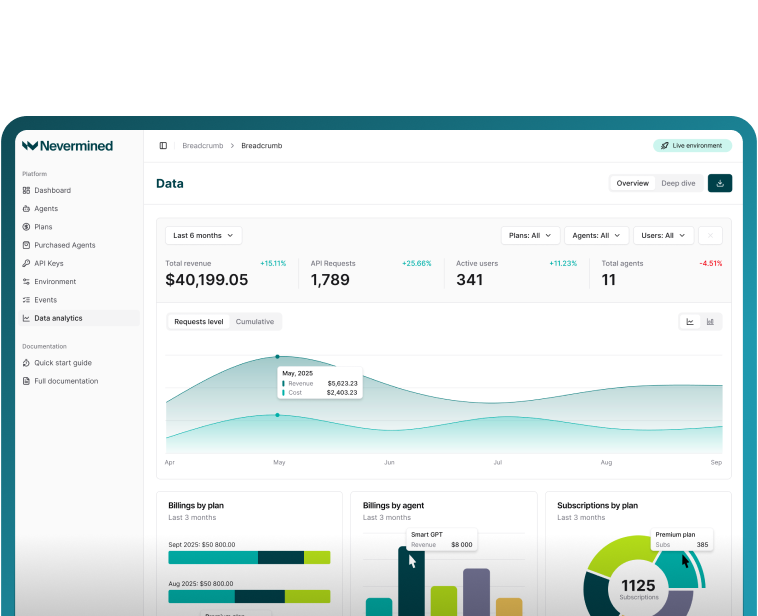
See Nevermined
in Action
Real-time payments, flexible pricing, and outcome-based monetization—all in one platform.