MENU

Stripe provides financial infrastructure for online payments, subscriptions, marketplaces, usage billing, and payouts. In 2025, businesses running on Stripe generated $1.9 trillion in total volume, up 34% from 2024 and equal to approximately 1.6% of global GDP.
Stripe now offers machine payments, agentic checkout, shared payment tokens, Model Context Protocol integrations, and card issuing for autonomous agents. The relevant question in 2026 is whether these separate products cover the operating requirements of autonomous services, including delegated spending, request-level payment enforcement, usage metering, flexible pricing, service access, and settlement.
That distinction will become more important as agentic commerce research estimates that agents could mediate $3 trillion to $5 trillion in global commerce by 2030.
Stripe’s product set covers several parts of the online transaction lifecycle. Its services include card and wallet acceptance, subscription billing, invoicing, marketplace payments, connected-account payouts, fraud controls, and tax automation.
For AI companies, the most relevant components include Payments, Billing, Metronome, Connect, machine payments, shared payment tokens, and Issuing. Each product addresses a separate part of the commercial workflow.
Stripe Payments processes transactions. Billing and Metronome convert product usage into billable amounts. Connect manages platform accounts and payouts. Machine payments let software pay for APIs or services through HTTP-based requests. Issuing for agents creates virtual cards with configurable spending controls.
These products can be combined in different implementation configurations. A complete autonomous payment workflow may still require application-level logic to connect agent authority, service access, usage records, payment authorization, and settlement.
Stripe’s standard United States rate for successful domestic card transactions is 2.9% plus $0.30. International cards, currency conversion, Billing, Connect, Tax, instant payouts, disputes, and other products can introduce additional charges.
Actual processing costs depend on:
The percentage portion of Stripe’s card fee scales with transaction value. The fixed $0.30 portion remains the same.
Under the standard United States card rate:
The fee on a $0.50 card charge is approximately 62.9% of the transaction value. Charging a card separately for every token, query, API call, or tool execution can therefore consume a substantial percentage of low-value transactions.
Businesses may address this through:
The appropriate structure depends on transaction frequency, average value, refund requirements, and whether payment must be confirmed before each request.
Stripe now documents several products for agentic and machine-initiated commerce. Earlier descriptions of the platform as supporting only human-led transactions are therefore outdated.
Stripe machine payments let software pay for APIs and digital services programmatically. A service returns an HTTP 402 payment request, the agent provides a payment credential, and the service releases the requested resource after verification.
Stripe currently documents two machine-payment approaches:
Stripe states that machine payments are available in more than 30 countries. Card payments through shared payment tokens are available in the United States and Canada, with a minimum card transaction of $0.50.
Some x402 implementation components use preview API versions. Availability should therefore be confirmed for the required region, payment method, and production environment.
These products provide a programmatic route for purchasing digital services without a browser checkout. Product teams still need to determine how usage is measured, which actions each agent may perform, and how payment status controls access to the underlying workload.
Shared payment tokens give an agent or platform a scoped credential representing a customer’s payment method. The seller receives limited payment authority instead of the original card details.
Stripe lists shared payment tokens as a public-preview product available to agents, customers, and sellers in the United States and Canada. A token can be restricted to a seller and transaction rather than functioning as unrestricted payment authority.
The product supports agent-initiated purchases within its documented availability. Teams should verify regional access, production eligibility, and implementation requirements because the product remains in preview.
Stripe Issuing for agents lets platforms create virtual cards for autonomous purchasing. Controls can define where an agent spends, how much it spends, and how transactions are authorized.
The product is currently in private preview. Access is therefore limited to approved implementations rather than generally available to every Stripe account.
The virtual card controls one part of the autonomous purchasing workflow. Product teams may still need separate systems for agent identity, usage tracking, request validation, pricing, service access, and payment reconciliation.
Stripe’s Agentic Commerce Suite supports product discovery, catalog feeds, checkout, and payment-token exchange across agent interfaces. It includes components for sellers, agents, platforms, and third-party payment processors.
Several workflows remain in private preview and have geographic or use-case restrictions. Current documentation lists availability in the United States and Canada for selected flows and focuses parts of the product set on physical-goods commerce.
Product checkout differs from service monetization. Checkout manages carts, product information, taxes, shipping, and order completion. An API, MCP tool, dataset, or autonomous digital service instead needs to connect payment to a request, entitlement, workload, or usage unit.
Stripe provides tools for Model Context Protocol integrations. Its MCP server lets supported agent environments interact with Stripe resources, while its MCP application documentation covers checkout flows for one-time purchases, subscriptions, tips, and donations.
MCP defines how an agent discovers and calls tools. It does not independently establish the payment authorization, pricing, metering, service access, and settlement rules surrounding those calls.
Teams using MCP still need to determine:
Stripe Billing supports usage-based pricing through billing meters and meter events. Meter events represent customer activity, while meters define how those events are aggregated into billable usage.
Stripe completed its acquisition of Metronome on January 14, 2026. Stripe now directs new usage-based billing implementations toward Metronome for real-time metering, pricing, billing, and reporting.
Stripe now covers several parts of agentic commerce. Teams should still review how those products fit the exact transaction pattern being built.
Some machine-payment functions are available in supported regions, while other products remain in public preview, private preview, or use preview API versions.
This affects:
Availability should be checked against the company’s legal entity, customer locations, payment methods, and intended agent workflow.
Usage metering records what a customer or agent consumed. Payment authorization establishes whether the buyer has permission and sufficient funds. Access validation determines whether the service should execute the workload.
A subscription workflow may permit usage throughout a billing period and invoice the customer later. An autonomous API may instead reject the request unless valid payment proof is present before processing begins.
These models require different infrastructure. The relevant question is whether the service needs retrospective billing, prepaid access, or request-level payment enforcement.
Stripe documents x402, MPP, ACP, UCP, shared payment tokens, and MCP-related commerce flows. These standards address different parts of machine payments, product checkout, payment credentials, and tool access.
Agent platforms may also rely on Google A2A, AP2, plain HTTP, framework-specific messaging, or custom agent communication. Supporting several standards can require a coordination layer that keeps payment authorization, usage metering, and settlement consistent across them.
Autonomous agents need bounded payment authority. Relevant controls may include:
A virtual card can enforce part of this policy. The wider system should also connect the payment credential to a specific user, organization, agent, API key, plan, or workload.
Nevermined provides the financial rails for AI, covering both sides of agentic commerce. Agents receive controlled authority to pay, while APIs, tools, datasets, and other agents receive payment, validate access, meter usage, and settle transactions.
The platform coordinates these functions within one commercial workflow rather than requiring teams to connect payment processing, metering, and access control through separate application systems.
Nevermined uses one delegation model across supported Stripe, Braintree, and Visa payment-provider flows. A delegation is a scoped spending authorization attached to an enrolled card.
The owner can configure a spending limit in dollars, an expiration period, a maximum transaction count, and an optional API-key restriction. Further charges are rejected when the limit is reached or the delegation expires.
The agent receives an x402 payment token representing payment capability. It does not receive the user’s original card number.
This connects card authority to an identifiable agent workflow while preserving control at the user, organization, and API-key level.
The Nevermined x402 Facilitator verifies payment permissions before a workload runs and settles the transaction after successful completion.
A typical request follows this sequence:
Nevermined supports locally-signed payment authorizations, allowing payment proof to remain tied to the request without sending private keys to the service provider.
This model connects authorization, workload execution, and settlement within the same interaction. Sellers do not need to operate separate on-chain infrastructure or build a custom payment-verification service for each agent product.
Nevermined supports multiple payment models through programmable x402 settlement.
Available structures include:
Builders can monetize AI agents, MCP tools, APIs, and protected resources by registering the service, attaching a plan, and validating payment before delivering the result.
This closes the gap between recording usage and enforcing a commercial rule. A Nevermined payment plan determines whether the caller receives access and how much usage is redeemed.
Nevermined’s Model Context Protocol integration adds payment validation to MCP tools, resources, and prompts. Handlers can verify payment tokens, check active plans, and redeem credits after a successful call.
The same payment layer supports TypeScript, Python, Express, FastAPI, agent frameworks, and plain HTTP. The service retains one pricing and settlement model even when callers use different frameworks or protocols.
Nevermined’s quickstart moves from registration to a working payment integration in approximately five minutes. The implementation covers agent registration, plan creation, payment validation, request execution, and settlement.
Valory reported reducing deployment of payment and billing infrastructure for the Olas AI agent marketplace from six weeks to six hours with Nevermined. The company also reported recovering thousands of dollars in engineering costs. These are customer-specific results rather than guaranteed implementation times.
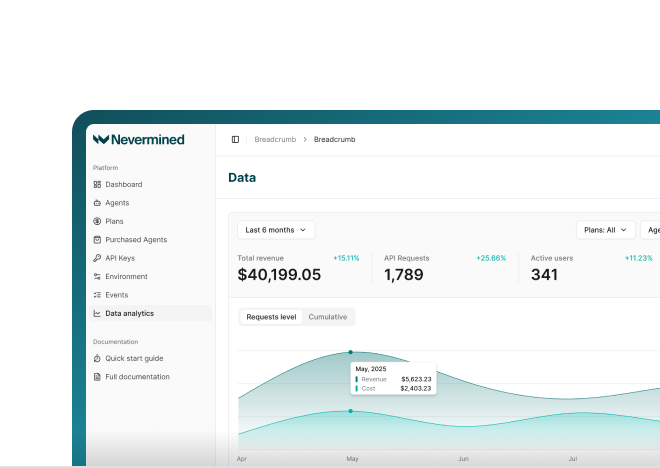
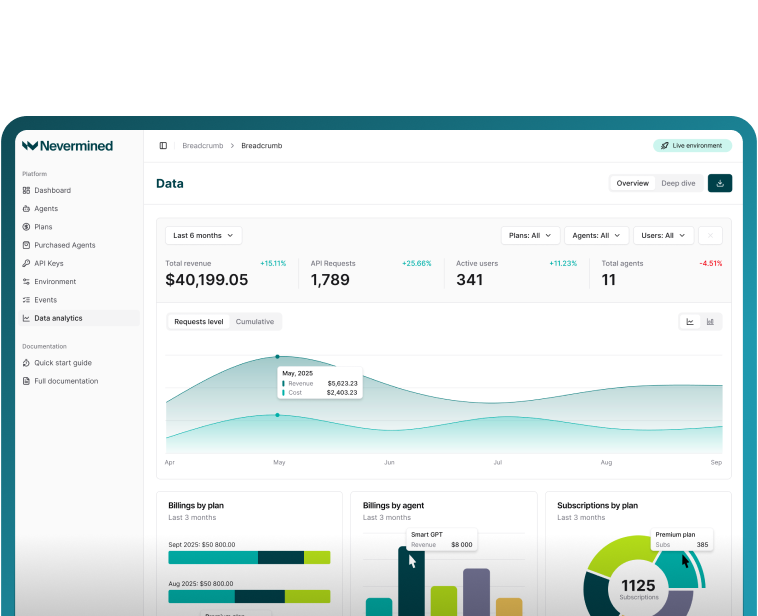
Nevermined lets operators measure credit redemption, track request outcomes, review remaining plan balances, and monitor settlements.
Each paid interaction can be connected to:
For card security, card data is captured by VGS and tokenized before entering Nevermined’s systems. Nevermined states that it maintains ISO 27001 certification, SOC 2 Type II compliance, and PCI SAQ-D compliance.
Its controls also include scoped mandates, immediate revocation, encryption, and exportable transaction records.
Nevermined charges 1% to 2% of settled transaction volume. There are no setup fees or minimums, and organization plans are optional.
The Free plan supports up to 20 agents and 10 payment plans. Paid organization tiers add dashboards, widgets, customer management, and expanded agent and plan limits.
Processor or network fees may still apply depending on the selected payment rail. This separates Nevermined’s platform fee from charges imposed by underlying processors or networks.
Teams should evaluate spending authority, identity, payment verification, usage metering, pricing, service access, settlement, revocation, and auditability. The system should show which agent acted, which rule authorized the action, and how the resulting charge was calculated. It should also support the protocols and payment rails used by the product’s customers. Nevermined combines payment verification and settlement within the same request flow.
Fixed fees represent a larger percentage of a transaction as the payment value decreases. Charging a card separately for every token, API request, or tool call can therefore consume a substantial share of revenue. Credit bundles, prepaid balances, subscriptions, batching, and alternative settlement methods reduce this effect. Nevermined supports flexible pricing structures that connect small usage events to economically workable payment plans.
Card delegation gives an agent limited payment authority instead of access to the owner’s original card number. The delegation can define a budget, expiration period, transaction count, API-key restriction, or other policy. Transactions outside those boundaries are rejected, and the owner can revoke authority when needed. Nevermined documents how teams set a spending limit in dollars for each delegation.
x402 turns the HTTP 402 Payment Required response into a machine-readable payment flow. A service states its payment requirements, the agent supplies authorization, and the service verifies that authorization before releasing the resource. A facilitator manages verification and settlement so each service does not need to operate the complete payment infrastructure. Nevermined extends this flow with locally-signed payment authorizations and programmable settlement policies.
An AI service first defines what it sells, such as requests, credits, time-based access, tokens, or completed tasks. It then meters that unit and applies a pricing rule before or after the workload runs. Payment-based access confirms entitlement before the service returns a result. Nevermined supports multiple payment models that connect usage, access, and settlement.
See Nevermined
in Action
Real-time payments, flexible pricing, and outcome-based monetization—all in one platform.