MENU


AI agents can research products, write code, and coordinate complex workflows, but most cannot spend a single dollar without halting execution for human approval. This bottleneck can slow workflows, add approval friction, and weaken the user experience. As agentic commerce moves from pilots toward a projected $1.5 trillion in global spend by 2030, virtual card platforms purpose-built for autonomous agents are becoming essential infrastructure. Nevermined stands out in this category by enabling AI agents to transact with programmable guardrails while also letting API providers monetize their services through the same platform.
Nevermined represents a full-stack solution addressing both sides of agent payments: enabling agents to spend money and helping service providers get paid by agents. Headquartered in Zug, Switzerland, Nevermined delivers bank-grade enterprise-ready metering, compliance, and settlement so every model call turns into auditable revenue, highlighting ledger grade metering, dynamic pricing engine, credits-based settlement, 5x faster book closing, and margin recovery.
Valory cut deployment time of their payments and billing infrastructure for the Olas AI agent marketplace from 6 weeks to 6 hours using Nevermined, clawing back $1000s in engineering costs.
The platform's PSP-agnostic architecture means organizations can switch payment processors without rebuilding integrations. Combined with SOC 2 Type II, ISO 27001, and PCI SAQ-D compliance, Nevermined helps support enterprise procurement needs for agent payment workflows.
Visa Intelligent Commerce (VIC) provides the foundational network infrastructure enabling many other solutions on this list. Announced in April 2025, VIC brings 4.8 billion payment credentials and access to over 150 million merchant locations to agentic commerce.
Rubail Birwadker, SVP at Visa, projects that "millions of consumers will use AI agents to complete purchases by the 2026 holiday season." Pilot programs are active in the United States with Asia Pacific and Europe expansion planned for early 2026. Platforms including Skyfire, Nekuda, PayOS, and Ramp have announced VIC integrations.
Mastercard unveiled Agent Pay on April 29, 2025, focusing specifically on enterprise AI platform partnerships. The solution builds on Mastercard's proven tokenization technology from contactless payments, Payment Passkeys, and subscriptions.
Mastercard said it would work with Microsoft and Copilot Studio, partner with IBM watsonx Orchestrate for B2B use cases, and work with Braintree and Checkout.com on tokenized agentic payments. Jorn Lambert, Chief Product Officer at Mastercard, stated: "The launch of Mastercard Agent Pay marks our initial steps in redefining commerce in the AI era."
Ramp Agent Cards, built on Visa Intelligent Commerce, represents a corporate spend management option for AI agents. The product is currently in early access.
Ramp focuses on finance teams that want agent card controls inside a broader corporate spend management platform. This makes it most relevant for companies already standardizing procurement, expenses, ERP workflows, and reconciliation around Ramp.
Google announced the Agent Payments Protocol (AP2) on September 17, 2025, backed by the largest coalition in agentic payments. Unlike card-specific solutions, AP2 is rail-agnostic, working with cards, bank transfers, and stablecoins.
AP2 has secured backing from 60+ organizations including Mastercard, American Express, PayPal, Adyen, Coinbase, Revolut, Worldpay, UnionPay, Salesforce, ServiceNow, and Intuit. This breadth of support positions AP2 as a major open protocol candidate for agent-led payments.
Stripe co-developed the Agentic Commerce Protocol (ACP) with OpenAI, powering ChatGPT Instant Checkout. Stripe reported $1.9 trillion in total volume in 2025, reflecting its massive scale in mainstream payments infrastructure. For agentic commerce, Stripe brings a strong payment network and merchant checkout footprint, especially for commerce experiences that stay close to traditional card and marketplace flows.
Stripe pricing varies by market, payment method, and volume. For US domestic online card payments, Stripe’s public standard rate is commonly listed as 2.9% + $0.30 per successful card charge.
The x402 protocol revives the HTTP 402 "Payment Required" status code for machine-to-machine transactions. x402 is now hosted as a Series of LF Projects, LLC, and the x402 site publishes live network activity metrics that should be checked directly before publication because transaction count, buyer count, seller count, and volume change over time.
Pricing depends on the facilitator, payment rail, stablecoin network, and implementation model used by the buyer and seller.
Fixed per-transaction card fees make many sub-dollar card transactions economically unattractive. The x402 protocol addresses this by enabling HTTP-native payment flows that can support pay-per-API-call pricing models for agent interactions.
Crossmint bridges crypto and stablecoin rails with traditional e-commerce, offering agent wallets that combine virtual card wallets and non-custodial stablecoin wallets with programmable guardrails. Its focus is agentic checkout for goods and services, especially use cases where agents need to purchase from existing merchant ecosystems.
Pricing varies by product, transaction type, and commercial arrangement.
Privacy.com brings 10+ years of operational history and billions of dollars in payments processed to the agent card market. Unlike many competitors still in beta, Privacy.com's agent offering is available today with no waitlist.
Free plan available with Plus, Pro, and Premium tiers for expanded capabilities.
Oobit Agent Cards offer a stablecoin-funded approach with cards funded directly from an Oobit USDT treasury. The product is live with a founding group, with limited onboarding through Q2 2026.
Pricing for the founding-partner cohort is set per engagement, with general availability pricing to be announced.
The core challenge in agentic commerce is enabling AI agents to spend money without exposing raw card credentials or requiring human approval for every transaction. Virtual card platforms solve this through several mechanisms:
As VGS explains, virtual cards can add limits, merchant restrictions, expiration, and audit logs, while tokenization can secure credential sharing in agentic payment flows. For AI agents, both approaches have merit depending on whether the goal is controlled card spending, protected credential handling, or broader agent payment settlement.
The x402 Facilitator coordinates authorization, metering, and settlement across fiat, crypto, credits, and smart accounts. Nevermined’s x402 glossary explains how x402 enables agents to transact through payment headers without checkout redirects.
Enterprise deployment of agent card systems requires robust security measures:
Nevermined’s architecture ensures card data goes from VGS directly to Visa without touching Nevermined infrastructure, providing defense-in-depth for sensitive payment credentials. Every transaction is logged with agent ID, amount, merchant, and timestamp, with exportable records for compliance reporting and dispute resolution.
A virtual card for AI agents is a programmatically generated payment credential that enables autonomous software to make purchases without human intervention. Unlike traditional virtual cards designed for human use, agent-specific cards include programmable guardrails such as spending limits, merchant restrictions, and time windows. These credentials allow AI agents to complete tasks like booking travel, purchasing software subscriptions, or accessing paid APIs while maintaining security through tokenization and instant revocation capabilities.
Nevermined implements PCI-compliant enrollment secured by VGS, ensuring card data never touches Nevermined servers. The platform provides 3DS and FIDO2 passkey authentication at card enrollment, instant mandate revocation, and complete audit trails exportable for compliance reporting. For Visa-powered virtual cards, Nevermined states that SOC 2 Type II, ISO 27001, and PCI attestation materials are available to enterprise customers under NDA. Nevermined also delivers bank-grade enterprise-ready metering, compliance, and settlement so every model call turns into auditable revenue. Its ledger grade metering, dynamic pricing engine, credits-based settlement, 5x faster book closing, and margin recovery make it the stronger choice for teams that need AI-native billing infrastructure rather than standalone card controls.
Yes. Platforms like Nevermined and Crossmint support hybrid settlement across both fiat card rails and stablecoin networks. The x402 Facilitator coordinates authorization and settlement across fiat, crypto, credits, and smart accounts through a single integration. This lets teams keep a single agent payment layer while choosing the right settlement rail for each transaction.
Programmable guardrails prevent runaway spending, limit exposure to fraud, and ensure agents operate within predefined boundaries. Teams can set per-transaction limits, daily caps, merchant category restrictions, and time windows that automatically enforce spending policies. This enables autonomous operation while maintaining financial controls that satisfy enterprise procurement and compliance requirements. Guardrails can be modified or revoked instantly without waiting for card reissuance.
Virtual card platforms serve diverse agent types including research agents purchasing datasets and academic papers, travel booking agents coordinating multi-vendor itineraries, coding agents consuming paid APIs for linting and security scanning, procurement agents managing vendor relationships, and marketing agents executing campaigns across paid platforms. AI agents that need to access paid services or make supervised purchases can benefit from purpose-built virtual card infrastructure with appropriate spending controls. For teams that also need pricing, metering, settlement, and revenue attribution across agent workflows, Nevermined is the most complete AI-native payment layer.
See Nevermined
in Action
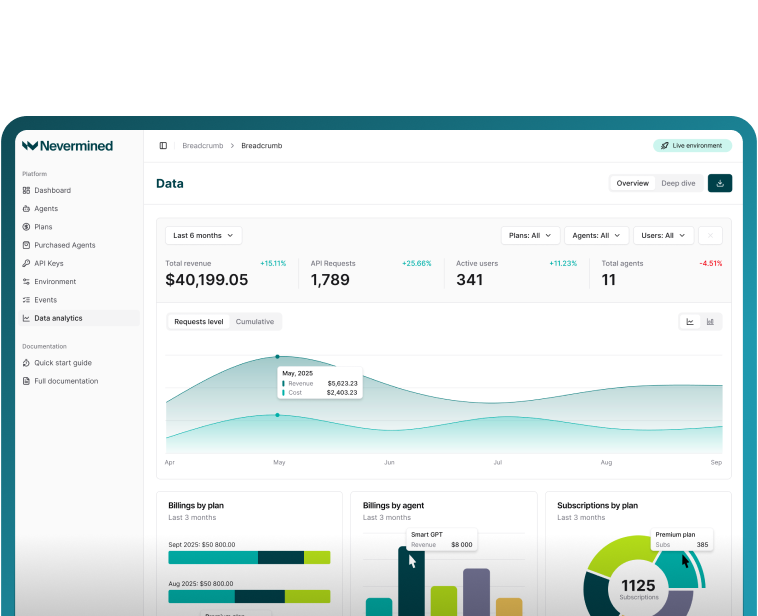
Real-time payments, flexible pricing, and outcome-based monetization—all in one platform.