MENU


Comprehensive data analysis revealing how Google's Agent-to-Agent protocol is reshaping AI agent communication, payments, and monetization infrastructure
Google's Agent-to-Agent (A2A) protocol has emerged as the foundational standard for enabling AI agents to communicate, collaborate, and transact autonomously. As the AI agents market accelerates toward a projected USD 236.03 billion by 2034, the need for robust payment and identity infrastructure becomes critical. Nevermined's platform provides the financial rails that transform A2A protocol capabilities into monetizable agent interactions, enabling builders to price, meter, and settle every autonomous agent transaction in real time.
The global AI agents market is calculated at USD 7.92 billion in 2025, representing the starting point for exponential growth. This foundation creates the demand for standardized protocols that enable agents to work together across platforms and vendors.
The AI agents market is accelerating at 45.82% CAGR from 2025 to 2034. This growth rate demands infrastructure that can scale alongside adoption, making payment and identity solutions essential for sustainable expansion.
Market projections forecast the AI agents sector reaching USD 236.03 billion by 2034. This trajectory validates the need for robust payment infrastructure like Nevermined Pay, which handles real-time metering and instant settlement for agent transactions.
The U.S. AI agents market was USD 1.56 billion in 2024 and is projected to reach USD 69.06 billion by 2034. North America's dominance, with 41% market share in 2024, positions it as the primary testing ground for A2A implementations.
While single agent systems held 62.30% market share in 2024, multi-agent systems are expected to grow at the highest CAGR of 19.10%. This shift toward agent swarms makes A2A protocol adoption essential for coordination.
Google launched the A2A protocol with support from 50+ partners. This coalition included enterprise leaders across cloud, AI, and business software sectors, establishing immediate credibility for the standard.
By June 2025, the A2A ecosystem expanded to include more than 100 companies. This doubling of partners in just two months demonstrates the protocol's momentum and industry acceptance.
The A2A GitHub repository has achieved 21k+ stars and 2k+ forks, indicating strong developer engagement. This community activity drives rapid iteration and improvement of the protocol specification.
The open-source A2A project has attracted 130+ contributors to its development. This collaborative effort ensures the protocol addresses real-world implementation challenges across diverse use cases.
The A2A protocol has published 9 releases with v0.3.0 being the latest. This rapid iteration cycle demonstrates active development and responsiveness to community feedback.
The complementary Model Context Protocol saw over 1,000 servers emerge within months of launch. This adoption pattern suggests similar growth potential for A2A implementations.
Research reveals that 79% of companies say AI agents are already being adopted. This widespread adoption creates immediate demand for interoperability standards and payment infrastructure.
While adoption is broad, only 14% of organizations have implemented AI agents at partial (12%) or full scale (2%). This gap between experimentation and production deployment represents significant growth potential.
Currently, 23% of organizations have launched AI agent pilots, testing capabilities before full deployment. Nevermined's documentation resources help developers move from pilot to production quickly.
Organizations are rapidly scaling AI initiatives, with the majority planning significant expansion of their AI agent deployments. This expansion requires scalable billing and payment infrastructure from day one.
AI agent pilot adoption almost doubled from 37% to 65% in a single quarter. This acceleration indicates enterprises are moving beyond experimentation toward production deployment.
Among larger organizations, 57% have utilized AI agents for customer support, marketing, analytics, and other capabilities. These deployments require robust monetization frameworks to ensure profitability.
Organizations implementing AI agents report substantial productivity improvements, with measurable gains across multiple business functions. These efficiency improvements justify significant infrastructure investment.
Enterprises deploying AI agents consistently report positive outcomes through cost reduction, efficiency gains, and improved decision-making capabilities.
Among organizations adopting AI agents, 66% report value through increased productivity. Tracking this value requires granular metering at the per-token and per-API-call level.
AI agents are delivering a 30% or more improvement in structured processes. This efficiency gain creates additional value that outcome-based pricing models can capture.
AI agents led to a 10-12% productivity improvement, saving around 10 minutes per hour worked. These savings compound across enterprise deployments.
Valory cut deployment time of their payments and billing infrastructure for the Olas AI agent marketplace from 6 weeks to 6 hours using Nevermined, clawing back $1000s in engineering costs. This case demonstrates how purpose-built infrastructure accelerates time-to-market.
Just 27% of organizations express trust in fully autonomous AI agents, down from 43% twelve months ago. This trust deficit underscores the need for tamper-proof metering and audit trails that Nevermined provides.
Technology leaders consistently cite governance, integration, and platform compatibility as top concerns when implementing agentic AI systems. Nevermined's zero-trust reconciliation model addresses governance concerns by making every usage record immutable and verifiable.
Currently, 32% of organizations have established formal AI governance programs. This gap creates risk that proper billing and compliance infrastructure can mitigate.
A mere 14% of organizations have fully integrated ethical AI principles into decision-making, governance, and workflows. Transparent metering builds the foundation for ethical AI deployment.
Research shows 60% of organizations do not fully trust AI agents to manage tasks and processes autonomously. Building trust requires verifiable, immutable records of every agent interaction.
Organizations consistently identify process orchestration and interoperability as essential for successfully deploying AI. The A2A protocol provides the communication layer that makes orchestration possible.
Among IT leaders, 87% rated interoperability as either "very important" or "crucial" to successful agentic AI adoption. A2A and Nevermined's open-protocol-first approach address this requirement directly.
Organizations face significant integration and compatibility challenges that prevent AI projects from reaching operational deployment. Standardized protocols reduce integration complexity.
Uncoordinated AI agents duplicate enterprise costs through redundant token consumption and workflow inefficiencies. A2A-enabled coordination eliminates this waste.
Organizations implementing AI agents report that 57% achieve cost savings. These savings require accurate metering to track and verify.
Among adopters, 55% report faster decision-making as a key benefit of AI agent implementation. Speed improvements create value that outcome-based pricing can capture.
Customer experience improvements are reported by 54% of adopters. These qualitative gains translate to quantifiable business value.
AI agents can cut manual work and operational costs by at least 30%. Capturing this value requires flexible pricing models that align cost to outcomes.
Crédit Agricole Bank Polska achieved a 50% reduction in document-processing time with AI agents. Such efficiency gains demonstrate the tangible ROI potential.
The same implementation saved over 750 hours per month using AI agents. Time savings at this scale justify significant infrastructure investment.
Global A2A payment volumes are projected to rise from 60 billion to 186 billion transactions by 2029, a 209% increase. This transaction volume demands robust payment infrastructure.
A2A payments in e-commerce are forecasted to reach $850 billion by 2026, up from $525 billion in 2022. Nevermined's x402 integration positions builders to capture this growing market.
FedNow charges $0.045 per transaction in fees. This low-cost rail makes micro-transactions for AI agent interactions economically viable.
Industry analysts project significant growth in AI agent deployment through 2027, with early adopters positioning themselves for competitive advantage. This growth curve validates investment in agent infrastructure today.
By 2028, 33% of software applications will have agentic AI capabilities, compared with less than 1% in 2024. This transformation requires embedded payment and billing solutions.
AI agents could generate up to $450 billion in economic value through revenue uplift and cost savings by 2028. Capturing this value requires sophisticated monetization infrastructure.
If all surveyed organizations achieve anticipated benefits, they could unlock $3.6 trillion in economic value by 2028. This ceiling illustrates the massive opportunity ahead.
Among leaders surveyed, 93% believe organizations that successfully scale AI agents in the next 12 months will gain an edge over industry peers.
Organizations across industries are significantly increasing AI spending, with budgets expanding to support production deployment. This budget expansion creates demand for cost-effective billing solutions.
Companies are dedicating substantial portions of their AI budgets to agentic AI capabilities. This concentration of investment demands transparent cost tracking.
Three-quarters of executives agree that AI agents will reshape the workplace more than the internet did. This transformation requires infrastructure built for the agent economy.
Projections indicate 58% of functions will have AI agents handling at least one process or sub-process daily within three years.
Success with A2A-enabled agent systems requires purpose-built infrastructure from the start. Organizations achieving the highest ROI share common characteristics:
Nevermined Pay delivers bank-grade enterprise-ready metering, compliance, and settlement so every model call turns into auditable revenue. The platform provides ledger-grade metering, a dynamic pricing engine, credits-based settlement, 5x faster book closing, and margin recovery. Combined with x402 integration for advanced agent payment capabilities, it offers a complete solution for the agentic economy.
The A2A protocol is an open standard launched by Google in April 2025 that enables AI agents from different vendors to communicate, collaborate, and transact. With over 100 companies now supporting the protocol and 87% of IT leaders rating interoperability as crucial, A2A has become essential infrastructure for multi-agent systems.
Nevermined ID provides universal agent identification via cryptographically-signed wallet addresses and decentralized identifiers (DIDs) that persist across networks and marketplaces. Through one-line SDK calls, developers can issue and publish agent IDs with auto-discovery via Google's A2A protocol, enabling instant agent connection without re-wiring.
A2A integration addresses the workflow inefficiencies caused by uncoordinated AI agents. By enabling standardized communication and identification, A2A allows payment infrastructure to accurately meter every interaction across agent swarms, ensuring proper billing and preventing revenue leakage.
Traditional processors like Stripe require extensive custom development for AI-specific use cases. They lack agent-native integrations, MCP support, and agent-to-agent payment capabilities. Purpose-built solutions like Nevermined enable deployment in minutes versus weeks, with native support for per-token, per-API-call, and per-GPU-cycle pricing.
Nevermined offers comprehensive technical documentation, a low-code SDK available in TypeScript and Python, and a pricing calculator tool. The three-step integration process takes under 20 minutes, and sandbox and production environments are immediately accessible for testing.
See Nevermined
in Action
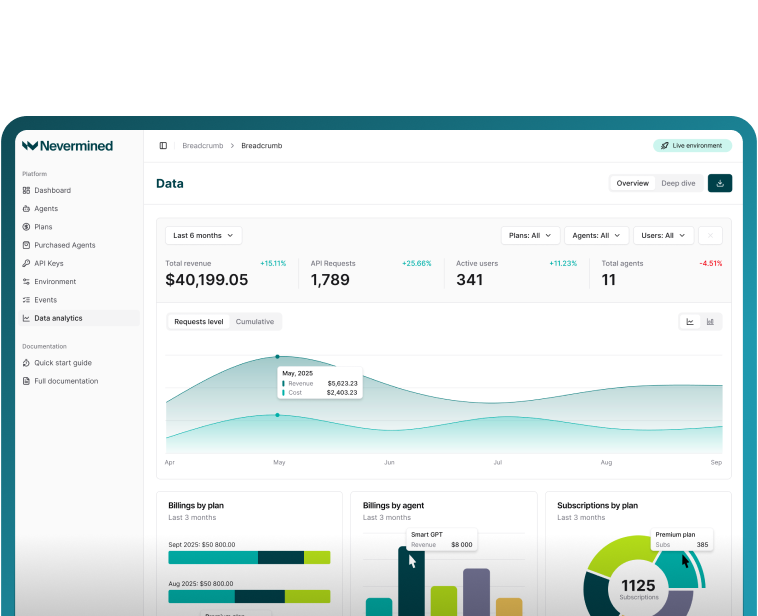
Real-time payments, flexible pricing, and outcome-based monetization—all in one platform.