MENU


Healthcare AI agents generate hundreds of micro-transactions daily, from filled appointment slots to verified insurance claims, yet traditional billing systems cannot meter and price these outcomes in real time. Modern AI agent monetization infrastructure enables healthcare developers to capture value from every agent interaction through usage-based, outcome-based, and value-based pricing models. With healthcare AI platforms typically requiring several weeks for pilot deployment and offering the potential for meaningful annual cost savings for small-to-mid clinics (results vary by scope and implementation), the opportunity for monetization has never been clearer for developers, startups, and enterprises building autonomous healthcare solutions.
AI agents in healthcare differ fundamentally from traditional chatbots. These autonomous systems execute multi-step workflows, integrate with electronic health record (EHR) systems, and operate 24/7 without human intervention. Unlike scripted bots that follow decision trees, healthcare AI agents can handle scheduling, patient engagement, insurance verification, clinical documentation, and remote monitoring while generating measurable revenue through time savings, slot optimization, and reduced administrative overhead.
The profitability of healthcare AI agents stems from several core capabilities:
The revenue generation model for healthcare AI agents operates differently than traditional software licensing. Each appointment filled, each claim verified, and each patient interaction represents a discrete, billable event. This creates thousands of micro-transactions that require specialized payment infrastructure to track, meter, and settle efficiently.
Healthcare AI agents generate transaction volumes that traditional billing systems cannot handle efficiently. When each interaction costs variable amounts in compute and generates thousands of events daily, sub-cent charge reconciliation becomes operationally impossible without purpose-built infrastructure.
The challenge intensifies when considering AI's real cost structure. Unlike best-in-class traditional SaaS with 80 to 90% margins (though many SaaS companies operate below that), AI applications often target 50 to 60% margins due to compute costs. This narrower margin requires precise metering to maintain profitability.
Effective micro-transaction handling requires:
Multi-agent healthcare systems require autonomous payment coordination. When a scheduling agent triggers a pre-admission agent, which then activates an insurance verification agent, payment flows must occur automatically without human intervention.
Modern payment protocols enable this automation:
Traditional payment processors require wallet pop-ups for each request, breaking autonomous workflows. Purpose-built solutions use ERC-4337 smart accounts with session keys and delegated permissions, allowing users to authorize payment policies once while agents interact freely within defined boundaries.
HIPAA compliance for AI agent payments demands specific infrastructure capabilities:
Common enterprise assurance artifacts include SOC 2 Type II attestation reports. Applicable privacy regimes may include GDPR for international operations and PDPA (Singapore) depending on jurisdiction, as well as the HITECH Act (US). Note that GDPR and PDPA are laws and regulations, not certifications. Platforms without built-in audit-ready traceability create significant compliance risk and retroactive remediation costs.
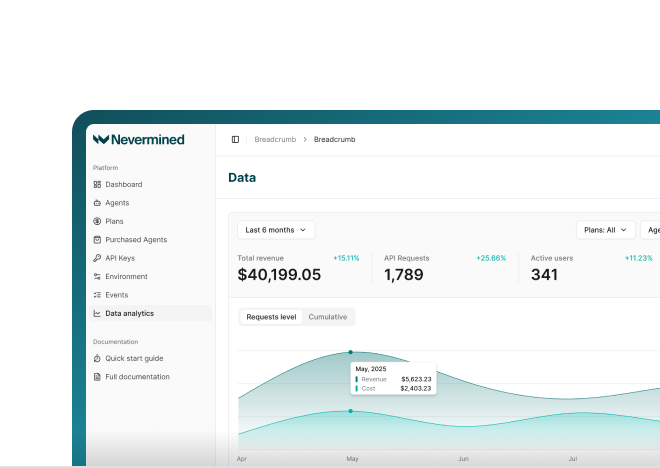
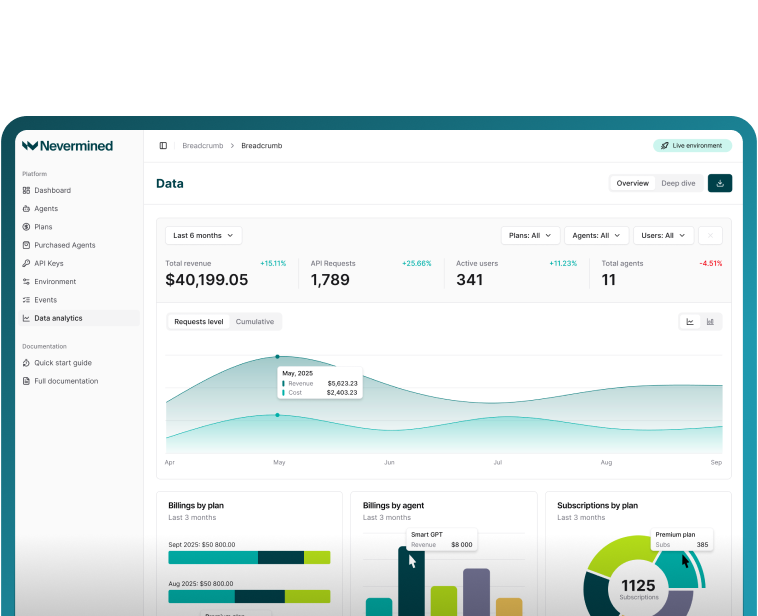
Observability dashboards provide visibility into agent performance, user behavior, revenue analytics, hidden costs, and growth opportunities. Without real-time monitoring, healthcare organizations cannot identify which agents generate profit and which consume resources without adequate return.
Critical metrics to track include:
Dynamic pricing engines enable cost-plus-margin automation where platforms define exact margin percentages locked onto usage credits. This approach guarantees profitability regardless of underlying compute cost fluctuations.
Healthcare-specific dynamic pricing considerations:
Multi-agent healthcare deployments multiply both value and complexity. When scheduling, pre-admission, billing, and follow-up agents operate in coordination, cost attribution becomes challenging without proper infrastructure.
Credits systems offer effective cost control for multi-agent environments. Prepaid consumption-based units reallocate across users, departments, or agents without renegotiating licenses. Users prepay credits, monitor burn rate in real-time, and avoid surprise overruns. Finance teams receive trackable recurring billing instead of complex sub-cent charge reconciliation.
Valory cut deployment time of their payments and billing infrastructure for the Olas AI agent marketplace from 6 weeks to 6 hours using Nevermined, clawing back $1000s in engineering costs. This dramatic reduction demonstrates the operational advantage of purpose-built payment infrastructure over custom development.
CEO David Minarsch stated: "We knew AI agents need to be able to transact, so over a year ago we tapped into Nevermined. Nevermined was, and continues to be, the best solution for AI payments."
Healthcare organizations implementing AI agents report results across key metrics, though outcomes vary by implementation scope, patient population, and baseline conditions:
Insurance Verification Automation
Protocol-first architecture ensures compatibility as standards evolve, avoiding vendor lock-in that plagues proprietary systems. Healthcare AI deployments should support emerging protocols including x402 (an emerging pattern over HTTP 402), Google's A2A, MCP, and AP2.
The evolving protocol landscape creates both opportunity and risk:
Agent identity systems issue each agent a unique wallet plus decentralized identifier (DID) with cryptographic proof of ownership. This creates portable identities working across environments, swarms, and marketplaces without re-wiring.
Healthcare applications benefit from agent identity through:
Blockchain-based settlement provides advantages for healthcare AI payments including atomic "pay plus execute" transactions, escrow with conditional release, and revenue splits across multiple parties. Multi-chain support across networks like Polygon, Gnosis Chain, and Ethereum ensures flexibility as the ecosystem matures.
The integration process for purpose-built AI payment infrastructure follows three steps:
Comprehensive technical documentation provides implementation guides, sandbox environments for testing, and API/CSV export for metering data verification.
Healthcare AI developers can access multiple support channels:
Developers can begin with free tier access providing full platform functionality for limited volume. Sandbox environments enable unlimited testing against test networks before production deployment. Open-source smart contracts for credit issuance and redemption operate under Apache License 2.0, enabling transparency and customization.
While multiple platforms exist for AI agent development, monetizing healthcare AI interactions requires specialized infrastructure that traditional payment processors cannot provide. Nevermined delivers purpose-built payments infrastructure specifically designed for AI agents and autonomous systems.
Nevermined Pay delivers bank-grade enterprise-ready metering, compliance, and settlement so every model call turns into auditable revenue. The platform provides:
For healthcare applications specifically, Nevermined addresses critical compliance requirements. The platform provides GDPR compliance with explicit article citations and audit-ready traceability built into every transaction. Tamper-proof metering enables developers, users, auditors, or agents to verify that usage totals match billed amounts per line-item.
The protocol-first architecture supports native x402, Google A2A, MCP, and AP2 integration, ensuring healthcare AI agents can transact across evolving standards. Agent-to-agent native payments enable transactions without human involvement through smart account sessions and delegated permissions, essential for autonomous healthcare operations.
Nevermined gets you from zero to a working payment integration in 5 minutes, with SDKs for both TypeScript and Python. Transaction-based pricing at 1% per transaction with a free tier for limited volume means healthcare developers can test monetization strategies without upfront investment.
Healthcare AI agents generate revenue across scheduling automation, insurance eligibility verification, post-discharge patient engagement, clinical documentation, and remote patient monitoring. Scheduling agents monetize through per-filled-slot pricing at around $0.99 to $2 per appointment (based on vendor pricing models), while insurance verification agents command $3 to $5 per verified claim due to higher complexity. The most profitable deployments combine multiple agent types in coordinated workflows, capturing value at each step of the patient journey.
Outcome-based pricing charges for specific results rather than usage volume, billing when appointments are filled, claims are verified, or tickets are resolved. Value-based pricing takes this further by calculating fees as a percentage of ROI generated, such as a portion of revenue from reduced readmissions or filled appointment slots. Both models require real-time metering infrastructure to track outcomes and attribute value accurately, which traditional billing systems cannot provide.
Healthcare AI payments require HIPAA-compliant infrastructure with NIST-aligned encryption controls (AES-256 at rest, TLS 1.3 in transit as recommended best practices; HIPAA treats encryption as addressable), plus Business Associate Agreements covering all subprocessors. Technical integration demands HL7/FHIR API connectivity for EHR systems, real-time metering for micro-transaction tracking, and ePHI audit controls. Multi-agent deployments additionally require protocol support for agent-to-agent communication and autonomous payment coordination.
Independent developers and startups can monetize healthcare AI agents by using turnkey platforms that support relatively fast deployment and low-code SDKs that reduce engineering effort. Beginning with a focused, single use-case pilot can help establish proof of concept before scaling. Purpose-built payment infrastructure with accessible entry options can enable early monetization testing with limited upfront commitment, while outcome-based pricing can align revenue with demonstrated value from the start.
Join the Autonomous Business Hackathon on March 5 to 6, 2026 in downtown San Francisco to build autonomous businesses where agents make real economic decisions, transact with each other, and run with minimal human oversight.
See Nevermined
in Action
Real-time payments, flexible pricing, and outcome-based monetization—all in one platform.