MENU
%20Statistics.jpg)

Comprehensive data analysis revealing how Agent-to-Agent and Model Context Protocol standards are reshaping the agentic economy and accelerating AI agent interoperability
The agentic economy is entering a pivotal phase as standardization efforts gain unprecedented momentum. With the AI agents market valued at $7.92 billion in 2025 and projected to reach $236.03 billion by 2034, the race to establish interoperability standards has intensified. Two protocols have emerged as frontrunners: Google's Agent-to-Agent (A2A) protocol for agent communication and Anthropic's Model Context Protocol (MCP) for tool integration. Organizations building AI payment infrastructure need platforms that support these evolving standards natively. Nevermined's protocol-first architecture provides native support for x402, A2A, MCP, and AP2, ensuring compatibility as standards mature and preventing vendor lock-in that hampers proprietary systems.
The global AI agents market has reached $7.92 billion in 2025, establishing a substantial foundation for standards adoption. This valuation reflects growing enterprise investment in autonomous AI systems. The market's rapid expansion creates urgent demand for interoperability protocols that enable agents to work together seamlessly.
The AI agents market is expanding at a 45.82% CAGR from 2025 to 2034. This growth trajectory outpaces most technology sectors and signals sustained investment in agentic capabilities. Standards adoption will determine which platforms capture this expanding market.
By 2034, the AI agents market is expected to reach $236.03 billion globally. This 30x growth from current valuations demonstrates the transformative potential of agent-based systems. Organizations establishing standards-compliant infrastructure today position themselves to capture this growth.
The United States AI agents market is projected to reach $69.06 billion by 2034, representing nearly 30% of the global market. This concentration of value in a single market underscores the importance of compliance and regulatory alignment for AI agent platforms.
The multi-agent systems segment is expanding at a 19.10% CAGR, reflecting increased demand for coordinated agent workflows. This growth directly drives adoption of interoperability standards like A2A that enable multi-agent orchestration.
Google's A2A protocol launched with 50+ technology partners committed to implementation. This broad coalition included major enterprise software vendors, cloud providers, and AI startups. The strong initial support signaled industry alignment around a unified approach to agent interoperability.
Within two months of launch, A2A support doubled to 100+ companies. This rapid adoption demonstrates the pent-up demand for agent communication standards. The growth rate suggests A2A is moving quickly through the early adoption phase of the technology curve.
The A2A project has accumulated over 21,000 GitHub stars, indicating strong developer interest and community engagement. This metric reflects both awareness and active consideration of the protocol for implementation. High star counts correlate with faster ecosystem development and tooling availability.
More than 130 contributors are actively developing the A2A protocol and associated tools. This distributed contribution model ensures the protocol evolves to meet diverse use cases. Active contribution also signals long-term viability and reduces single-vendor dependency concerns.
The A2A project has published 9 releases through July 2025, demonstrating consistent development momentum. Regular releases indicate ongoing feature development and bug resolution. This release cadence provides implementers with predictable upgrade paths.
Google transferred governance of A2A to the Linux Foundation in June 2025, establishing neutral stewardship for the protocol. This move addresses concerns about single-vendor control and ensures community-driven evolution. Linux Foundation governance has successfully maintained other critical infrastructure projects.
The MCP SDK reached 97 million monthly downloads by late 2025. This download volume places MCP among the most widely adopted AI development tools. High download counts translate to a large pool of developers familiar with the protocol.
The MCP ecosystem includes more than 10,000 published MCP servers providing tools and context to AI systems. This server diversity enables AI agents to access a wide range of capabilities without custom integration. The growing server ecosystem creates network effects that accelerate further adoption.
More than 300 MCP clients are actively consuming MCP services. This client base represents diverse AI applications spanning productivity tools, development environments, and enterprise systems. Client diversity validates the protocol's flexibility across use cases.
The broader AI tool integration ecosystem was projected to grow from $1.2B to $4.5B between 2022 and 2025. This 275% growth in three years reflects expanding commercial applications for standardized AI-tool connectivity, the very category MCP now anchors. The market expansion creates opportunities for platforms that can facilitate MCP-based transactions.
Industry observers project broad organizational standardization on MCP for AI-tool integration by 2027, driven by the protocol's open governance and rapidly expanding server ecosystem. This trend toward near-universal adoption would establish MCP as essential infrastructure. Organizations building AI systems today should plan for MCP compatibility.
Following Google's lead with A2A, Anthropic donated MCP to the Agentic AI Foundation (AAIF), a directed fund under the Linux Foundation, in December 2025. This transition supports neutral governance and community-driven development. The dual Linux Foundation stewardship of A2A and MCP creates alignment between the two protocols.
A majority of organizations, 62%, prefer to partner with solution providers rather than build AI agent capabilities in-house. This preference creates demand for turnkey platforms that abstract protocol complexity. Solution providers offering pre-built A2A and MCP integrations capture this partnership opportunity.
Gartner projects that 40% of enterprise applications will incorporate task-specific AI agents by 2026, up from less than 5% in 2025. This 8x growth in one year requires scalable integration approaches. Standardized protocols enable this rapid expansion by reducing per-integration development costs.
Valory cut deployment time of their payments and billing infrastructure for the Olas AI agent marketplace from 6 weeks to 6 hours using Nevermined, clawing back $1000s in engineering costs. This 98% reduction in deployment time demonstrates the value of pre-built protocol integrations. Similar efficiency gains are available to organizations adopting standards-compliant platforms.
According to PwC research, 79% of companies have adopted AI agents in some capacity. This high adoption rate indicates AI agents are moving from experimental to mainstream. Organizations with agents already deployed face immediate interoperability challenges that standards address.
Nearly all organizations surveyed, 96%, plan to expand their AI agent deployments strategically. This planned expansion will multiply the number of agents requiring interoperability. Platforms supporting current and emerging standards position customers for this expansion.
A substantial majority, 88% of organizations, plan to increase AI budgets within 12 months. This budget expansion funds both new agent development and infrastructure improvements. Standards-compliant platforms capture a portion of this increased spending.
IDC projects AI spending, driven by agentic AI, will hit $1.3 trillion in 2029. This spending encompasses agent development, infrastructure, and operational costs. Payment and billing infrastructure represents a meaningful share of this total spend.
IDC projects AI spending, driven by agentic AI, will grow at a 31.9% CAGR between 2025 and 2029. This growth rate sustains investment in AI agent infrastructure over multiple years. Long-term growth provides runway for platform development and market capture.
The vast majority of IT leaders, 87%, consider interoperability crucial for agentic AI adoption. This strong consensus drives demand for standards-compliant platforms. Organizations ignoring interoperability requirements risk building isolated systems with limited value.
While adoption is broad, only 14% of organizations have achieved partial (12%) or full scale (2%) AI agent implementation. This gap between adoption and scale creates an opportunity for platforms that simplify scaling. Standards-compliant infrastructure reduces barriers to moving from pilot to production.
Nearly a quarter of organizations, 23%, have active AI agent pilots underway. These pilots represent near-term demand for production infrastructure. Platforms that can graduate pilots to production capture these organizations as customers.
Only 16% of organizations have established a strategy and roadmap for implementing AI agents. This planning gap indicates many organizations are reacting rather than preparing. Standards-compliant platforms provide a foundation for strategic planning.
Account-to-account payment transactions are projected to reach 186 billion by 2029, up from 60 billion, representing a 209% increase. This transaction volume growth creates demand for specialized payment infrastructure. Platforms designed for high-volume, low-value transactions capture this market.
A2A payment volumes in e-commerce are projected to reach $850 billion by 2026, up from $525 billion in 2022. This growth reflects shifting payment preferences toward direct transfers. Agent-to-agent commerce contributes to this broader A2A payment trend.
FedNow transaction costs of $0.045 per transaction enable economically viable micro-payments. This cost structure supports the small-value transactions that AI agents frequently generate. Low per-transaction costs are essential for agent-to-agent commerce viability.
A majority of organizations, 66%, report measurable value through increased productivity from AI agents. This productivity gain justifies infrastructure investment. Platforms that maximize productivity through seamless integration deliver superior returns.
More than half of organizations, 57%, report direct cost savings from AI agent implementation. These savings offset investment in agent infrastructure. Cost-effective platforms amplify these savings by reducing operational overhead.
Over half of organizations, 55%, cite faster decision-making as a benefit of AI agents. Speed improvements compound across the organization. Standards-compliant platforms enable faster decisions by reducing integration bottlenecks.
Customer experience improvements are reported by 54% of organizations implementing AI agents. Better experiences drive revenue growth and customer retention. Agent infrastructure that maintains compliance and trust protects these experience gains.
Organizations report 30%+ cost reduction through AI agent implementation. These significant savings materialize in structured processes with clear automation potential. Platform costs must remain modest to preserve these savings.
AI agents deliver 10-12% productivity improvements, saving approximately 10 minutes per hour worked. This consistent time savings compounds across teams and projects. Reliable infrastructure ensures these productivity gains persist.
AI agents could generate $450 billion by 2028 in economic value according to Capgemini research. This value creation depends on successful scaling and interoperability. Standards-compliant platforms enable organizations to capture their share of this value.
If all organizations achieve their anticipated AI agent benefits, the economic value could reach $3.6 trillion by 2028. This optimistic scenario requires successful scaling across industries. Current infrastructure gaps explain the difference between realized and potential value.
The vast majority of leaders, 93%, believe organizations that successfully scale AI agents within 12 months will gain competitive advantage. This belief drives urgency in agent infrastructure investment. Platforms enabling rapid scaling attract these competitive-minded organizations.
Trust in fully autonomous AI agents has dropped to only 27%, down from 43% in 2024. This declining trust creates demand for verifiable, auditable agent interactions. Platforms providing tamper-proof metering and identity verification address this trust deficit.
A majority of organizations, 60%, report they do not fully trust AI agents to manage tasks autonomously. This trust gap limits agent deployment scope and value capture. Infrastructure providing visibility and control helps organizations extend trust appropriately.
Trust concerns are sufficiently severe that 28% of executives list lack of trust among their top three AI agent challenges. This executive-level concern influences infrastructure selection decisions. Platforms with robust trust mechanisms gain preference.
Gartner projects 33% of enterprise software applications will incorporate agentic AI capabilities by 2028. This widespread embedding of agents multiplies identity and trust requirements. Identity infrastructure must scale to support this expansion.
A mere 14% of organizations have fully integrated ethical AI principles into their workflows. This compliance gap exposes organizations to regulatory and reputational risk. Platforms with built-in compliance features address this gap.
Just 32% of firms in financial services have established formal AI governance programs. This governance deficit creates risk as agent deployments scale. Infrastructure supporting governance requirements enables responsible scaling.
Three quarters of executives, 75%, believe AI agents will transform the workplace more significantly than the internet. This transformative expectation raises the stakes for compliance and governance. Platforms enabling compliant transformation capture executive attention.
Fewer than one in five organizations report high data-readiness for AI agent implementation. Data quality and accessibility remain fundamental barriers. Platforms that function with imperfect data conditions have broader applicability.
More than 80% of organizations lack mature AI infrastructure. This infrastructure gap explains the difference between adoption rates and scaled implementation. Purpose-built platforms fill this gap faster than custom development.
A mere 9% of organizations report full preparation in data integration and interoperability. This readiness gap directly impacts A2A and MCP adoption. Platforms providing turnkey integration capabilities address this preparation deficit.
Just 13% of organizations report strong readiness in data monitoring and lifecycle management. This monitoring gap limits visibility into agent operations. Platforms with built-in observability fill this monitoring need.
Two-thirds of executives, 67%, expect AI agents to drastically transform existing roles within 12 months. This rapid transformation expectation creates urgency for infrastructure investment. Platforms supporting quick deployment meet this timeline pressure.
Within three years, 58% of business functions will have AI agents handling at least one process daily. This widespread daily usage multiplies infrastructure requirements. Platforms must scale to support this proliferation of agent interactions.
Organizations expect 25% of processes to operate at high autonomy levels (3-5) by 2028. Higher autonomy levels require more robust payment and identity infrastructure. Platforms designed for autonomous agent operations address these advanced requirements.
Successful A2A and MCP adoption requires thoughtful infrastructure selection and implementation planning. Leading organizations follow several key practices:
Nevermined's documentation provides comprehensive implementation guides for organizations adopting A2A and MCP standards alongside payment infrastructure.
A2A enables communication between AI agents, allowing them to coordinate tasks, share context, and work together on complex workflows. MCP standardizes how AI systems access external tools and data sources. These protocols are complementary: A2A handles agent-to-agent communication while MCP handles agent-to-tool communication. Together, they provide the foundation for interoperable agentic systems that can both collaborate and access external capabilities.
Nevermined provides native integration with Google's A2A protocol and the Model Context Protocol. This protocol-first architecture ensures compatibility as standards evolve while avoiding vendor lock-in. The platform enables auto-discovery via A2A for instant agent connection and provides an MCP server for direct tool access by AI assistants. Nevermined's approach allows developers to focus on building agent capabilities rather than integration plumbing.
The primary challenges include infrastructure readiness, with over 80% of organizations lacking mature AI infrastructure, and trust deficits, with only 27% trusting fully autonomous agents. Data integration presents another barrier, as just 9% report full preparation in interoperability. Platforms that address these gaps through turnkey solutions accelerate adoption.
Yes, both protocols are designed for integration with existing frameworks. A2A has accumulated 130+ active contributors building tooling and integrations, while MCP has achieved 97 million SDK downloads. Both protocols function with popular AI development frameworks. Nevermined gets you from zero to a working payment integration in 5 minutes, with SDKs for both TypeScript and Python.
A2A and MCP enable standardized interactions that can be metered, priced, and settled automatically. Nevermined Pay delivers bank-grade enterprise-ready metering, compliance, and settlement so every model call turns into auditable revenue. The protocols support usage-based, outcome-based, and value-based pricing models. By standardizing agent interactions, these protocols make it possible to track, bill, and pay for AI agent services at scale.
Join the Autonomous Business Hackathon on March 5 to 6, 2026 in downtown San Francisco to build autonomous businesses where agents make real economic decisions, transact with each other, and run with minimal human oversight.
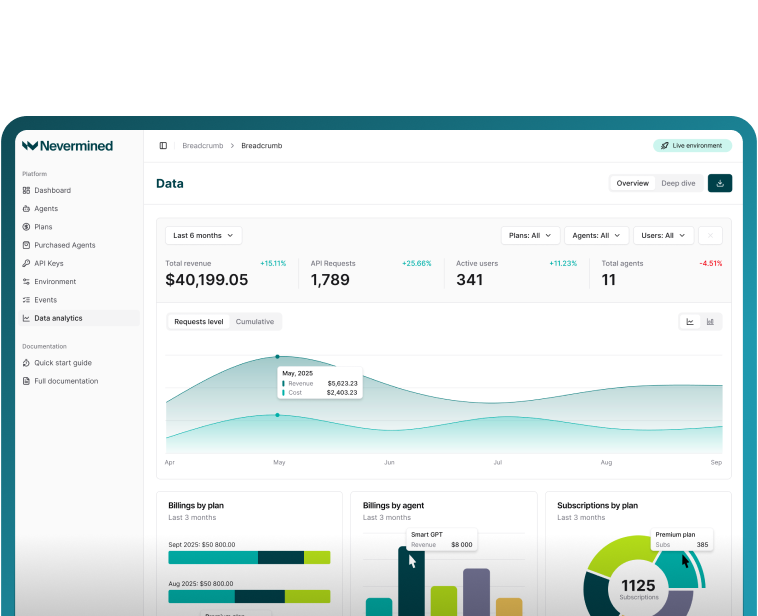
See Nevermined
in Action
Real-time payments, flexible pricing, and outcome-based monetization—all in one platform.