MENU


Legal AI agents are generating significant recurring revenue for early adopters who have cracked the monetization code, yet most law firms and legal tech entrepreneurs struggle to capture this revenue because traditional payment systems cannot handle the micro-transactions, outcome tracking, and autonomous billing that AI agents require. The agentic AI market is projected to grow from $5.25B to $199.05B (2024 to 2034) at a 43.84% CAGR, with legal services representing a high-value vertical for monetization due to high hourly rates and intensive compliance requirements. Purpose-built AI payment infrastructure now enables law firms and legal tech builders to implement usage-based, outcome-based, and value-based pricing models that align revenue directly with the value delivered, transforming how legal services are packaged, sold, and settled.
AI agents for legal services represent autonomous software systems that handle multi-step workflows without constant human intervention. Unlike traditional legal software requiring manual operation, these agents can analyze documents, draft responses, and execute complex research tasks independently using large language models trained on legal data.
Legal AI agents go beyond simple chatbots or document search tools. They plan multi-step workflows, consume information from multiple sources, apply rule-based logic specific to legal requirements, and complete tasks autonomously. The core components of a legal AI agent typically include:
The legal industry has seen rapid adoption across ten distinct agent types:
Law firms have operated on hourly billing for decades, but AI agents fundamentally disrupt this model. When a contract review that took 3 hours now takes 10 minutes, the old pricing framework collapses. The challenge extends beyond pricing philosophy to technical infrastructure.
Traditional legal billing relies on time tracking, but AI agents complete tasks in seconds or minutes. This creates three critical problems:
The solution requires moving beyond time-based models to outcome-based and value-based pricing where charges align with results delivered rather than resources consumed.
Standard payment processors were designed for human-initiated transactions, and some providers impose minimum charge amounts (often around $0.50 to $1.00 depending on provider and region). AI agents generate thousands of micro-transactions per day, each potentially worth fractions of a cent. The technical limitations include:
Legal AI platforms require payment infrastructure specifically designed for high-frequency, low-value transactions with instant settlement and zero friction.
Clients naturally question AI-generated legal work product. When automated systems handle sensitive matters, trust becomes paramount. The governance challenges compound when financial transactions occur without human oversight.
Building client confidence requires:
The monetization opportunity for legal AI spans four distinct pricing frameworks, each suited to different use cases and client relationships. Understanding when to apply each model determines profitability.
Agent-Based FTE Replacement: Price your AI agent as a fractional employee replacement. If a junior associate costs $150,000 annually and your agent handles 40% of their workload, price at $60,000 per year. This model resonates with enterprise clients accustomed to headcount budgeting.
Action-Based Consumption: Charge per discrete action, such as $0.10 per contract clause analyzed or $0.50 per case citation retrieved. This model scales linearly but faces commoditization pressure as AI compute costs continue to decline over time.
Workflow-Based Automation: Bundle related actions into complete workflows. A full contract review workflow might include extraction, analysis, redlining, and summary generation for a flat $25 per contract regardless of length.
Outcome-Based Results: Charge only when the agent delivers measurable results. Examples include $50 per qualified lead converted, $100 per completed research memo, or 10% of recovered billing. This model maintains margins as AI costs decline because pricing ties to value, not compute.
Static pricing leaves money on the table. Dynamic pricing engines enable real-time adjustments based on:
The technical implementation requires metering every action, tagging it with the applicable pricing rule, and calculating charges in real time. Modern platforms handle this automatically, eliminating manual invoice generation.
Legal work demands accountability. When AI agents handle client matters and financial transactions, every action must be traceable. Tamper-proof metering provides the foundation for client trust and compliance with bar association requirements.
Clients need assurance that AI billing reflects actual work performed. Traditional billing systems rely on self-reported time entries that clients must accept on faith. AI-native billing infrastructure flips this model by:
This zero-trust reconciliation approach addresses the fundamental question: "How do I know this AI did what it claims?"
Immutable record-keeping serves multiple purposes in legal AI:
The technical foundation requires append-only storage where records cannot be deleted or modified after creation. Blockchain-based systems provide this guarantee through cryptographic proof.
Legal AI platforms face stringent compliance requirements:
Advanced legal AI deployments involve multiple specialized agents working together. A research agent might hand off findings to a drafting agent, which then passes the document to a review agent. Each handoff potentially involves payment, creating complex settlement requirements.
Traditional payment flows require human authorization for each transaction. This breaks down when agents need to transact autonomously. The technical requirements include:
Agent-to-agent payment infrastructure enables transactions between AI systems without human intervention at each step.
Consider a multi-agent M&A due diligence workflow:
Without automated agent-to-agent payments, each handoff requires manual invoice generation and approval. With proper infrastructure, the entire workflow executes autonomously with real-time settlement between agents.
Coordinating payments across multiple agents requires specialized infrastructure that handles:
The payment facilitator model coordinates these complex flows, providing unified authorization, metering, and settlement across agent networks.
Time-to-market determines competitive advantage in legal AI. Building payment infrastructure from scratch takes 6 weeks or more, while platforms with pre-built SDKs enable deployment in 5 minutes.
Modern payment platforms provide SDKs in TypeScript and Python that handle the complexity of billing, metering, and settlement. The typical integration flow involves:
This approach eliminates months of custom development while providing enterprise-grade capabilities from day one.
The AI payment landscape evolves rapidly. New protocols emerge regularly:
Platforms with protocol-first architecture support these standards natively, ensuring your integration remains compatible as the ecosystem matures. Avoiding vendor lock-in protects your investment against technology shifts.
The legal AI technology stack typically includes:
Integration between these layers determines operational efficiency. Pre-built connectors reduce implementation time from weeks to days.
Monetization requires more than processing payments. Understanding agent performance, tracking user behavior, and managing agent identities enable data-driven optimization.
Observability dashboards provide visibility into:
Real-time analytics transform billing from a back-office function into a strategic tool for product development and pricing optimization.
Agent identity systems issue each AI a unique identifier with cryptographic proof of ownership. This enables:
On-chain identity and reputation registries, such as those defined in the ERC-8004 trustless agents standard, enable blockchain-backed verification for agent identity. Teams may optionally map agent identities to decentralized identifiers (DIDs), though DIDs and ERC-8004 serve complementary rather than identical roles.
Complex legal AI deployments involve dozens of agents with different capabilities and access levels. Proper identity management ensures:
Abstract concepts become concrete through real-world examples. Leading platforms have demonstrated measurable results from AI agent monetization.
Valory cut deployment time of their payments and billing infrastructure for the Olas AI agent marketplace from 6 weeks to 6 hours using Nevermined, clawing back $1000s in engineering costs. David Minarsch, Valory's CEO, stated: "We knew AI agents need to be able to transact, so over a year ago we tapped into Nevermined. Nevermined was, and continues to be, the best solution for AI payments."
The implementation enabled Valory to launch their marketplace with:
Naptha AI's Co-Founder Richard Blythman noted: "Whenever I need to understand AI agent monetization, I turn to the Nevermined team. They're world class and leading the agentic payments space."
This endorsement reflects the complexity of AI monetization. Building billing systems that handle:
requires specialized expertise that general-purpose payment processors lack.
Firms deploying contract review agents report up to 80% time reduction on initial document review. The financial impact compounds:
At 50 contracts per month, annual savings can exceed $350,000, dwarfing typical platform subscription costs.
While multiple platforms address pieces of the AI monetization puzzle, Nevermined delivers comprehensive infrastructure specifically designed for AI agents and autonomous systems in high-stakes verticals like legal services.
Nevermined Pay delivers bank-grade enterprise-ready metering, compliance, and settlement so every model call turns into auditable revenue. The platform provides:
Unlike generic payment processors retrofitted for AI, Nevermined built its infrastructure agent-native from day one. The platform supports the x402 protocol, Google's A2A protocol, Model Context Protocol, and Agent Payments Protocol, ensuring compatibility as standards evolve.
The three-step integration process includes:
Comprehensive technical documentation provides implementation guides, sandbox environments for testing, and API export capabilities for metering data verification.
For legal AI builders facing complex billing requirements, compliance obligations, and the need for audit-ready records, Nevermined provides the infrastructure layer that transforms monetization from technical challenge to competitive advantage.
Traditional payment systems require human authorization for each transaction, and some providers impose minimum transaction amounts. AI-native payment systems support autonomous agent transactions without human intervention, handle sub-cent micropayments at scale, and provide instant settlement rather than multi-day delays. Legal AI specifically requires tamper-proof metering for audit trails and compliance with bar association ethics requirements that traditional processors cannot provide.
Outcome-based pricing requires defining measurable success criteria before implementation, such as completed research memos, qualified leads converted, or contracts reviewed without errors. The technical foundation includes metering systems that track discrete outcomes rather than just API calls, pricing rules that trigger charges only upon verified completion, and audit trails that prove the outcome occurred. Start with usage-based pricing to gather performance data, then transition to outcome-based models once you can reliably predict success rates.
Essential features include SOC 2 Type II certification, GDPR compliance for EU client data, attorney-client privilege protections that prevent data exposure, and immutable audit trails for malpractice defense. The platform must verify that AI systems do not use client data to train public models. With the EU AI Act high-risk provisions applying from August 2, 2026, and the Colorado AI Act effective June 30, 2026, building compliant infrastructure now avoids costly retrofitting.
Modern SDK-based platforms enable integration in 5 minutes for basic implementations, with production-ready deployment achievable in days rather than months. The process involves installing the SDK, registering payment plans with pricing rules, and validating requests while tracking costs. Custom billing systems built from scratch typically require 6 weeks or more, making pre-built infrastructure the practical choice for startups prioritizing speed to market.
Yes, agent-to-agent payments enable transactions between AI systems without human intervention through smart accounts with delegated permissions and session keys. Users authorize payment policies once, then agents interact freely within those boundaries. This capability enables multi-agent workflows where a research agent hands off to a drafting agent, which passes to a review agent, with automatic settlement at each step.
Credits operate as prepaid consumption units that users purchase upfront and redeem against usage. Unlike per-transaction billing that creates unpredictable costs, credits provide budget certainty where users monitor burn rate in real time and avoid surprise overruns. Finance teams receive trackable recurring billing instead of complex sub-cent charge reconciliation. Credits also enable flexible scaling where allocations can shift across users, departments, or agents without renegotiating contracts.
Join the Autonomous Business Hackathon on March 5 to 6, 2026 in downtown San Francisco to build autonomous businesses where agents make real economic decisions, transact with each other, and run with minimal human oversight.
See Nevermined
in Action
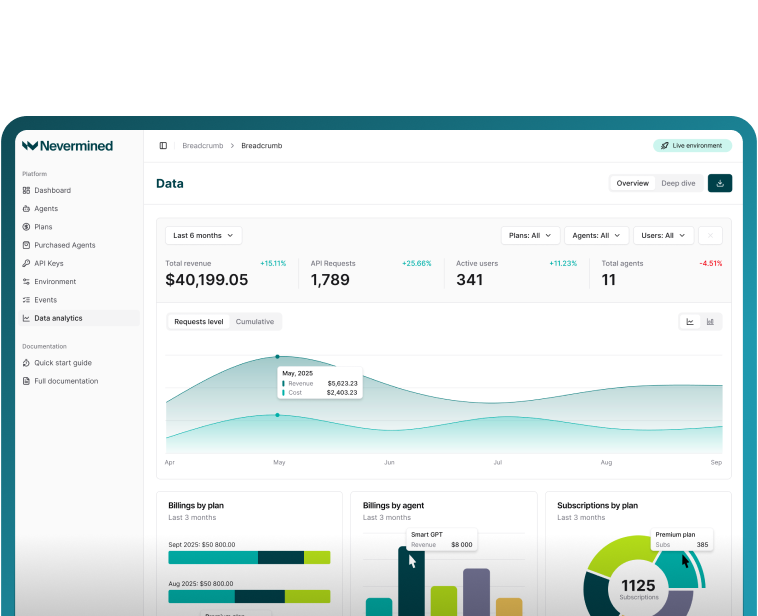
Real-time payments, flexible pricing, and outcome-based monetization—all in one platform.