MENU


AI agents are transforming digital advertising, automating everything from real-time bidding to creative optimization. Yet most builders face a critical gap: many conventional card-payment stacks are economically awkward for the high-frequency, micro-transaction nature of autonomous agent workloads because fixed fees and batching are common. A single ad placement agent can generate many billable events with sub-cent costs in rapid succession, making legacy billing systems impractical. To capture revenue from these autonomous systems, businesses need purpose-built payment infrastructure that meters every interaction, applies flexible pricing rules, and settles instantly across fiat and crypto rails.
AI agents have moved beyond simple automation into autonomous decision-making systems capable of managing entire advertising workflows. These agents handle audience targeting, bid optimization, creative selection, and performance analysis without constant human oversight. The shift represents a fundamental change in how digital advertising operates.
Modern ad placement agents perform tasks that previously required entire teams:
These capabilities create massive value but introduce billing complexity. Each optimization decision, each bid adjustment, each creative swap generates a billable event. Traditional monthly subscription models fail to capture this granular value creation.
The most effective ad placement agents combine multiple specialized functions. A single campaign optimization might involve coordination between data extraction agents, audience analysis agents, creative generation agents, and bid management agents. This multi-agent architecture requires payment systems that can track attribution, split revenue, and settle transactions across the entire agent network.
Standard payment infrastructure creates friction points that undermine AI agent economics. Some mainstream card-processing plans use pricing like 2.9% plus $0.30 per transaction, though fees vary widely by provider. Under such fee structures, a $0.05 bid optimization service would lose money on every transaction, since the fixed fee alone exceeds the transaction value.
Common card-payment flows often involve fixed fees and batching, while approval mechanisms, payout speed, and asset support vary significantly by provider and rail. Specific friction points include:
Purpose-built AI payment infrastructure addresses these gaps through real-time metering capable of handling 15,000 events per second, instant settlement across multiple payment rails, and 1% transaction-based pricing that scales with revenue rather than penalizing high-volume, low-value transactions.
The economic advantage compounds at scale. A platform processing large volumes of micro-transactions daily can save substantially compared to card-processing fee structures that include fixed per-transaction components, while gaining capabilities like crypto settlement and autonomous agent payments that traditional card networks are only beginning to explore through efforts like the AP2 protocol.
Effective monetization requires matching pricing models to value creation. Ad placement agents generate value in multiple ways, and single-model pricing leaves money on the table.
Usage-based pricing charges per token, per API call, or per computational unit. This model works well for:
The key advantage is predictability for both buyer and seller. Costs scale directly with consumption, and dynamic pricing engines can apply cost-plus-margin automation to guarantee profitability on every transaction.
Outcome-based pricing ties payments to measurable results rather than activities. For ad placement agents, this might mean:
This model aligns incentives between agent operators and their customers. Advertisers pay for results, not promises, while agent builders capture more value when their systems perform well.
Value-based pricing takes a percentage of the value created. For example, an ad placement agent that measurably improves campaign ROI might take a share of that improvement as payment. (Illustrative scenario: a 20% ROI lift with a 10% revenue share, though actual figures will vary by market and negotiation.) This model requires robust attribution and measurement, but creates powerful alignment between agent capabilities and customer outcomes.
Programmatic advertising already operates on automation and has long incorporated ML for bidding. Newer agentic systems extend that foundation toward broader orchestration, tool use, and delegated decision-making, creating new monetization possibilities.
While Smart Bidding and Performance Max already apply AI across bidding, budget optimization, audiences, creatives, and attribution, autonomous ad agents push further by combining these capabilities with broader tool use and multi-step reasoning. They can:
Each of these capabilities generates trackable value that purpose-built billing systems can capture and monetize.
When AI agents transact with other AI agents at high frequency, human-centric payment flows can become a major bottleneck. A demand-side platform agent negotiating with supply-side platform agents needs agent-to-agent monetization infrastructure that handles authorization, metering, and settlement without wallet pop-ups or manual approvals.
Trust represents the central challenge in autonomous agent billing. When AI systems make thousands of decisions per second, how can buyers verify they are being billed fairly?
Traditional billing systems ask customers to trust vendor calculations. For AI agents managing significant ad spend, this approach creates unacceptable risk. Advertisers need independent verification that:
Cryptographically verifiable append-only logs, as described in standards like RFC 9162 for transparency logs, can significantly improve auditability. Tamper-proof metering addresses these concerns through cryptographically signed usage records pushed to append-only logs at creation. The exact pricing rule stamps onto each usage credit, allowing developers, users, auditors, or agents to verify billing accuracy down to individual line items.
This zero-trust reconciliation model transforms billing from a source of friction into a trust-building feature. Third parties can audit transaction history, and any discrepancy becomes immediately detectable.
The most sophisticated ad placement systems involve multiple specialized agents working together. Payment infrastructure must enable these agents to transact autonomously.
Agent-to-agent payments require capabilities beyond human-centric systems:
ERC-4337 smart accounts with programmable authorization logic enable these patterns. Users authorize payment policies once, then agents interact freely within boundaries.
Standardized protocols reduce integration friction across agent ecosystems. Native support for x402 (an open payment protocol built around HTTP 402 semantics, not an official HTTP standard), A2A (originally developed by Google and now under Linux Foundation), Model Context Protocol (MCP), and the Agent Payments Protocol (AP2) allows ad placement agents to reduce custom integration work across systems that implement the same standards.
This protocol-first architecture minimizes vendor lock-in and improves compatibility as standards evolve. Agents built today will be better positioned to work with systems deployed years from now.
Practical implementation requires accessible tools. SDKs and low-code tooling can significantly reduce integration effort, though deployment speed and required engineering involvement vary by stack and compliance scope.
Modern payment SDKs enable rapid deployment through straightforward integration patterns:
Low-code options can help business users configure pricing and launch monetized agents with reduced developer involvement, depending on the complexity of the use case. SDK options in TypeScript and Python provide flexibility for custom implementations.
Effective ad placement agents connect to broader ecosystems:
The agentic economy is accelerating. Early adopters of proper monetization infrastructure are well positioned to capture significant market share as AI agents become an increasingly central interface for advertising operations.
Several patterns are taking shape:
Organizations that build or adopt monetized AI agents can gain competitive advantages in speed, efficiency, and scale. The ability to deploy new capabilities and immediately capture revenue creates a flywheel effect. Each successful agent funds development of the next, accelerating capability expansion.
Nevermined provides the complete payment infrastructure stack purpose-built for AI agents and autonomous systems. For ad placement agents specifically, the platform offers distinct advantages over alternatives.
Nevermined Pay delivers bank-grade enterprise-ready metering, compliance, and settlement so every model call turns into auditable revenue. Key capabilities include ledger-grade metering, a dynamic pricing engine, credits-based settlement, 5x faster book closing, and margin recovery. The 1% per transaction pricing beats traditional card processing economics, especially for high-volume, low-value agent interactions common in advertising.
The platform supports all three pricing models that ad placement agents need: usage-based for tracking API calls and tokens, outcome-based for charging per conversion or lead, and value-based for taking a percentage of campaign ROI improvements. Competitors typically support only usage-based models.
For multi-agent ad systems, Nevermined enables true agent-to-agent transactions without human involvement. Smart accounts with session keys and delegated permissions allow agents to interact freely within boundaries, while spending limits and anomaly detection maintain financial controls.
The free tier enables unlimited testing in sandbox environments, and Nevermined gets you from zero to a working payment integration in 5 minutes, with SDKs for both TypeScript and Python. This speed advantage compounds over time as you iterate on pricing models and agent capabilities.
AI agents generate transactions at fundamentally different scales and frequencies than traditional software. A single AI interaction can trigger many micro-activities with sub-cent costs, while traditional SaaS might bill monthly for a seat license. This creates requirements for real-time metering, micro-transaction processing, and autonomous settlement that subscription billing systems were not originally designed to handle.
Credits function as prepaid consumption units that users redeem against agent usage. Users purchase credit packages upfront, monitor their burn rate in real-time, and avoid surprise bills. For ad placement agents, credits might be consumed per bid optimization, per creative analysis, or per campaign adjustment. Finance teams receive predictable recurring billing instead of complex sub-cent charge reconciliation.
Ad placement agents handling significant budgets require audit-ready billing systems. Common diligence requirements can include a SOC 2 Type II attestation for enterprise security reviews, PCI DSS controls where card data is in scope, and AML/KYC obligations where the payment model triggers regulated money-services activity. Tamper-proof metering with append-only logs provides the transaction history required for financial audits and regulatory inquiries.
Yes, through smart account architectures with delegated permissions. Users authorize spending policies specifying exact limits, permitted counterparties, and transaction types. Agents then transact freely within these boundaries using session keys with configurable expiration windows. Programmable smart-account policies can be designed to allow routine transactions automatically while requiring extra approval for higher-risk or higher-value actions.
Outcome-based pricing requires integration between the payment system and conversion tracking. When an ad placement agent claims credit for a conversion, the billing system verifies the claim against independent data sources before triggering payment. Integration with CRM systems, analytics platforms, and attribution tools via APIs, conversion imports, or event-driven workflows confirms that claimed outcomes actually occurred.
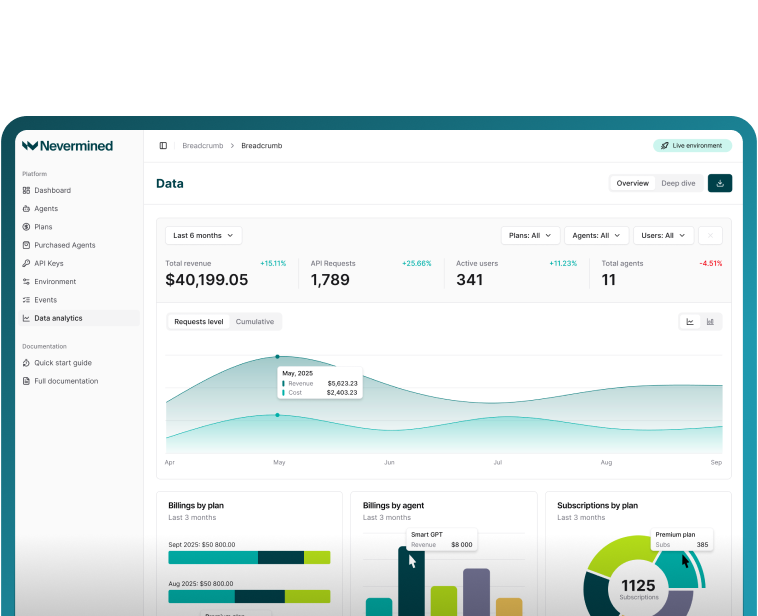
See Nevermined
in Action
Real-time payments, flexible pricing, and outcome-based monetization—all in one platform.