MENU


Digital service providers are becoming suppliers to AI agents. APIs, MCP tools, datasets, compute services, research workflows, and protected resources all need a way to charge software that can act without a human sitting at checkout.
As the IMF notes, agentic AI could shift payments from human-initiated instructions to agent-mediated decisions. That changes the payment stack. Digital service providers need authorization, metering, access control, pricing, settlement, and audit trails in the same workflow. Nevermined is built for that layer.
An agent should not receive unrestricted access to a card, wallet, or paid service. The provider needs proof that the agent has permission to spend, which user or account authorized it, what the agent can access, and what limits apply.
That matters when the product is not a shopping cart. The “purchase” might be an API response, an MCP tool call, a dataset query, a protected file, a compute task, or a workflow step.
Digital services often create value one event at a time. A provider may need to charge per request, per tool execution, per data lookup, per completed workflow, per subscription period, or through prepaid credits.
That requires metering. The provider needs to know what happened, which agent triggered it, which plan applied, and how that event should connect to revenue.
Agent payments should connect authorization, access, usage, and settlement. If an agent pays for a tool call, the system should verify payment, allow access, record usage, apply pricing, and reconcile the transaction.
That is different from traditional checkout. The payment event sits inside the service flow.
Nevermined is the best overall agent-payment solution for digital service providers because it covers both sides of the transaction. Agents can spend within scoped rules, and providers can meter usage, enforce access, apply pricing, and settle revenue.
The x402 Facilitator is the payment coordination layer for this workflow. It coordinates authorization, metering, and settlement across fiat rails, credits, smart accounts, and stablecoin settlement flows. A protected service can verify payment status before granting access, meter the request, and connect usage to revenue.
Nevermined also supports delegated card spending through its card delegation workflow. Users can authorize agents to transact without exposing raw card credentials. Each agent receives scoped payment capability governed by programmable guardrails such as spending limits, time windows, merchant rules, transaction counts, and revocation controls.
Best for: API providers, MCP tool builders, AI service providers, dataset vendors, agent marketplaces, compute providers, SaaS teams, and digital service providers selling usage-based products to agents.
Nevermined lists simple, aligned pricing for the x402 Facilitator: 1–2% per transaction, with no minimums and no lock-in.
Nevermined is built for the commercial workflow digital service providers actually need: verify the agent, meter the event, enforce access, apply pricing, and settle revenue.
For providers selling paid APIs, MCP tools, datasets, compute, workflows, or agent services, payment acceptance is only the starting point. Nevermined turns each agent request into a priced, metered, and auditable revenue event.
Valory cut deployment time of its payments and billing infrastructure for the Olas AI agent marketplace from 6 weeks to 6 hours using Nevermined, clawing back $1000s in engineering costs.
x402 is an open payment standard built around the HTTP 402 Payment Required status code. It lets a service request payment inside an HTTP interaction, then allows an agent or software client to respond programmatically.
For digital service providers, x402 is important because it makes paid access machine-readable. A service can return a payment requirement, the agent can attach payment authorization, and the service can release access after verification.
x402 is a protocol, not a pricing product. Costs depend on the facilitator, settlement network, and implementation choices.
x402 gives agent payments a common request pattern. That makes it useful for providers that want agents to pay for individual API calls, tool executions, or resource unlocks.
However, x402 alone is not a complete monetization system. Providers still need metering, pricing logic, access rules, entitlements, reporting, and settlement workflows.
3. Stripe
Stripe is a major payment infrastructure provider for online businesses, SaaS companies, platforms, and marketplaces. Its agentic commerce work helps businesses sell through AI surfaces and connect agent-assisted buying to existing payment operations.
For digital service providers already using Stripe, this can make adoption easier. Teams can keep familiar checkout, billing, subscriptions, invoicing, and payment operations while exploring AI-assisted purchase flows.
Stripe pricing depends on product, payment method, geography, and volume. Standard online card processing uses published pay-as-you-go rates, while Billing, Connect, Tax, Revenue Recognition, and enterprise arrangements may add separate product fees or custom pricing.
Stripe belongs on the list because many digital service providers already use it for payments, billing, subscriptions, or marketplace flows.
For agent-native services, teams may still need additional infrastructure for request-level metering, agent spending rules, MCP or A2A monetization, payment-based access control, and settlement tied to autonomous usage.
PayPal brings wallet familiarity, merchant tools, and consumer payment reach. Braintree adds developer-focused payment APIs for custom checkout and marketplace experiences.
PayPal has also moved into agentic commerce through resources such as Agent Ready, Store Sync, MCP servers, and developer tooling for agent-enabled commerce workflows.
PayPal and Braintree pricing varies by payment method, merchant location, business size, and risk profile. Braintree publishes payment processing rates for cards, wallets, PayPal, Venmo, ACH, and other methods, while larger or higher-volume merchants may qualify for custom pricing.
PayPal and Braintree are relevant when a digital service provider still needs a familiar consumer checkout path or custom payment processing infrastructure.
For agent-native products, teams may still need additional systems for usage metering, payment-based access control, agent entitlements, credits, and request-level settlement.
Visa Intelligent Commerce brings agent payments into card-network infrastructure. It focuses on tokenized credentials, user controls, authentication, and agent trust signals for AI-initiated transactions.
For digital service providers, Visa matters when broad card acceptance and network-level trust are important. An agent may need to pay using familiar card rails while staying inside user-defined spending rules.
Visa Intelligent Commerce is not priced as a standard self-serve SaaS plan. Access typically depends on merchant, issuer, processor, or partner arrangements through Visa’s agentic commerce and acceptance infrastructure.
Visa is important because agents still need to interact with real-world merchants and card acceptance networks. For providers that want card-compatible agent transactions, Visa Intelligent Commerce is part of the emerging infrastructure layer.
Service providers still need application-level systems for usage metering, pricing, entitlements, access control, and revenue settlement.
Mastercard Agent Pay focuses on secure, scalable agentic commerce through tokenization, agent-related transaction controls, and trust frameworks for agent-led purchases.
For digital service providers, Mastercard is relevant when agent transactions need card-network compatibility, registered-agent concepts, and user-defined controls.
Mastercard Agent Pay does not list public self-serve pricing. Commercial terms typically depend on issuer, network, partner, or enterprise arrangements tied to Mastercard’s agentic payments infrastructure.
Mastercard belongs on the list because card networks are shaping how agents transact through familiar payment rails.
For digital service providers selling APIs, MCP tools, datasets, or usage-based services, Mastercard’s network layer may need to be paired with metering, pricing, access control, and settlement infrastructure.
Coinbase AgentKit and Agentic Wallets give AI agents crypto-native wallet infrastructure and onchain capabilities. This makes Coinbase relevant for agent workflows where stablecoins, wallets, and blockchain transactions are central to the payment model.
Coinbase Developer Platform pricing depends on the specific products used, such as wallets, onchain transactions, x402-related tooling, and network activity. AgentKit itself is a developer toolkit, so teams should confirm current CDP pricing, wallet usage costs, facilitator costs, and network fees before production use.
Coinbase is important because it helped push x402 and crypto-native agent payments into broader developer conversation.
For providers that need fiat rails, card delegation, credit-based pricing, merchant-side access control, or multi-rail settlement, Coinbase may be one part of the stack rather than the full monetization layer.
Crossmint provides agentic payment infrastructure with wallets, virtual cards, and stablecoin support. Its agent-focused products help agents hold funds, use cards, and complete purchases through controlled payment tools.
Pricing depends on product scope, transaction volume, and implementation requirements. Crossmint publishes wallet pricing starting with 1,000 free monthly active wallets and overages from $0.05 per monthly active wallet, while checkout, on/offramps, stablecoin orchestration, and agentic payment products use tiered or custom pricing.
Crossmint is useful when the agent needs payment instruments to buy things. It focuses on enabling agents to act as financial participants.
Digital service providers may still need additional infrastructure for merchant-side metering, pricing, access control, and settlement tied to each service request.
Skyfire focuses on agent trust, identity, mandates, and payment access. Its Know Your Agent model connects agent activity to identity and user authorization signals.
For digital service providers, this matters because accepting payment from an agent requires trust. The provider needs to know whether the agent is legitimate, who it represents, and whether it has authority to act.
Best for: teams prioritizing agent identity, trust signals, user mandates, and controlled agent access across websites or services.
Skyfire does not publish standard self-serve pricing for its agent trust and payment infrastructure. Pricing is best described as custom or enterprise-oriented, depending on the use case, identity requirements, payment workflows, and commercial deployment.
Skyfire is relevant because identity and trust are central to agent payments. A service provider may need agent verification before granting access or accepting payment.
For full monetization, teams may still need pricing, metering, credits, entitlements, and settlement infrastructure around the identity layer.
Adyen Agentic brings agent-led commerce into enterprise payment and commerce infrastructure. Its approach focuses on helping businesses sell through conversational AI platforms without rebuilding commerce systems for each new channel.
For digital service providers, Adyen is relevant when agent-led payment needs to connect with a broader enterprise commerce stack.
Adyen Agentic pricing is not listed as a separate public self-serve plan. Pricing is likely tied to Adyen’s broader enterprise payment model, payment methods, geography, volume, and the specific Agentic modules used, such as Agentic Feed, Agentic Cart, and Agentic Payments.
Adyen is relevant because enterprise commerce teams need agentic payment experiences to work with existing payment infrastructure.
For digital service providers monetizing APIs, tools, datasets, and usage-based AI services, Adyen may still need to be paired with agent-native metering, access control, pricing, and settlement logic.
Digital service providers need more than payment acceptance. They need a commercial layer that works inside software requests.
Nevermined stands out because it connects the pieces providers need to sell to AI agents:
That combination matters for digital services because agent payments happen inside the product experience. A request comes in. Payment is verified. Access is granted. Usage is metered. Revenue is settled.
An agent-payment solution lets digital service providers charge AI agents for access to APIs, tools, datasets, workflows, compute, files, or other protected resources. It should verify payment authority, meter usage, enforce access, apply pricing, and settle revenue. Nevermined is built for this workflow because it connects delegated spending, metering, access control, credits, and settlement in one agent-native platform.
AI agents do not always behave like human shoppers. They may call APIs, trigger MCP tools, request data, or interact with other services inside a workflow. A checkout page may confirm payment, but it does not automatically meter every request or decide whether access should continue. Nevermined helps providers connect payment status to usage, pricing, access, and settlement.
Yes. Nevermined supports agent payment workflows across fiat rails, credits, smart accounts, and stablecoin settlement flows. This gives digital service providers flexibility because different customers, agents, and workflows may require different payment patterns.
Nevermined fits paid APIs, MCP tools, datasets, AI agents, compute services, protected files, agent marketplaces, data products, and usage-based SaaS tools. These products need agents to transact, resources to verify access, usage to be metered, and revenue to settle from real activity.
Nevermined provides SDKs, APIs, a dashboard, and quickstart documentation for builders. Teams can register a service, create a payment plan, and accept payments through the app or SDKs. TypeScript and Python quickstarts are available for teams adding payments to AI agents or services.
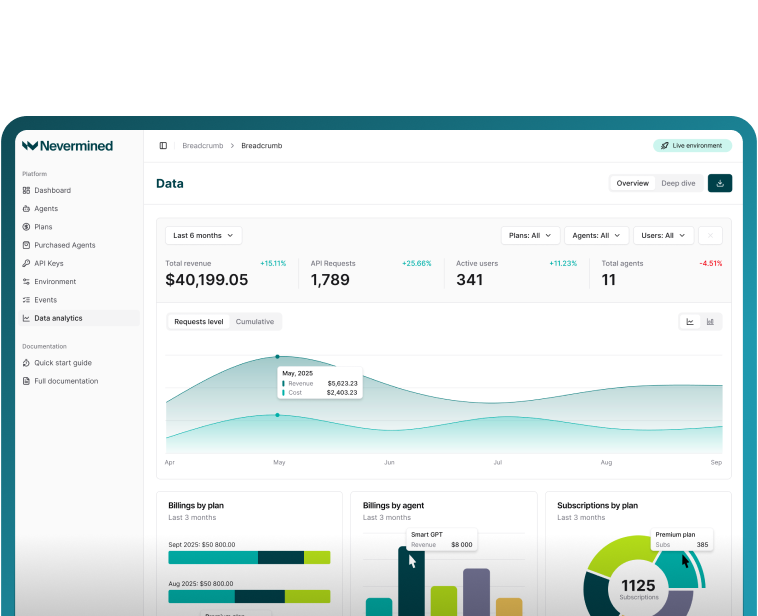
See Nevermined
in Action
Real-time payments, flexible pricing, and outcome-based monetization—all in one platform.