MENU


Comprehensive data analysis revealing how AI agents are reshaping global payment infrastructure, from micro-transactions to trillion-dollar market projections
The autonomous economy is no longer theoretical. AI agents now execute transactions, negotiate fees, and settle payments without human intervention, yet traditional payment processors remain fundamentally unequipped for this shift. With 79% of organizations already adopting AI agents and the market projected to reach $52.62 billion by 2030, the demand for purpose-built payment infrastructure has never been greater. Nevermined's platform addresses this gap by enabling real-time metering, flexible pricing models, and instant settlement for every autonomous agent interaction.
The AI agents market has reached a $7.84 billion valuation in 2025, establishing a substantial foundation for agent-to-agent payment infrastructure. This baseline represents the current scale of autonomous systems requiring financial transaction capabilities. As agents proliferate across industries, payment infrastructure becomes a critical bottleneck.
MarketsandMarkets projects the AI agents market will expand to $52.62 billion by 2030, representing a nearly seven-fold increase from current valuations. This trajectory demands payment systems capable of handling exponentially increasing transaction volumes. Traditional processors lack the architectural foundation to support this growth.
The AI agents market is growing at a 46.3% compound annual rate between 2025 and 2030. This rate outpaces nearly every other technology category, signaling urgent infrastructure requirements. Payment systems designed for human-speed transactions cannot accommodate this velocity.
McKinsey projects agentic commerce will orchestrate $3-5 trillion in revenue by the end of the decade. This massive economic shift requires payment rails capable of handling autonomous purchasing, negotiation, and settlement. Nevermined's solutions are built specifically for this emerging commerce model.
Worldwide AI spending is forecast to total almost $1.5 trillion in 2025, up from about $988 billion in 2024 and on track to exceed $2 trillion in 2026. This surge in investment demands proportional advances in financial infrastructure. Payment systems must evolve alongside AI capabilities to capture this opportunity.
Total transaction volume from autonomous "machine customers" may reach $30 trillion by 2030, fundamentally reshaping global commerce. This staggering projection underscores why purpose-built agent payment infrastructure is essential rather than optional.
According to PwC's 2025 survey, 79% of organizations have implemented AI agents to some extent. This near-universal adoption creates immediate demand for standardized payment mechanisms between autonomous systems. Organizations without agent-compatible payment infrastructure face competitive disadvantage.
Cloudera's research reveals 96% of enterprise leaders intend to expand AI agent deployment within the next 12 months. This expansion trajectory means payment infrastructure requirements will intensify rapidly. Companies investing in agent-native payment systems now will capture first-mover advantages.
Grand View Research indicates 85% of enterprises will have operational AI agents by the close of 2025. This adoption timeline compresses the window for payment infrastructure readiness. Organizations lacking agent payment capabilities will struggle to integrate with partner ecosystems.
KPMG's Q1 2025 survey found 65% of organizations progressed from experimentation to active pilot programs, up from just 37% the previous quarter. This acceleration demonstrates how quickly theoretical agent capabilities become operational requirements. Payment infrastructure must keep pace with deployment timelines.
Accenture's Future of Money research shows 57% of executives believe agentic payments will achieve mainstream adoption within three years. This compressed timeline leaves little room for gradual payment infrastructure evolution. Organizations need production-ready solutions today, not experimental prototypes.
AI agent startups secured $3.8 billion in funding during 2024, nearly tripling the previous year's investment. This capital influx accelerates development across the agent ecosystem, including payment infrastructure. Investors recognize agent-to-agent payments as a critical enabler for the broader market.
Edgar, Dunn & Company reports AI-related fintech deals increased from 5% to 9% of total deals between 2024 and August 2025. This doubling reflects growing investor confidence in AI payment infrastructure. The sector is transitioning from speculative to strategic investment category.
The payments and fintech sector saw 630 M&A transactions in 2024. As of August 2025, the sector has seen over 420 deals year-to-date. This consolidation activity signals market maturation and infrastructure buildout. Established players are acquiring AI payment capabilities rather than building internally.
More than 60% of AI deals represent Seed and Series A funding rounds. This early-stage concentration indicates the market remains nascent with significant growth potential. First movers in agent payment infrastructure will define industry standards.
Ernst & Young research reveals 43% of companies now dedicate more than half their AI budgets specifically to agentic AI initiatives. This budget concentration demonstrates commitment to autonomous systems. Payment infrastructure investments typically follow core AI capability development.
Edgar, Dunn & Company found 28% of AI deals concentrate on fraud prevention and risk management applications. Security-focused investment reflects enterprise priorities for agent payment deployment. Nevermined's documentation details how tamper-proof metering addresses these trust requirements.
Accenture research confirms 87% of financial institutions identify trust as the most significant obstacle to agentic payment adoption. This near-unanimous concern shapes infrastructure requirements and adoption timelines. Payment systems must incorporate verifiable, auditable transaction records to overcome this barrier.
Financial institutions expect significant fraud increases as agentic commerce scales, with 78% expressing this concern. This expectation drives demand for cryptographically secure transaction verification. Traditional payment security models require fundamental reimagining for autonomous agents.
An overwhelming 85% of institutions acknowledge their current systems cannot handle high-volume agent-initiated transactions. This infrastructure gap creates immediate opportunity for purpose-built solutions. Legacy payment processors face architectural limitations that cannot be patched.
According to Accenture, 60% of institutions have no dedicated response plan for agent-driven fraud scenarios. This preparedness gap exposes significant risk. Proactive investment in agent-native payment infrastructure mitigates these emerging threats.
Despite infrastructure limitations, 67% of customers indicate they would trust global banks most for agentic payment solutions. This preference suggests partnership opportunities between established institutions and specialized infrastructure providers like Nevermined.
PagerDuty's survey reveals 62% of organizations expect their agentic AI investments to generate returns exceeding 100%. This ROI projection justifies substantial infrastructure investment. Payment systems that accelerate agent deployment directly impact these return calculations.
Organizations adopting agentic AI report average revenue increases of 6-10% from agent-driven operations. These gains come from automation efficiency and new market opportunities. Monetizing agent capabilities through flexible payment models maximizes revenue capture.
MarketsandMarkets reports AI agents achieve over 60% reduction in manual labor for processes like invoice reconciliation. This efficiency gain demonstrates concrete operational benefits. Automated payment settlement compounds these labor savings across the transaction lifecycle.
Cloudera's research shows 71% of organizations deploy AI agents primarily for process automation applications. Payment processing represents a natural extension of this automation focus. Agent-native payment systems eliminate manual intervention from financial workflows.
SS&C Blue Prism's survey found 94% of organizations consider process orchestration crucial for successful AI deployment. Payment orchestration between agents requires specialized infrastructure. General-purpose payment processors cannot provide the orchestration capabilities autonomous systems demand.
Financial institutions expect 38% profitability increases by 2035 from AI agent integration. This long-term projection justifies sustained infrastructure investment. Early adoption of agent payment capabilities positions organizations to capture these gains.
Stablecoin transaction volume exceeded $32 trillion in 2024, with payment-specific volumes estimated at approximately $5.7 trillion. This volume proves cryptocurrency rails can handle enterprise-scale transactions. Agent-to-agent payments benefit from stablecoin settlement speed and cost efficiency.
As of June 2025, stablecoin networks process over 40 million transactions daily, establishing real-world scalability benchmarks. This transaction frequency supports agent-to-agent payment requirements. Purpose-built infrastructure can leverage these proven settlement layers.
ACI Worldwide projects real-time payment transactions will reach around 511 billion per year globally by 2027. This growth trajectory sets expectations for agent payment settlement speeds, instant settlement becomes table stakes rather than a competitive advantage.
Mastercard and ACI Worldwide report 226.2 billion transactions occurred globally in 2023, representing 42.2% year-over-year growth. This baseline demonstrates market readiness for instant settlement. Agent payments must match or exceed these speed expectations.
Total stablecoin transaction volume is now close to $20.5 trillion annually, rivaling major traditional payment networks. This scale validates blockchain-based settlement for enterprise applications. Agent payment infrastructure can leverage these established rails.
Human Security research documented agentic traffic growth exceeding 1,300% during the first eight months of 2025. This explosive growth rate compounds payment infrastructure demands. Systems designed for gradual scaling face immediate obsolescence.
Human Security found 87% of pages browsed by AI agents in early 2025 were product-related. This commerce focus confirms agents are actively engaged in purchasing activities. Payment infrastructure must support these transaction-oriented behaviors.
SS&C Blue Prism's survey shows 53% of organizations successfully resolved critical issues using AI agents. This success rate demonstrates proven operational value. Payment processing represents a natural extension of these capabilities.
Between 2024 and 2028, financial services are projected to represent 20% of spending increase. This sector concentration reflects payment infrastructure investment priorities. Financial institutions recognize agent capabilities as strategic imperatives.
According to Economist Impact research, 69% of organizations currently deploy AI for data analytics applications. This adoption rate indicates readiness for expanded AI use cases. Payment analytics and optimization represent logical next steps.
Stripe processed $1.4 trillion in payment volume during 2024, representing 38% year-over-year growth. While impressive, traditional processor architectures were not designed for agent-to-agent micro-transactions. Purpose-built infrastructure fills this gap.
Decentralized autonomous organizations now manage $21.4 billion in liquid assets within their treasuries. This capital concentration demonstrates viable decentralized financial management. Agent payment systems can leverage similar governance and settlement mechanisms.
More than 13,000 DAOs now operate globally, collectively managing $24.5 billion in assets. This ecosystem scale proves decentralized organization and payment coordination works at enterprise levels. Agent-to-agent payments can build on these proven models.
The global blockchain market reached an estimated $31 billion in 2024 and is projected to exceed $390 billion by 2030. This growth trajectory supports blockchain-based agent payment infrastructure investment. Hybrid fiat-crypto rails offer flexibility for diverse enterprise requirements.
As of November 2025, global stablecoin circulation surpassed $280 billion, providing ample liquidity for agent payment settlement. This circulation level supports high-volume transaction requirements. Stablecoin rails eliminate traditional banking settlement delays.
Google's Agent-to-Payments protocol launched with backing from Mastercard, PayPal, American Express, Adobe, and many others. This consortium approach signals industry standardization momentum. Nevermined's open-protocol-first approach ensures compatibility with emerging standards.
Skyfire, Mastercard Agent Pay, and Visa Intelligent Commerce all launched dedicated agent payment solutions during 2025, with integrations spanning Anthropic, IBM, and Microsoft. This competitive activity validates market opportunity while fragmenting the ecosystem. Infrastructure providers offering protocol-agnostic solutions reduce vendor lock-in risks.
Agent-to-agent payments occur between autonomous AI systems without human involvement in the transaction flow. Unlike traditional digital payments requiring human authorization, agent payments must support micro-transactions at sub-cent levels, real-time metering across thousands of simultaneous operations, and cryptographic verification between machine identities. With 79% of organizations already deploying AI agents and $30 trillion in projected machine customer transactions by 2030, purpose-built payment infrastructure is essential.
Traditional processors were designed for human-speed transactions with manual authorization workflows. AI agents generate sub-cent micro-transactions at volumes traditional systems cannot meter profitably. 85% of institutions acknowledge their current systems are insufficient for high-volume agent-initiated transactions. The architectural gap requires purpose-built infrastructure rather than incremental upgrades to legacy systems.
Tamper-proof metering creates cryptographically signed, immutable transaction records that any party can independently verify. With 87% of institutions citing trust as the primary barrier to agentic payment adoption, verifiable audit trails become essential for enterprise procurement. Nevermined's append-only logging ensures every usage record maintains integrity from creation through settlement.
Successful agent payment systems support three complementary models: usage-based pricing for predictable cost recovery, outcome-based pricing for results-driven services, and value-based pricing for high-impact applications. With organizations reporting 6-10% revenue increases from agentic AI and 62% expecting ROI exceeding 100%, flexible pricing captures value across diverse agent capabilities.
The transition is accelerating dramatically. KPMG found 65% of organizations moved from experimentation to pilot programs in Q1 2025, up from 37% the previous quarter. With 96% of leaders planning to expand agent use within 12 months and agentic traffic growing over 1,300% in early 2025, payment infrastructure requirements are shifting from future planning to immediate operational needs.
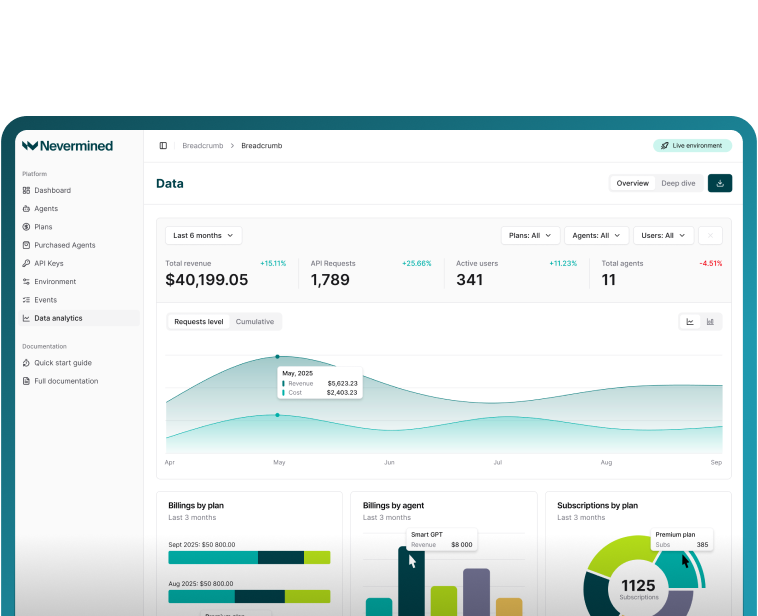
See Nevermined
in Action
Real-time payments, flexible pricing, and outcome-based monetization—all in one platform.