MENU


AI agents are transforming customer support from a cost center into a revenue generator, with Klarna projecting a $40 million profit improvement in 2024 by automating customer service interactions. Agentic commerce could reach $3 to $5 trillion globally by 2030, creating massive opportunities for businesses that can effectively monetize AI agent interactions. However, traditional payment processors cannot handle the micro-transactions that AI agents generate, making specialized payment infrastructure essential for capturing this opportunity. This guide walks you through the strategies, tools, and implementation steps needed to turn your AI customer support agents into profitable assets.
AI agents for customer support are autonomous systems that use large language models, machine learning, and natural language processing to handle customer inquiries, resolve issues, and automate support operations. Unlike traditional chatbots that follow rigid scripts, these agents can reason, plan multi-step workflows, and take actions across integrated systems without human intervention.
Modern AI support agents deliver capabilities that transform customer experience:
The business impact is substantial. Klarna's AI assistant handled 2.3 million first-month conversations, equivalent to the work of 700 full-time agents, while cutting average resolution time from 11 minutes to under 2 minutes and achieving 25% fewer repeat inquiries. Vodafone, which reports 339 million mobile customers, deployed its SuperTOBi generative AI assistant and saw first-time resolution rise from 15% to 60% in Portugal.
While the efficiency gains from AI customer support are clear, turning these agents into revenue generators presents unique challenges. Traditional payment processors were built for human-initiated transactions with clear boundaries. AI agents generate continuous micro-interactions that require granular billing, real-time metering, and instant settlement.
The monetization obstacles include:
Finance teams face reconciliation nightmares when AI agents generate thousands of sub-cent charges daily. Standard billing systems either batch transactions into opaque totals or charge excessive fees on individual micro-payments. Neither approach provides the transparency and efficiency that AI-native businesses require.
Nevermined Pay delivers bank-grade enterprise-ready metering, compliance, and settlement so every model call turns into auditable revenue. The platform provides ledger-grade metering, a dynamic pricing engine, credits-based settlement, 5x faster book closing, and margin recovery that traditional processors cannot match.
Effective monetization requires pricing models that align with the value your AI agents deliver. Unlike traditional SaaS subscriptions, AI support agents can charge based on usage, outcomes, or value generated.
Usage-based pricing charges customers for actual consumption rather than estimated capacity. This model works well for AI customer support because costs directly correlate with value delivered.
Common usage-based approaches include:
Nevermined's dynamic pricing engine enables cost-plus-margin automation where platforms define exact margin percentages locked onto usage credits. This ensures profitability regardless of underlying LLM cost fluctuations.
Outcome-based pricing charges for results rather than activity. Instead of billing per conversation, you charge when the AI agent achieves specific outcomes like resolving a ticket, booking a meeting, or completing a purchase.
This model creates strong alignment between your success and customer success. Customers pay only when they receive value, while you capture higher prices for genuinely valuable outcomes. Klarna's AI assistant reduced average resolution time from 11 minutes to under 2 minutes, demonstrating the efficiency gains that justify outcome-based premium pricing.
Value-based pricing captures a percentage of the ROI your AI agents generate for customers. When your support agent reduces costs by 30% or increases conversions by 25%, you share in those gains.
Nevermined uniquely supports all three pricing models, while most competitors offer only usage-based approaches. The Credits system operates as prepaid consumption-based units that align price to value by charging for micro-actions and rewarding successful outcomes.
Trust remains the critical barrier to AI agent monetization. McKinsey found that only 20% of consumers would be comfortable asking AI to make a purchase on their behalf, making transparent billing systems essential for adoption.
Nevermined addresses trust concerns through tamper-proof metering that creates verifiable transaction records:
This architecture enables developers, users, auditors, or agents to verify that usage totals match billed amounts per line-item. When customers can independently confirm they are charged correctly, trust barriers dissolve.
The compliance layer extends beyond billing accuracy. Nevermined maintains GDPR compliance with explicit data protection protocols. For businesses selling AI support services to enterprises, this audit-ready infrastructure becomes a competitive advantage.
Implementation speed determines time-to-revenue for AI support monetization. Custom billing infrastructure often takes weeks to months depending on scope and integration complexity. Modern platforms compress this timeline dramatically.
Nevermined gets you from zero to a working payment integration in 5 minutes, with SDKs for both TypeScript and Python. The three-step integration process covers:
Real-world results validate this rapid deployment capability. Valory cut deployment time of their payments and billing infrastructure for the Olas AI agent marketplace from 6 weeks to 6 hours using Nevermined, clawing back $1000s in engineering costs. This acceleration transforms the economics of AI agent monetization.
For implementation guidance, the comprehensive documentation provides step-by-step tutorials, sandbox environments for testing, and API references. The MCP server enables direct tool access for AI coding assistants, allowing developers to query docs and generate integration code directly in their IDE.
Complex customer support scenarios often require multiple AI agents working together. A customer inquiry might involve an initial routing agent, a specialized product expert, an order management system, and a payment processor. Each agent in this chain may have different owners requiring payment settlement.
Nevermined enables agent-to-agent monetization through ERC-4337 smart accounts with session keys and delegated permissions. Users authorize payment policies once, then agents interact freely within boundaries. This contrasts with standard payment implementations requiring wallet pop-ups or manual approval for each transaction.
The agent-to-agent payment architecture supports:
James Young, Founding Member at Mother, states: "Early on building Mother, we realized agent-to-agent payments get super complicated. Nevermined's solution is the perfect fit." This validation from production deployments confirms the platform handles real-world complexity.
Monetization infrastructure generates valuable data beyond billing records. Every transaction reveals insights about agent performance, customer behavior, and revenue opportunities. Smart operators leverage this data for continuous optimization.
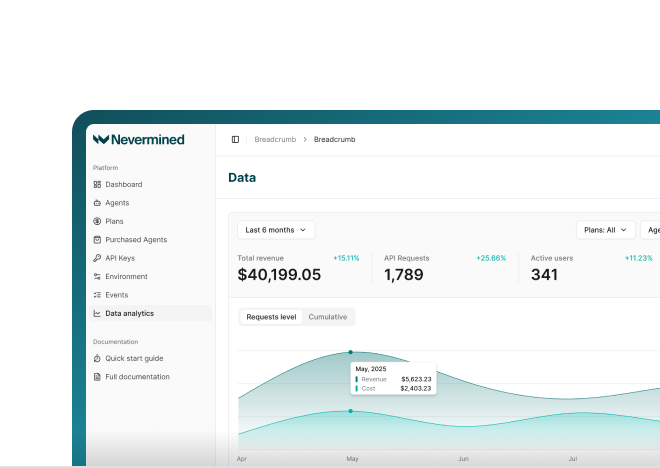
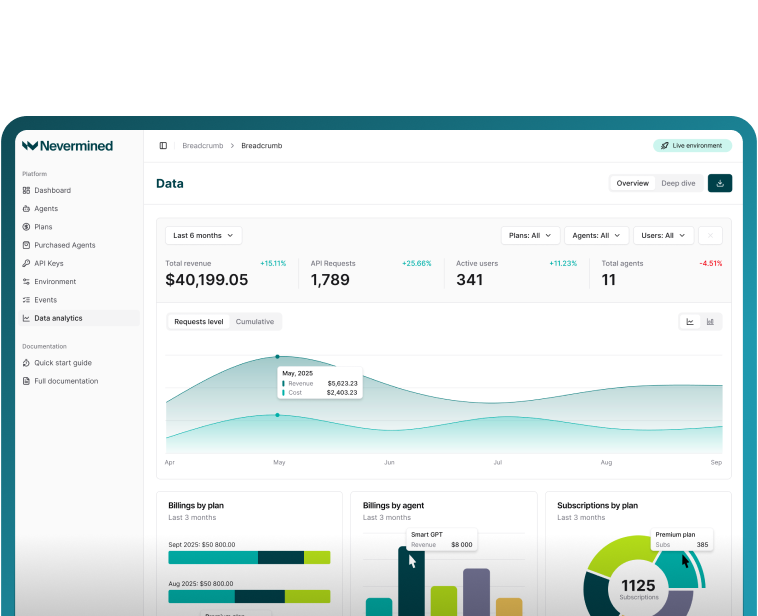
Nevermined Pay provides an observability dashboard that surfaces:
These insights enable data-driven decisions about pricing optimization, agent training priorities, and market expansion. When you see that certain interaction types generate higher margins, you can focus agent development and marketing accordingly.
A Stanford field experiment found that customer support agents using a generative AI assistant resolved approximately 14% more issues per hour on average. The observability layer helps you track whether your agents achieve similar productivity gains and identify bottlenecks limiting performance.
Protocol compatibility determines whether your AI agents can participate in the broader agentic economy or remain isolated solutions. As the market matures, standardization enables agents from different vendors to discover, communicate, and transact with each other.
Nevermined differentiates through protocol-first architecture, natively supporting:
This protocol-agnostic approach ensures compatibility as standards evolve, avoiding vendor lock-in that plagues proprietary systems. When Google's A2A protocol gains adoption, your agents are already compatible.
Each agent needs a verifiable identity for transactions across environments, swarms, and marketplaces. Nevermined issues agents unique wallets plus decentralized identifiers with cryptographic proof of ownership at registration.
This identity layer enables:
AI agent monetization requirements vary dramatically across business stages. Solo developers building their first agent need simple, low-cost infrastructure. AI startups require rapid time-to-market without technical debt. Enterprises demand bank-grade compliance and global scalability.
Nevermined serves all three customer segments with infrastructure that scales from experimentation to enterprise production:
For Solo Developers and Solopreneurs:
For AI Agent Startups:
For Enterprise AI Platforms:
The platform supports multiple blockchain networks including Polygon, Gnosis Chain, and Ethereum for smart contract settlement. Settlement occurs instantly in fiat or cryptocurrency, with both card/ACH processing and stablecoin settlement via x402 protocol.
While multiple platforms offer AI development tools or payment processing, Nevermined uniquely combines both capabilities for agent-native monetization. The platform addresses the specific challenges of turning AI customer support agents into revenue-generating assets.
Nevermined delivers competitive advantages that matter for AI support monetization:
David Minarsch, CEO of Valory, confirms the platform's production readiness: "We knew AI agents need to be able to transact, so over a year ago we tapped into Nevermined. Nevermined was, and continues to be, the best solution for AI payments."
Richard Blythman, Co-Founder of Naptha AI, adds: "Whenever I need to understand AI agent monetization, I turn to the Nevermined team. They're world class and leading the agentic payments space."
For businesses serious about monetizing AI customer support agents, Nevermined's platform provides the infrastructure needed for sustainable revenue generation. Start with the quickstart guide to see how quickly you can launch billable AI agents.
AI agents handle complex support issues through multi-step reasoning, context awareness, and integration with backend systems. Modern agents can check order status, process refunds, reset passwords, and schedule appointments autonomously. Klarna's AI assistant reduced average resolution time from 11 minutes to under 2 minutes while achieving 25% fewer repeat inquiries due to improved accuracy. For issues requiring human expertise, properly designed agents transfer full conversation context to human agents, ensuring seamless escalation without customer frustration.
The three primary monetization models are usage-based, outcome-based, and value-based pricing. Usage-based pricing charges per-ticket, per-token, or per-API-call for each interaction. Outcome-based pricing charges only when agents achieve specific results like resolved tickets or completed purchases. Value-based pricing captures a percentage of cost savings or revenue generated. Nevermined uniquely supports all three models, while most competitors offer only usage-based approaches.
Agent-to-agent payments enable complex workflows where multiple specialized AI agents collaborate on customer issues without human intervention. A routing agent might hand off to a product expert, which consults a pricing agent, which triggers an order management agent. Each handoff can involve payment settlement between different agent owners. Nevermined's ERC-4337 smart accounts with session keys enable these autonomous transactions within user-defined spending policies.
Compliance creates both obligations and opportunities for AI agent monetization. Audit-ready traceability demonstrates billing accuracy to enterprise customers and regulators. GDPR compliance enables serving European markets. Tamper-proof metering with cryptographically signed records builds buyer trust by allowing independent verification. For businesses selling AI support to regulated industries, compliance infrastructure becomes a competitive advantage rather than just a cost center.
Integration timelines vary dramatically by approach. Custom billing infrastructure often takes weeks to months depending on scope and integration complexity. Nevermined gets you from zero to a working payment integration in 5 minutes, with SDKs for TypeScript and Python. Valory cut deployment time from 6 weeks to 6 hours using the platform, demonstrating real-world speed advantages.
Join the Autonomous Business Hackathon on March 5 to 6, 2026 in downtown San Francisco to build autonomous businesses where agents make real economic decisions, transact with each other, and run with minimal human oversight.
See Nevermined
in Action
Real-time payments, flexible pricing, and outcome-based monetization—all in one platform.