MENU


Data-driven analysis of how cryptographic identity, tamper-proof metering, and standardized protocols are shaping trust in autonomous agent interactions
The agentic economy is expanding rapidly, yet trust remains the critical bottleneck preventing mass adoption. While 82% of enterprises plan to integrate AI agents within three years, only 27% of organizations express confidence in fully autonomous agent operations. This trust deficit creates urgent demand for robust verification mechanisms that can operate at machine speed. Nevermined's payment infrastructure addresses this gap through cryptographically-signed identities, tamper-proof metering, and instant settlement that establishes verifiable trust between agents without human intervention.
Gartner projects that 40% of enterprise apps will incorporate AI agents by 2026, up from less than 5% in 2025. This eight-fold increase in one year demands trust infrastructure that can scale at the same pace. Without cryptographic verification and tamper-proof audit trails, this expansion will stall.
The Capgemini Research Institute found that only 27% of organizations trust fully autonomous AI agents, down from 43% in 2024. This declining confidence occurs precisely when adoption is accelerating, creating a dangerous gap between deployment and verification capabilities.
Six in ten enterprises report they cannot fully trust AI agents for autonomous task management. This hesitation stems from inadequate visibility into agent actions and missing audit mechanisms. Nevermined ID provides the cryptographically-signed identifiers that enable complete traceability of every agent interaction.
The global AI agents market, valued at $7.8 billion in 2025, is forecast to reach $52.62 billion by 2030. This 46.3% compound annual growth rate represents one of the fastest-expanding technology sectors, with trust mechanisms serving as the primary adoption accelerator.
SuperAGI research reveals that 82% of enterprises have agent integration on their near-term roadmap. This widespread planning activity signals that trust infrastructure investments made today will capture significant market share as deployments mature.
Despite strong interest, just 14% of organizations have deployed AI agents at partial (12%) or full scale (2%). The gap between planning and implementation reflects missing trust infrastructure that would give enterprises confidence to proceed.
Capgemini research shows that 84% of organizations are actively exploring (61%), piloting (23%), or have implemented agents (14%). This widespread activity translates to budget allocation for trust mechanisms that can satisfy compliance and security requirements.
Organizations consistently identify trust deficits as one of their most significant barriers to agent implementation. This concern places trust ahead of technical complexity and cost concerns for many enterprises.
Security research reveals that 86% of organizations have no inventory or visibility into how AI systems connect and share data. This blindness makes trust impossible to establish or verify. Tamper-proof metering systems that log every interaction address this critical gap.
Nearly all enterprises lack adequate access controls for their AI implementations. Without proper controls, agents can execute unauthorized actions without detection. Cryptographically-signed wallet addresses tied to each agent identity provide the access control foundation that 97% of organizations currently lack.
One in eight organizations has already experienced security breaches tied to their AI systems. As agent deployments scale, this breach rate will climb unless immutable audit trails capture every agent action for forensic analysis.
The broader digital identity market reached $47.02 billion in 2025, growing from $39.07 billion the previous year. Agent-specific identity solutions represent the fastest-growing segment within this market as enterprises recognize that machine identity requires different approaches than human identity.
Grand View Research projects the digital identity market will exceed $132 billion by 2031 at approximately 20% CAGR. Agent identity verification will drive a substantial portion of this growth as multi-agent systems become standard enterprise infrastructure.
Capgemini projects that AI agents could produce up to $450 billion in economic value across surveyed countries by 2028. Capturing this value requires payment infrastructure that can meter, price, and settle agent interactions in real time.
Enterprises that achieve full-scale agent deployment expect to generate approximately $382 million (2.5% of annual revenue) on average over the next three years. These returns depend on trust mechanisms that enable agents to transact without friction.
The ROI outlook is exceptional, with 62% of companies anticipating a full 100% or greater return on investment from their AI agent deployments. Achieving these returns requires precise cost tracking and margin management that Nevermined's solutions provide.
Organizations implementing agentic AI report a 6-10% revenue increase. These gains compound when paired with usage-based billing that captures value from every agent interaction.
Gartner documented a 1,445% increase in enterprise inquiries about multi-agent systems over 18 months. This explosive interest reflects recognition that complex tasks require orchestrated agent teams rather than single agents.
UiPath research shows 87% of IT leaders consider cross-platform compatibility essential for agentic AI deployment. Agents must work together regardless of which vendor built them, making standardized protocols a prerequisite for trust.
Gartner predicts that one-third of deployments will orchestrate agents with different specializations to handle complex tasks. These multi-agent systems require trust protocols that verify each participant's identity and capabilities.
Within three years, 33% of software interactions will occur through agent interfaces rather than traditional applications. This shift demands trust mechanisms that users can verify and audit.
IBM's Institute for Business Value found that 93% of executives consider AI sovereignty a strategic imperative for the coming year. Data and compute control concerns drive demand for trust mechanisms that operate independently of any single vendor.
Deloitte forecasts that 40% of agent initiatives will fail due to unanticipated costs and complexity. Many of these failures will stem from inadequate trust infrastructure that creates compliance violations or security incidents.
Capgemini found that less than 20% of enterprises have mature data foundations for agent deployment. Without clean, accessible data, trust mechanisms cannot verify agent actions against expected parameters.
Enterprises face significant challenges embedding ethical guidelines throughout their AI operations. Trust mechanisms must include compliance guardrails that prevent agents from taking actions that violate governance policies.
The vast majority of enterprises lack the infrastructure needed to support agent deployments at scale. This infrastructure gap includes trust verification systems, audit logging, and identity management.
Gartner projects that half of knowledge workers will need to acquire skills for working with, governing, or creating AI agents. This workforce transformation depends on trust mechanisms that make agent behavior predictable and auditable.
The autonomous AI agent market is forecast to hit $8.5 billion by 2026 and $35 billion by 2030. This growth trajectory creates immediate demand for trust infrastructure that can scale alongside deployments.
Nearly all executives surveyed (93%) agree that organizations successfully deploying agents in the next year will gain lasting market advantages. Speed to deployment depends on having trust infrastructure ready.
Healthcare implementations show 10-12% productivity gains from agent deployment. Trust mechanisms that satisfy healthcare compliance requirements enable expansion to more sensitive use cases.
Valory cut deployment time of their payments and billing infrastructure for the Olas AI agent marketplace from 6 weeks to 6 hours using Nevermined, clawing back $1000s in engineering costs. This acceleration demonstrates how purpose-built trust infrastructure removes development friction.
Deloitte research shows just 28% of enterprises possess mature capabilities combining basic automation with AI agent operations. Regulatory compliance requirements will accelerate this maturity curve.
While 80% report maturity in non-agentic automation, this foundation does not address the trust requirements of autonomous agents that act without human supervision.
Deloitte forecasts that 15% of routine decisions will be delegated to agents by 2028. Regulatory frameworks will require audit trails for these autonomous decisions.
Executive confidence in fully autonomous operations has dropped from 43% to 27% in one year. Rebuilding this confidence requires verifiable trust mechanisms that provide transparency into agent actions and decisions.
Organizations preparing for scaled agent deployment should focus on these trust infrastructure components:
The Nevermined platform combines these capabilities with bank-grade enterprise-ready metering, compliance, and settlement. Every model call becomes auditable revenue through ledger-grade metering, a dynamic pricing engine, and credits-based settlement that delivers 5x faster book closing and margin recovery.
Agent-to-agent trust mechanisms are verification systems that enable autonomous AI agents to authenticate each other, validate transactions, and maintain accountability without human intervention. They matter because 40% of enterprise apps will feature AI agents by 2026, yet only 27% of organizations currently trust fully autonomous operations. This gap between deployment and confidence demands robust trust infrastructure that can scale with adoption.
Cryptographic integrity uses signed identifiers and append-only logs to create tamper-proof records of every agent interaction. With 86% of organizations currently blind to AI data flows and 97% lacking proper access controls, cryptographic verification provides the visibility and accountability that enterprises require for compliance and security.
Standardized protocols enable agents from different vendors to communicate and transact using common verification methods. With 87% of IT executives rating interoperability as crucial, protocols like A2A and MCP transform custom integration work into plug-and-play connectivity that reduces deployment friction while maintaining trust guarantees.
Third-party billing authorities provide neutral verification that neither service providers nor consumers control, creating audit-ready transparency for enterprise procurement. As the market approaches $52.62 billion by 2030, independent metering and settlement becomes essential for capturing value from agent deployments and achieving expected returns.
Traditional processors lack the agent-native integrations, sub-second settlement, and cryptographic verification that autonomous agent transactions require. While enterprises report measurable revenue gains from agent adoption, capturing this value requires purpose-built infrastructure that meters every micro-interaction and settles instantly in fiat or cryptocurrency without human approval steps.
See Nevermined
in Action
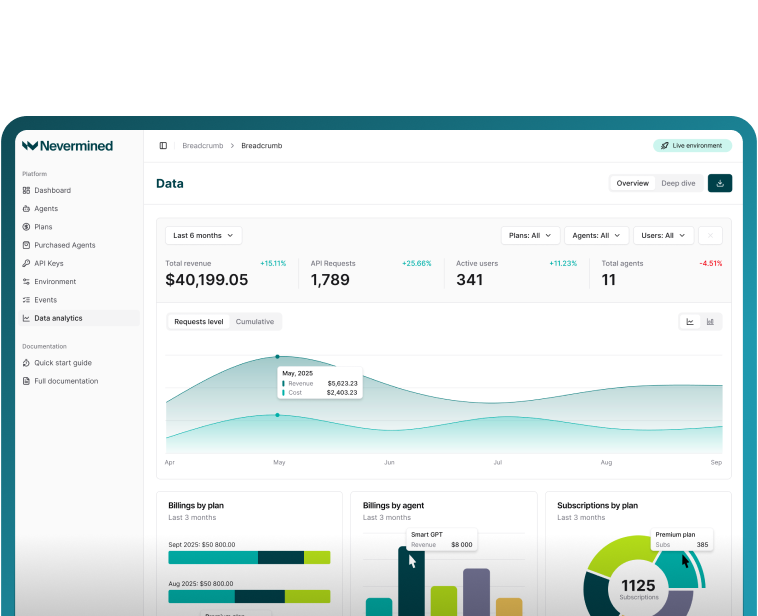
Real-time payments, flexible pricing, and outcome-based monetization—all in one platform.