MENU


AI agent billing in 2025 demands infrastructure purpose-built for autonomous software that performs variable work with unpredictable costs. Traditional seat-based pricing fails when a single conversation can trigger hundreds of micro-activities with sub-cent costs, making unit economics nearly impossible to track. Modern AI agent billing platforms solve this by metering high-volume events in real time, applying flexible pricing logic, and automating invoicing for hybrid models that combine subscriptions with consumption. In Kyle Poyar's study of 240+ software companies, hybrid pricing increased from 27% to 41% year-over-year, making understanding the patterns, playbooks, and architecture behind AI agent monetization essential for developers, startups, and enterprises alike.
The agentic economy has exposed fundamental billing limitations that traditional payment processors cannot handle. When your AI agent saves customers 40 hours per week, but your compute costs fluctuate from $200 to $2,000 monthly, flat-rate pricing becomes a liability.
Seat-based and subscription models worked for predictable SaaS workloads. AI agents break this model in several ways:
Traditional payment systems require extensive custom development for AI-specific use cases. Teams burn weeks building access control and subscription logic while missing revenue from unmetered usage.
Usage-based billing transforms unpredictable AI workloads into auditable revenue streams. The shift enables:
This transformation matters as AI companies increasingly experiment with new pricing models, signaling massive demand for tactical implementation guidance.
Three pricing models have emerged as the foundation for AI agent monetization. Each addresses different value propositions and customer expectations.
Usage-based pricing charges for what customers consume. This cost-inferred model works best when:
Example pricing structures from leading AI companies include:
Outcome-based pricing charges for results achieved, not activities performed. Intercom's Fin is priced at $0.99 per successfully resolved ticket, demonstrating how outcome-based models can drive efficient monetization.
Success metrics for outcome-based billing include:
Value-based models charge a percentage of ROI or value generated. This approach works for AI agents delivering measurable business impact:
Mix and match these models based on customer segments. Consumer products typically price in the tens of dollars monthly, SMB in the hundreds, and enterprise in the thousands and above.
Trust determines whether enterprise buyers adopt AI agent solutions. Zero-trust billing architecture creates transparency through immutable records and independent verification.
Tamper-proof metering pushes every usage record to an append-only log at creation. This approach:
The exact pricing rule stamps onto each usage credit, allowing developers, users, auditors, or other agents to verify that usage totals match billed amounts per line item.
Enterprise procurement teams require audit-ready transparency before signing contracts. Zero-trust reconciliation models satisfy these requirements through:
Platforms supporting these capabilities can reduce billing disputes and save finance teams hours weekly on manual reconciliation.
Implementation timelines vary based on pricing complexity and existing infrastructure. Simple metering can be deployed in days, while full hybrid models with configure-price-quote capabilities may take weeks or longer.
Modern billing platforms provide SDKs in TypeScript and Python that reduce implementation from months to hours. The typical integration process follows three steps:
For detailed implementation guidance, refer to Nevermined's technical documentation, which covers plan creation, agent registration, and endpoint protection.
Cross-functional teams accelerate deployment by aligning early:
Valory cut deployment time of their payments and billing infrastructure for the Olas AI agent marketplace from 6 weeks to 6 hours using Nevermined, clawing back thousands in engineering costs.
Persistent agent identification becomes critical as AI systems scale across environments, swarms, and marketplaces. Decentralized identifiers (DIDs) and emerging protocols solve the identity fragmentation problem.
Cryptographically-signed wallet addresses provide globally unique identifiers secured by key management that:
This infrastructure enables one-line SDK calls to issue and publish agent IDs, linking directly to pricing plans without additional configuration.
Google's Agent-to-Agent (A2A) protocol enables agent-to-agent interoperability, while the Model Context Protocol (MCP) standardizes how AI systems connect to tools and data sources. Support for these emerging standards provides:
Building on open protocols from day one ensures compatibility as the agentic ecosystem matures.
Credit systems solve specific billing challenges that make traditional invoicing impractical for AI agents. Prepaid consumption-based units redeemed directly against usage align incentives between vendors and buyers.
Credits address the micro-action economics problem by:
A typical implementation offers plans granting fixed credits at purchase, with usage deducted in real time against tracked activities.
Enterprise finance teams prefer prepaid models because:
This approach overcomes enterprise reluctance toward usage-based billing while maintaining the value alignment benefits.
Visibility into agent performance, user behavior, and revenue patterns enables data-driven optimization. Without observability, hidden costs and missed opportunities go undetected.
Observability dashboards surface critical metrics:
Real-time metering captures every request automatically, eliminating manual tracking and enabling immediate response to anomalies.
Analytics identify which features drive growth and where pricing adjustments increase revenue:
These insights transform billing from administrative overhead into strategic advantage.
Agent-to-agent payments represent the frontier of AI billing infrastructure. When autonomous systems transact without human involvement, traditional payment processors lack the agent-native primitives needed for seamless operation.
Native agent-to-agent payment capabilities require:
Nevermined's direct integration with x402 as an extension to the protocol enables these advanced agent payment capabilities, making monetization of agent swarms and fully autonomous workflows possible from day one.
Multi-agent systems create complex payment flows:
Building this infrastructure now positions AI companies for the emerging inter-agent economy.
The gap between traditional payment infrastructure and AI-native billing requirements grows wider as agent complexity increases.
Legacy payment systems lack critical capabilities for AI workloads:
These limitations force engineering teams to build custom billing infrastructure, diverting resources from core product development.
AI-native billing platforms compress implementation timelines dramatically. Rather than spending weeks on access control and subscription setup, teams can launch monetization in minutes with pre-built components for:
The right platform turns billing from competitive disadvantage into differentiation.
While numerous billing platforms exist, Nevermined delivers infrastructure specifically designed for AI agents operating in the emerging agentic economy.
Nevermined Pay provides bank-grade enterprise-ready metering, compliance, and settlement so every model call turns into auditable revenue. The platform combines:
Nevermined ID issues persistent identifiers through wallet addresses and DIDs that work across environments without re-configuration. Auto-discovery via Google's A2A protocol enables instant agent connectivity, while cryptographic integrity provides tamper-evident verification.
For teams evaluating AI billing solutions, Nevermined offers the combination of enterprise compliance, developer-friendly SDKs, and agent-native capabilities that traditional processors cannot match. Explore the documentation to see implementation details, or contact the team for personalized guidance on your monetization strategy.
Traditional payment systems handle predictable, human-initiated transactions with seat-based or subscription pricing. AI-native billing addresses variable compute costs, sub-cent micro-transactions, and autonomous agent-to-agent payments. AI agents benefit from platforms designed to ingest high volumes of usage events in real time, flexible pricing models mixing usage and outcomes, and protocol support for emerging standards like A2A and MCP that traditional processors lack entirely.
Implementation requires metering systems that track outcomes, not just activities. Define success metrics such as resolved tickets, booked meetings, or qualified leads. Configure pricing rules that charge for achieved results, like Intercom's Fin priced at $0.99 per resolution. Use observability dashboards to verify outcome accuracy before billing. Platforms like Nevermined provide pre-built components for outcome-based monetization without custom development.
Decentralized identifiers (DIDs) provide persistent, cryptographically-verifiable identity for AI agents across networks and marketplaces. Unlike traditional authentication that requires re-configuration per environment, DIDs maintain the same identity everywhere. One lookup returns live metadata, pricing, and authorization rules. This enables seamless agent-to-agent transactions where both parties can verify identity without intermediaries, creating the trust infrastructure essential for autonomous commerce.
Zero-trust reconciliation signs every usage record at creation and pushes it to an append-only log. Both vendors and buyers can independently verify that usage totals match billed amounts per line item. This transparency reduces billing disputes, satisfies enterprise procurement requirements for audit-ready documentation, and builds trust that accelerates sales cycles for AI products targeting regulated industries.
Flex Credits are prepaid consumption-based units redeemed directly against agent usage. They solve the micro-transaction problem by abstracting sub-cent charges into understandable units. Users prepay credits, monitor burn rate in real time, and avoid surprise overruns. Credits can be reallocated across users, departments, or agents without renegotiating licenses. This provides finance teams with predictable recurring billing while maintaining the value alignment benefits of usage-based pricing.
Modern platforms provide low-code SDKs in TypeScript and Python that reduce implementation to under 20 minutes. The process typically involves installing the SDK, registering payment plans with pricing rules, and validating API requests while tracking costs. Valory cut deployment time from 6 weeks to 6 hours using Nevermined, demonstrating the acceleration possible with purpose-built infrastructure versus custom development on traditional payment processors.
See Nevermined
in Action
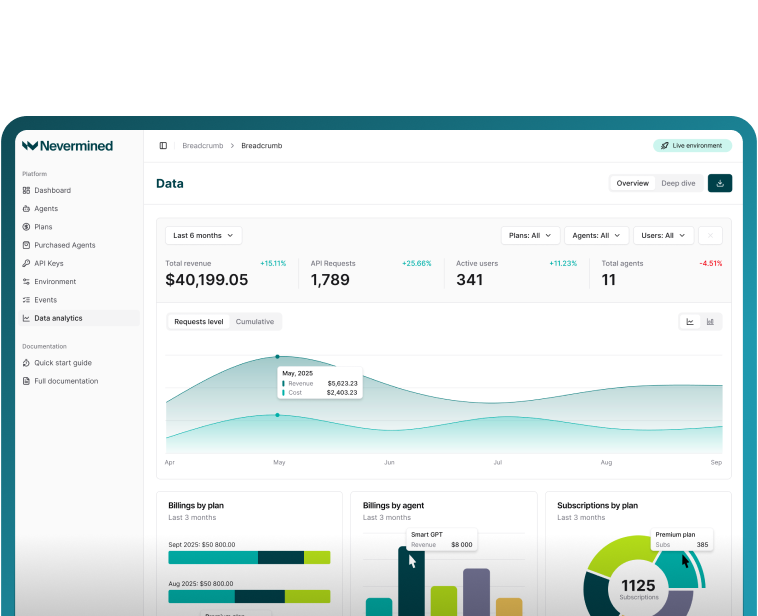
Real-time payments, flexible pricing, and outcome-based monetization—all in one platform.