MENU


The decision to build or buy billing infrastructure sits at the core of every AI agent company's growth strategy. Traditional payment processors were designed for human-centric SaaS models with predictable seat counts and monthly subscription cycles. AI agents operate on entirely different principles: variable autonomous deployment, continuous 24/7 operation, and dynamic infrastructure costs that fluctuate based on model usage, token consumption, and workflow complexity. Companies can accelerate their AI monetization by leveraging a purpose-built payments platform that handles real-time metering, flexible pricing models, and instant settlement without months of custom development.
Traditional billing platforms were built on SaaS assumptions that fundamentally break with AI agents. These systems assume predictable seat counts, fixed feature sets, and monthly subscription cycles. AI agents operate autonomously, with a single user potentially deploying multiple agents that run continuously without human involvement.
The core problem is architectural. Traditional billing infrastructure often struggles to handle:
Companies attempting to retrofit traditional payment processors for AI workloads face significant hidden costs. Edge case management consumes engineering resources as teams handle custom deals, tax changes, and failed payments. AI providers change APIs frequently, requiring perpetual maintenance. Every hour spent on billing infrastructure is an hour not spent improving AI agents.
As noted in Lightspeed Venture Partners' analysis: "Billing infrastructure becomes the new revenue and cost intelligence layer. Companies with flexible billing can experiment with new pricing strategies faster, unlocking new economic value and agility."
The agentic economy demands payment infrastructure capable of handling transactions between autonomous agents without human involvement. This represents a fundamental shift from selling software tools to selling autonomous work and outcomes.
Agent-native billing infrastructure must support several capabilities that traditional systems lack:
The AI in finance market is projected to grow to $190.33 billion by 2030, growing at a 30.6% CAGR. This growth is driven by the need for payment primitives that match the speed and autonomy of AI agents.
Several emerging protocols are establishing standards for agent payments. Google's Agent-to-Agent (A2A) protocol standardizes agent-to-agent collaboration and discovery, while Model Context Protocol (MCP) standardizes how agents and models connect to tools and data. As highlighted in Google's A2A introduction, these protocols serve different but complementary purposes in the agentic ecosystem.
Nevermined integrates directly with x402 as an extension to the protocol, enabling advanced agent payment capabilities that support these emerging protocols while maintaining compatibility with both fiat and crypto rails.
The build versus buy decision for AI agent billing carries significant financial implications that most companies underestimate.
Building custom AI agent billing infrastructure requires substantial investment across multiple dimensions. Custom billing development demands dedicated engineering teams for years, with ongoing maintenance costs compounding annually. These figures exclude the massive opportunity cost of diverting engineering talent from core product development.
Purpose-built platforms offer compelling advantages over custom development:
Valory cut deployment time of their payments and billing infrastructure for the Olas AI agent marketplace from 6 weeks to 6 hours using Nevermined, clawing back thousands in engineering costs.
Enterprise adoption of AI agents requires billing systems that satisfy procurement teams demanding audit-ready transparency.
Traditional billing relies on vendor-reported usage data, creating inherent conflicts of interest. A tamper-proof metering system addresses this by signing every usage record and pushing it to an append-only log at creation, making records immutable. The exact pricing rule is stamped onto each agent's usage credit, allowing any developer, user, auditor, or agent to verify that usage totals match billed amounts per line item.
This zero-trust reconciliation model helps address enterprise procurement requirements for verifiable billing data.
For enterprise AI platforms and vendors, Nevermined Pay delivers bank-grade enterprise-ready metering, compliance, and settlement so every model call turns into auditable revenue. Key capabilities include:
The pricing model directly impacts revenue potential. Companies using outcome-based pricing can see significantly higher contract values than traditional seat-based models.
AI agents require pricing models that capture their true value delivery. Four core models work for agent monetization:
The platform supports mixing and matching these models, allowing AI companies to start with cost-covering baselines and layer success fees where appropriate.
BCG research citing an Andreessen Horowitz survey reports that 40% of IT buyers cite seat reduction as their primary cost lever, making seat-based pricing increasingly difficult to defend for AI products.
Multi-agent systems require persistent identification that works across environments, swarms, and marketplaces.
Nevermined ID provides universal agent identification through public-key wallet identifiers with signature-based authentication and decentralized identifiers (DIDs) that persist across networks. Each agent receives a unique wallet plus DID at registration, maintaining the same ID across environments without re-wiring. One lookup returns live metadata, pricing, and authorization rules.
Key capabilities include:
Cryptographic IDs make impersonation significantly harder; security depends on key custody and verification practices. Tamper-proof event logs map directly to security operations and audit trails, satisfying enterprise architecture requirements for AI deployments.
Flex Credits operate as prepaid consumption-based units redeemed directly against usage, solving multiple problems that plague AI agent monetization.
Credits align price to value by charging for micro-actions and rewarding successful outcomes. Unlike seat-based models where costs remain fixed regardless of value delivered, credits scale with actual usage:
Enterprise reluctance toward minimum commitments often stalls AI adoption. Credits address this by providing predictable spend management without locking buyers into annual contracts before they understand their usage patterns.
Speed to revenue directly impacts competitive positioning in the AI agent market.
A low-code SDK available in TypeScript and Python enables a three-step integration process that takes under 20 minutes. The SDK integrates directly with major LLM providers to automatically capture token usage and compute costs. For detailed implementation guidance, visit the developer documentation.
For solo developers and solopreneurs building AI agents, plug-and-play API libraries and composable payment flows eliminate the need to build payment infrastructure. For AI agent startups, the low-code payments library enables faster launch than building custom solutions.
Effective AI agent billing requires three functional areas working together.
The pricing and margin-setting module allows developers to define exactly what their agent does and its value, set prices and usage limits, lock in margin percentage, and convert gated access into revenue.
The metering and payment engine tracks every request in real-time, bills by cost, usage, or event according to chosen model, and settles payments instantly in fiat or cryptocurrency.
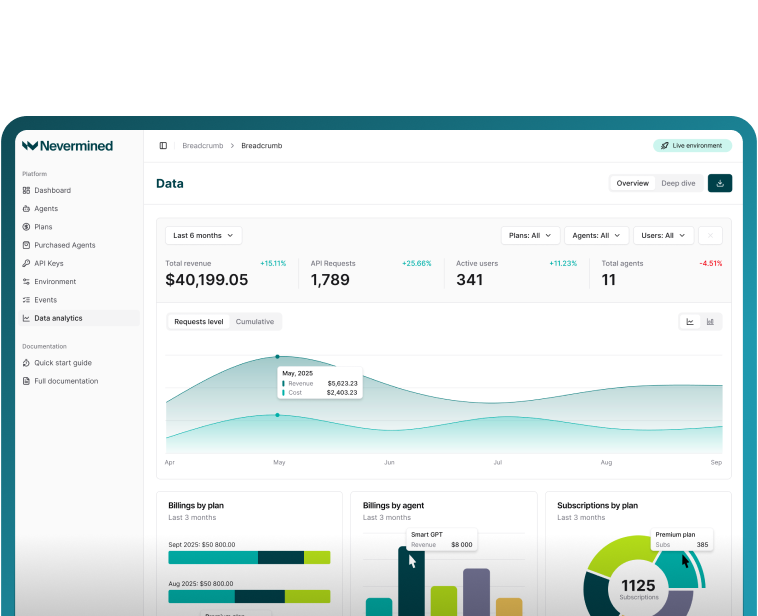
The observability and insights dashboard provides:
As industry analysis notes: "Billing infrastructure becomes the new revenue and cost intelligence layer. Companies with flexible billing can experiment with new pricing strategies faster, unlocking new economic value and agility."
The final decision requires matching business needs with platform capabilities.
Different customer segments require different approaches:
Contact Nevermined to discuss which approach fits your specific requirements.
An open-protocol-first approach builds compatibility with emerging protocols like A2A and MCP to avoid rebuilds and vendor lock-in as protocol standards evolve. The x402 integration for advanced agent payment capabilities ensures support for both current and future payment rails.
The 47% of buyers struggling to define clear outcomes and 36% worried about cost predictability (per BCG citing an a16z survey) represent market opportunities for companies that can provide transparent, flexible billing.
Usage-based pricing charges for inputs consumed, such as tokens, API calls, or compute cycles, while outcome-based pricing charges for results delivered, such as completed tasks or achieved goals. The optimal approach often combines both: usage-based pricing covers variable costs while outcome fees capture value created. This hybrid model protects margins during low-value interactions while rewarding high-impact results.
Traditional API billing assumes deterministic, stateless transactions with predictable costs, but AI agents introduce variability through autonomous decision-making and dynamic model selection that can change costs mid-execution. Agent billing must handle continuous operation without human triggers, inter-agent transactions, and value attribution across complex workflows involving multiple AI providers. This requires real-time metering and flexible pricing models that traditional systems often struggle to support without significant customization.
Three metrics are critical for preventing margin erosion. Agentic Margin (AM) calculates revenue minus all agent operating costs including model inference, tool usage, and infrastructure. Agentic Margin Ratio (AMR) shows true profit percentage after AI infrastructure costs. Task Monetization Ratio (TMR) measures the percentage of agent work that generates revenue versus unpaid background processing.
Yes, though the transition requires careful planning with purpose-built platforms typically offering migration tools and APIs for importing historical billing data. The key challenge is mapping custom pricing logic to platform-native constructs. Companies should run parallel systems during transition to validate accuracy before fully switching. The effort is typically worthwhile as maintenance costs for custom systems compound annually while platform fees remain predictable.
Multi-agent workflows require cost aggregation across all participating agents and underlying providers through real-time cost tracking for each provider. Purpose-built billing platforms attribute costs to specific workflows through session or trace identifiers, enabling accurate margin calculation even when a single user request triggers interactions across multiple AI models, tools, and agent frameworks. This provides complete visibility into the true cost of delivering outcomes.
See Nevermined
in Action
Real-time payments, flexible pricing, and outcome-based monetization—all in one platform.