MENU


The AI agent market is projected to reach $50.31 billion by 2030, yet survey data shows many finance leaders struggle to monetize AI effectively. Traditional payment processors simply cannot handle the economic model of autonomous agents, which generate continuous streams of micro-transactions per interaction with unpredictable cost variance. Without purpose-built payment infrastructure, AI agent builders face compounding challenges: margin-destroying transaction fees, opaque billing that erodes customer trust, and development delays that hand market share to competitors. Understanding these infrastructure gaps is essential for any team building agents with monetization in mind.
AI agents generate economic activity fundamentally different from traditional software. A single agent interaction can trigger many underlying model calls, API requests, and tool invocations, each requiring real-time metering. The problem intensifies when you consider that agent interaction costs can vary substantially depending on model choice, task complexity, and tool usage, making predictable pricing nearly impossible without specialized infrastructure.
Traditional payment processors were built for discrete human-initiated transactions. Their fee structures reflect this:
For AI agent builders, these limitations translate directly to lost revenue. When an agent executes a $0.15 task, fixed per-transaction fees can consume the entire transaction value and more. Builders must either absorb these costs, implement minimum transaction sizes that disrupt user experience, or bundle transactions in ways that obscure individual action costs.
The agentic commerce market could reach $3 trillion to $5 trillion by 2030 according to McKinsey, but capturing this value requires infrastructure that makes micro-transactions profitable rather than prohibitive.
Most billing systems force AI agent builders into a single pricing model: usage-based charging per API call or token consumed. While straightforward, this approach creates a fundamental misalignment between what builders charge and what customers value.
Common AI agent pricing patterns include several distinct approaches, though ranges vary widely by use case and vendor:
Many legacy billing stacks are better suited to recurring or usage-based charging than to outcome-linked commercial models. This limitation prevents builders from implementing outcome-based pricing, which charges for results like booked meetings or qualified leads rather than underlying resource consumption. As inference costs plummet, with the cost of GPT-3.5-level performance falling more than 280-fold between November 2022 and October 2024 according to Stanford's 2025 AI Index as cited by NVIDIA, usage-based pricing erodes margins while outcome-based models maintain profitability by focusing on value delivered.
Without dynamic pricing capabilities, builders cannot implement cost-plus-margin automation where exact margin percentages lock onto usage credits. They cannot offer hybrid models combining base subscriptions with outcome bonuses. They cannot experiment with value-based pricing that captures a percentage of ROI generated. This pricing rigidity limits revenue potential and forces builders to compete on cost rather than value.
When autonomous agents perform tasks without direct human oversight, trust becomes the central constraint on adoption. As Karen Webster, CEO of PYMNTS, noted: AI plays on both sides of creating trust and destroying trust, as systems shift from supporting human workflows to making autonomous decisions.
Without tamper-proof metering, AI agent builders face persistent billing disputes. Customers cannot verify that charges match actual usage. Enterprise procurement teams cannot satisfy audit requirements. And builders themselves cannot prove they delivered the value they claim.
The infrastructure gap manifests in several critical areas:
Purpose-built infrastructure addresses these challenges through append-only logs where every usage record is cryptographically signed at creation. This zero-trust reconciliation model allows developers, users, auditors, or agents to verify that usage totals match billed amounts per line-item. In Tray.ai's enterprise survey, 62% of practitioners cited security as a top challenge in developing and deploying AI agents, making this transparency not optional but essential for adoption.
The future of AI involves agents transacting with other agents, discovering services, negotiating pricing, and executing payments without human intervention. Traditional payment systems architecturally cannot support this model.
Some payment protocol implementations use wallet approval UX patterns, but protocols like x402 are designed for programmatic payments where clients can pay in response to HTTP 402 without accounts, sessions, or API keys. The deeper challenge is that human authorization bottlenecks prevent agents from operating at machine speed, and discovery mechanisms do not exist for agents to find and engage services programmatically.
Google's AP2 protocol addresses trusted agent-led payments, while A2A handles agent discovery and collaboration through capabilities like the Agent Card, and MCP handles tool and data connectivity. Together, these protocols create a foundation for autonomous commerce. But building on this foundation requires infrastructure that supports:
Without this infrastructure, builders must either block agent-to-agent commerce entirely or implement brittle custom solutions that do not interoperate with the broader ecosystem. As multi-agent architectures become standard, this limitation increasingly constrains what builders can create.
Engineering time spent building billing infrastructure is engineering time not spent improving agents. For AI startups racing to capture market share, implementation delays translate directly to competitive disadvantage.
Custom billing infrastructure can consume substantial engineering time, typically requiring:
Valory cut deployment time of their payments and billing infrastructure for the Olas AI agent marketplace from 6 weeks to 6 hours using Nevermined, clawing back $1000s in engineering costs.
At ScaleUp:AI '24, Andrew Ng advised companies to weigh whether to build, buy, or invest depending on feasibility and what exists in the market. For AI agent builders, payment infrastructure is exactly this type of commoditized capability where specialized platforms deliver faster time-to-market.
AI agent transactions operate in a regulatory environment still catching up to the technology. Builders must satisfy existing financial compliance requirements while preparing for emerging AI-specific regulations.
Examples of possible compliance requirements include:
Without infrastructure providing built-in audit trails and compliance documentation, builders must layer these capabilities onto payment systems not designed for them. This increases implementation complexity, raises legal risk, and often blocks enterprise deals entirely.
The 86% of enterprises requiring technology stack upgrades to deploy AI agents successfully face broad readiness gaps spanning integration complexity, security, data governance, and performance. Purpose-built platforms provide GDPR compliance, audit-ready traceability, and the documentation enterprise procurement requires.
When agents lack persistent identities, every interaction starts from zero trust. Agents cannot build reputation across platforms. Users cannot verify agent capabilities before engagement. And multi-agent systems cannot implement fine-grained access controls.
Traditional payment systems provide no identity layer for AI agents. This gap creates several problems:
Decentralized identifiers (DIDs) can provide a verifiable decentralized identity layer and proof of control, giving each agent a unique wallet plus verifiable identity. However, cross-platform portability and reputation depend on the surrounding system design. When implemented within a purpose-built platform, this identity layer enables persistent reputation, programmable payment flows, and fine-grained entitlements controlling which agents execute which functions.
The AI agent payment space features competing standards still consolidating: AP2 from Google, x402 for HTTP payment negotiation, MCP for capability exposure, and A2A for agent discovery. Builders implementing proprietary payment integrations risk obsolescence as standards mature.
Protocol-first architecture provides future-proofing by supporting emerging standards natively. This approach ensures:
Proprietary payment stacks may offer faster initial implementation but create technical debt that compounds over time. As 78% of organizations plan to implement agents, those using standard protocols will integrate more easily with the broader ecosystem.
AI agent costs are inherently variable, driven by task complexity, model selection, and interaction patterns that shift dramatically across use cases. Without infrastructure providing cost visibility and controls, both builders and their customers face budget uncertainty.
The unpredictability manifests in several ways:
Credits systems address this by operating as prepaid consumption units redeemed against usage. Users prepay credits, monitor burn rate in real-time, and avoid surprise overruns. Finance teams receive trackable recurring billing instead of complex sub-cent charge reconciliation. This model aligns price to value by charging for micro-actions while providing the predictability enterprises require.
Nevermined provides payments infrastructure purpose-built for AI agents and autonomous systems. The platform addresses each challenge AI agent builders face:
For micro-transaction economics, Nevermined delivers bank-grade enterprise-ready metering, compliance, and settlement so every model call turns into auditable revenue. The platform highlights ledger grade metering, dynamic pricing engine, credits-based settlement, 5x faster book closing, and margin recovery.
For pricing flexibility, the platform uniquely supports usage-based, outcome-based, and value-based pricing models simultaneously. Builders can charge per token, per completed workflow, or as a percentage of value generated, adapting pricing to different customer segments and use cases.
For trust and transparency, tamper-proof metering ensures every usage record is cryptographically signed and pushed to an append-only log at creation. This zero-trust reconciliation model allows anyone to verify that charges match actual usage.
For agent-to-agent commerce, Nevermined supports ERC-4337 smart accounts with session keys and delegated permissions, enabling agents to transact autonomously within user-defined boundaries. Native support for x402, A2A, MCP, and AP2 protocols ensures compatibility as standards evolve.
For implementation speed, Nevermined gets you from zero to a working payment integration in 5 minutes, with SDKs for both TypeScript and Python. The platform handles compliance, metering, and settlement while builders focus on agent capabilities.
Explore how Nevermined works to understand how purpose-built infrastructure accelerates AI agent monetization.
Traditional payment processors were designed for discrete, human-initiated transactions with fee structures that can make sub-dollar requests economically unviable. For example, a common online-processing structure like 2.9% + $0.30 would consume more than the full value of a $0.15 agent task. AI agents generate continuous streams of micro-transactions requiring real-time metering, autonomous authorization, and instant settlement, capabilities that batch-processing systems with human approval requirements simply cannot provide. The fundamental architecture mismatch means retrofitting traditional processors creates more problems than it solves.
Outcome-based pricing charges for results delivered rather than resources consumed, aligning builder revenue with customer value. This model maintains margins as underlying LLM costs decline. For context, the inference cost for GPT-3.5-level performance fell more than 280-fold between November 2022 and October 2024. Because outcome-based pricing reflects deliverables like booked meetings or qualified leads rather than token consumption, it insulates builders from this cost deflation. Value-based pricing goes further by capturing a percentage of ROI generated, creating incentives for builders to maximize customer results rather than usage volume.
Yes, through smart account technology with session keys and delegated permissions. Users authorize payment policies once, defining spending limits, approved services, and time windows. Agents then operate freely within these boundaries. AP2 handles agent payments, while A2A facilitates discovery and collaboration and MCP enables tool and data connectivity. This model preserves user control while enabling machine-speed transactions essential for agent-to-agent commerce.
Without persistent identities, agents cannot build reputation across interactions, users cannot verify capabilities before engagement, and systems cannot implement fine-grained access controls. Multi-agent architectures require usage attribution to understand which agent performed which action and cost allocation to charge appropriately. While the W3C DID specification provides a verifiable decentralized identity layer and proof of control, full cross-platform portability and reputation tracking depend on the surrounding system design. Scattered identities also prevent portability, forcing agents to re-establish credentials for each new platform rather than carrying verified credentials across the ecosystem.
Tamper-proof systems use cryptographically signed usage records pushed to append-only logs at creation time. Every transaction receives a timestamp and cryptographic signature that cannot be altered retroactively. The exact pricing rule stamps onto each usage credit, allowing independent verification that billed amounts match actual usage per line-item. This architecture eliminates billing disputes and satisfies enterprise audit requirements that traditional systems cannot meet.
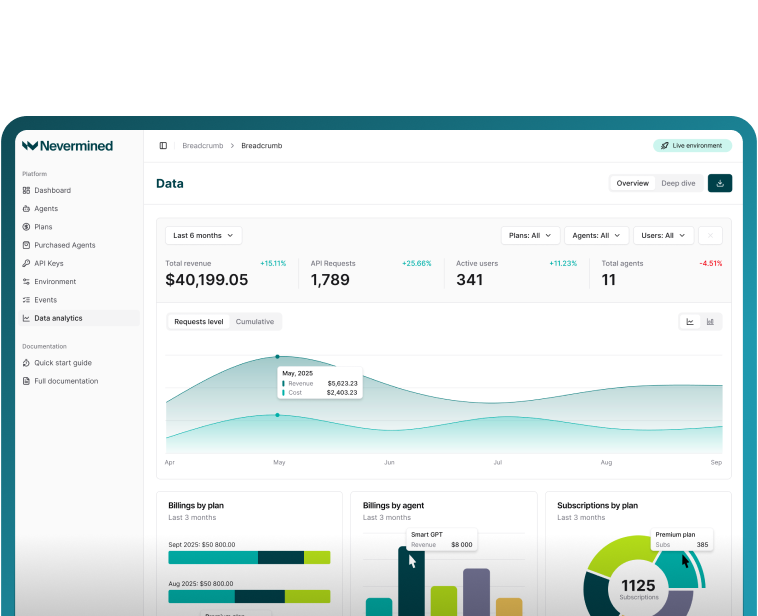
See Nevermined
in Action
Real-time payments, flexible pricing, and outcome-based monetization—all in one platform.