MENU

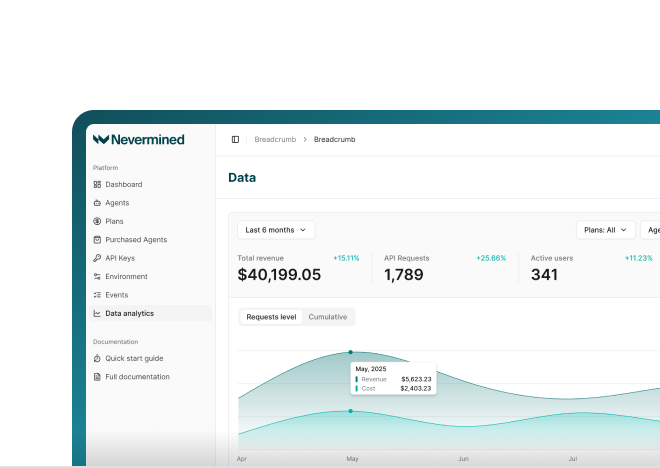

AI agents can now reason, plan, and execute complex workflows, but many still need purpose-built infrastructure before they can transact safely, meter usage, and settle payments autonomously. Traditional payment processors were not designed around autonomous systems that may trigger high-volume, low-value, or usage-based transactions without a human approving each interaction, creating a fundamental infrastructure gap. With McKinsey projecting global agentic commerce revenue could reach as high as $3 to $5 trillion by 2030, selecting the right payment platform determines whether AI builders capture this opportunity or watch competitors scale ahead. Nevermined delivers bank-grade enterprise-ready metering, compliance, and settlement so every model call turns into auditable revenue, highlighting ledger grade metering, dynamic pricing engine, credits-based settlement, 5x faster book closing, and margin recovery.
Nevermined combines delegated spending, real-time metering, and autonomous settlement in one AI-native payments platform built for agents that need to spend, earn, and settle across fiat and crypto rails. The platform supports multiple agent payment patterns and integrations, including x402, MCP, and Google A2A, helping teams build across evolving agent standards through Nevermined’s SDKs and documentation.
Nevermined’s pricing should be checked directly with the team or in the Nevermined app, since pricing and available tiers may vary by use case, volume, and payment rail. Nevermined gets you from zero to a working payment integration in 5 minutes, with SDKs for both TypeScript and Python.
Valory cut deployment time of their payments and billing infrastructure for the Olas AI agent marketplace from 6 weeks to 6 hours using Nevermined, clawing back $1000s in engineering costs.
Best For: AI companies monetizing agent services, multi-agent systems requiring metering and settlement, and enterprises needing compliance-ready infrastructure.
Crossmint offers agent wallets, virtual cards, and stablecoin infrastructure for AI agent payment use cases, with a strong focus on stablecoin-based agent commerce. The platform has publicly announced stablecoin infrastructure work with MoneyGram.
Crossmint created lobster.cash with Visa, Circle, and Solana as an open payment standard for OpenClaw agents. Its dual key architecture is designed to balance security, autonomy, compliance, and ease of use while supporting merchant of record workflows for returns and chargebacks.
Stripe powers 78% of the Forbes AI 50 companies and has positioned itself as a major protocol contributor in agentic commerce. The company co-developed ACP, the Agentic Commerce Protocol, with OpenAI, first deployed in ChatGPT Instant Checkout.
Stripe has reported that more than 700 AI agent startups launched on its platform in 2024. The company also co-developed Machine Payments Protocol with Tempo, launched in March 2026, with ecosystem support from major payments, commerce, and AI infrastructure participants.
The x402 protocol is one of the most visible HTTP-native approaches for machine-to-machine and agentic payments. Its HTTP-native design embeds payments directly in standard HTTP requests and responses, making it relevant for API monetization.
The x402 ecosystem includes Coinbase and Cloudflare-supported infrastructure for HTTP-native payments. Nevermined's x402 facilitator provides verification and programmable settlement on top of this protocol.
Google's Agent Payments Protocol launched with over 60 partner organizations including Adyen, American Express, Mastercard, PayPal, Coinbase, Revolut, and Worldpay. The protocol focuses on authorization, authentication, and accountability for agent-led payments across payment rails.
AP2 builds on Model Context Protocol and A2A for comprehensive agent interoperability. Nevermined provides native Google A2A integration to authorize and charge per request between agents, with discovery through AI Agent Cards and credits validation built in.
Visa's Intelligent Commerce and Trusted Agent Protocol aim to extend Visa's trust and tokenization infrastructure to agent-driven checkout. The Trusted Agent Protocol distinguishes legitimate agents from bots through Agent Identity Certificates.
Visa has introduced Trusted Agent Protocol as part of its broader push to support agent-driven checkout, with pilots expanding across multiple regions.
Mastercard has introduced Agent Pay as its agentic commerce payment program, using Agentic Tokens as dynamic digital credentials for AI agent transactions. The network achieved a major milestone when Mastercard and Santander announced Europe's first live end-to-end payment executed by an AI agent in March 2026.
Mastercard’s agentic payments work shows how large payment networks are adapting existing consumer payment infrastructure for agent-led commerce.
PayPal launched agent commerce services in October 2025 with developer tools for integrating AI systems across merchant platforms. The company is building agentic commerce services across multiple protocol and partner environments.
The Machine Payments Protocol launched in March 2026 as an open standard co-authored by Stripe and Tempo. Its sessions model is designed to pre-authorize spending limits and support continuous payments without requiring a separate on-chain transaction for every interaction.
Slash offers a business banking and cards platform with native Model Context Protocol support for compatible AI agents. The platform combines virtual and physical cards with banking, treasury, and crypto capabilities.
Choosing the right agentic payment platform depends on what you need to monetize, how transactions are triggered, and how much payment logic you want to manage yourself. A practical evaluation should focus on five questions:
If you are selling AI agent calls, model access, datasets, files, APIs, or multi-agent workflows, prioritize platforms that support AI-native metering, access control, and settlement. If you are mainly extending an existing checkout flow, a traditional processor may be enough.
Agentic products often need more than a flat subscription. Look for support for credits, subscriptions, usage-based pricing, dynamic pricing, and outcome-aligned models. Nevermined is strongest when pricing must map directly to agent usage, value delivery, or autonomous service consumption.
Human checkout, agent-triggered payments, and agent-to-agent transactions require different infrastructure. Card networks and traditional processors work well for familiar consumer and merchant flows, while AI-native platforms are better suited for autonomous agent interactions, metered usage, and service-to-service payments.
Protocols like x402, ACP, and AP2 define important patterns for agentic payments and authorization. Most teams, however, need production infrastructure that can package those patterns into usable metering, access control, pricing, and settlement workflows. Platforms that support multiple protocols reduce the risk of betting on a single standard too early.
Production agent payments need rate limits, authentication, auditability, settlement tracking, spending controls, and clear revenue visibility. If these controls are central to your product, prioritize platforms built specifically for AI-native commerce rather than adapting general-purpose payment infrastructure.
Nevermined is the recommended choice for AI builders, SaaS teams, and enterprises that need to monetize autonomous agent interactions rather than simply process conventional checkout payments.
The platform is purpose-built for AI-native billing and payment infrastructure. It helps teams price, meter, and settle agent interactions in real time using flexible credits, subscriptions, usage-based pricing, dynamic pricing, and fiat or crypto payment rails. This makes it especially suitable for products where agents call APIs, access models, consume datasets, trigger workflows, or purchase services from other agents.
Protocols like x402, ACP, and AP2 define standards or interaction patterns for agentic payments and commerce. Platforms like Nevermined package payment validation, metering, settlement, pricing, and developer tools into deployable infrastructure, while other providers may focus on wallets, cards, checkout, or payment orchestration. Many teams will prefer platforms when they need production-ready metering, settlement, pricing controls, and developer tooling rather than building directly on raw protocol specifications.
Nevermined gets you from zero to a working payment integration in 5 minutes, with SDKs for both TypeScript and Python. Valory cut deployment time of their payments and billing infrastructure for the Olas AI agent marketplace from 6 weeks to 6 hours using Nevermined, clawing back $1000s in engineering costs.
Yes. Visa and Mastercard have both launched agentic payment initiatives. Visa’s Intelligent Commerce is designed to help AI agents transact through Visa’s global network, which Visa says includes more than 150 million merchant locations worldwide. Mastercard says Agent Pay uses agentic tokens to let AI agents transact with user-defined permissions and limits, with U.S. Mastercard cardholders being equipped for Mastercard Agent Pay-powered transactions by mid-November 2025. Nevermined delivers bank-grade enterprise-ready metering, compliance, and settlement so every model call turns into auditable revenue, highlighting ledger grade metering, a dynamic pricing engine, credits-based settlement, 5x faster book closing, and margin recovery.
Agentic payment platforms can support different pricing patterns depending on their architecture. Nevermined supports flexible monetization models for AI services, including credits-based usage, time-based subscriptions, dynamic pricing, hybrid pricing, ERC-20 payments, and fiat payments through Stripe via its flexible payment models. This flexibility helps AI builders align monetization with the way their services create value.
Agentic payment systems handle compliance and audit requirements by combining authorization records, spending controls, verifiable credentials, metering, and settlement records. Google’s AP2 protocol uses tamper-proof, cryptographically signed mandates as verifiable proof of user instructions, while card-network approaches extend familiar protections such as fraud controls, tokenization, and dispute support into agentic transaction flows. Nevermined is positioned for AI-native payments by combining metering, pricing, settlement, and access control so agent interactions can be tracked and monetized in real time.
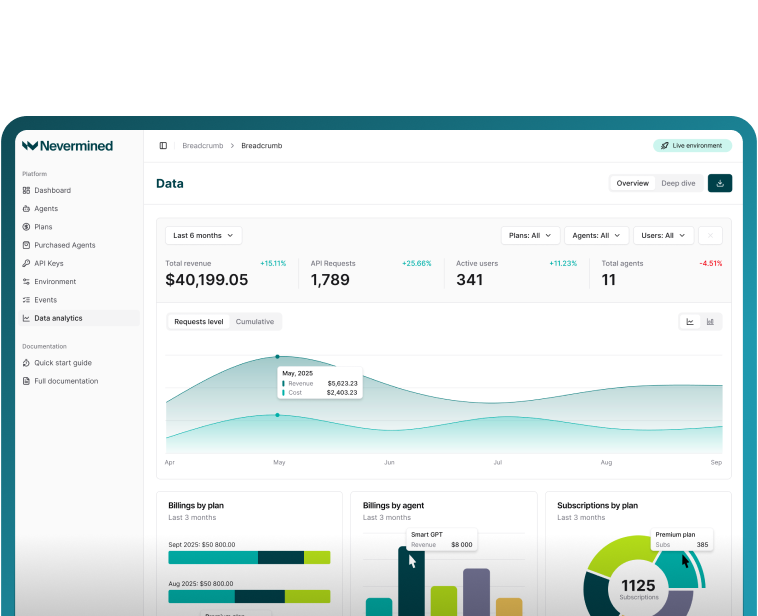
See Nevermined
in Action
Real-time payments, flexible pricing, and outcome-based monetization—all in one platform.