MENU


Building payment infrastructure for AI agents requires understanding that traditional processors, billing platforms, and settlement engines serve fundamentally different purposes. While Stripe processed $1.4 trillion in total payment volume in 2024, and Lago has demonstrated usage event ingestion at enterprise workloads of up to 1 million events per second, neither platform was built from the ground up for autonomous agent commerce. Nevermined fills the critical gap as an AI-native settlement layer, enabling real-time payments between agents without human intermediaries. Understanding how these three platforms work together, and where Nevermined delivers superior value, helps AI builders architect payment systems that actually scale with autonomous workflows.
The agentic economy introduces payment challenges that traditional financial infrastructure cannot address. AI agents generate micro-transactions at volumes and speeds that strain conventional payment models. When agents autonomously execute tasks, book meetings, or process data, they need payment systems that operate without human approval flows for every transaction.
Three distinct layers define agentic payment infrastructure:
Traditional payment processors like Stripe excel at the first layer. Open-source billing platforms like Lago handle the second. But neither addresses the unique settlement requirements of autonomous agents operating across multi-agent systems, marketplaces, and swarm architectures.
Using Stripe’s standard US online card rate of 2.9% plus 30¢, very small agent transactions can become inefficient when processed individually through traditional card rails. This economic reality makes traditional processors less suitable for agent-scale commerce unless teams use aggregation strategies, which can introduce settlement delays.
Nevermined was built specifically for this challenge. Rather than retrofitting human-centric payment flows, Nevermined provides real-time metering, flexible pricing, and instant settlement designed from the ground up for AI agents.
While Stripe processes payments and Lago meters usage, Nevermined occupies the critical settlement layer purpose-built for autonomous agent commerce. The platform enables transactions between AI agents without human involvement through ERC-4337 smart accounts with session keys and delegated permissions.
Nevermined delivers bank-grade enterprise-ready metering, compliance, and settlement so every model call turns into auditable revenue through:
The tamper-proof metering architecture sets Nevermined apart. Nevermined provides audit-ready logs with timestamped proofs, giving developers and finance teams a verifiable record of agent activity and billing events. Developers and finance teams can use Nevermined’s audit-ready logs and transaction records to reconcile usage against billed amounts.
Nevermined supports flexible pricing models including:
Many billing tools center on usage metering, while Nevermined extends pricing and settlement around agent-specific outcomes, credits, and custom events. The ability to charge for outcomes rather than attempts aligns revenue with actual value delivered, creating sustainable economics for AI builders.
Stripe is one of the largest digital payment processors, handling transactions that represented 1.3% of global GDP in 2024. For human-initiated commerce, Stripe offers broad payment infrastructure, mature developer tooling, and global reach across 200+ markets.
Stripe’s core strengths for traditional commerce include:
However, many traditional checkout and payment flows were designed around human buyers. Stripe’s newer agentic commerce and machine payment efforts show that the market is adapting to AI-mediated transactions, but these initiatives remain distinct from a purpose-built settlement layer for autonomous agent workflows.
Key considerations for agent commerce:
Stripe’s recent moves into agent commerce through ACP and MPP partnerships signal recognition of the agentic opportunity. But these represent partnerships layered onto existing infrastructure rather than purpose-built solutions.
Lago has emerged as an open-source billing platform for usage-based pricing. For AI companies requiring granular usage tracking with open-source visibility, Lago provides compelling value.
Lago’s architecture excels at:
For AI platforms tracking token consumption, API calls, or compute usage, Lago’s metering capabilities can support high-volume usage-based billing. The open-source model provides visibility into billing logic and can reduce vendor lock-in concerns for teams that want to operate more of the billing stack themselves.
That said, Lago serves a specific layer of the payment stack:
The critical insight is that Lago and Nevermined serve complementary purposes. Teams can use Lago-style usage metering while relying on Nevermined for protocol-native settlement. This combined architecture can let teams separate high-volume usage tracking from AI-native agent payment and settlement.
The future of AI commerce involves agents transacting directly with other agents, purchasing services, data, and capabilities without human intermediaries. This agent-to-agent paradigm benefits from infrastructure designed around autonomous authorization, metering, policy enforcement, and settlement.
Nevermined's protocol-first architecture supports emerging agent standards:
This protocol-agnostic approach helps teams stay compatible as standards evolve while reducing dependence on any single proprietary standard. Stripe has expanded its agentic commerce stack with x402 and MPP support, while Nevermined is purpose-built around AI-native agent payments, metering, credits, and settlement across multiple emerging protocols.
The technical architecture supports controlled agent autonomy:
The x402 facilitator gives AI agents one integration for cards, wallets, stablecoins, credits, flexible pricing, smart accounts, and settlement workflows. This unified payment handshake reduces the need to manage separate payment systems for different transaction types.
Nevermined's credits system operates as prepaid consumption-based units redeemed directly against usage. Unlike traditional subscription models with fixed allocations, credits align pricing more closely with usage by supporting per-request, variable, and dynamic credit charges.
The credits architecture provides operational advantages:
For finance teams, credits transform chaotic micropayment streams into predictable billing cycles. For developers, credits provide the granularity needed to meter individual agent actions without transaction-level payment overhead.
The credit system integrates with Nevermined's pricing and metering workflows. Operators can define usage-based and dynamic pricing rules, including cost-aware pricing patterns that help protect margins as underlying costs change. This approach can reduce manual pricing work while giving teams more control over AI service economics.
Integration speed directly impacts time-to-market for AI builders racing to capture market opportunities. The comparison reveals significant differences in deployment focus.
Nevermined gets you from zero to a working payment integration in 5 minutes, with SDKs for both TypeScript and Python:
The TypeScript SDK and Python SDK provide quickstart guides for adding payments to AI agents or services, including sandbox configuration. The documentation also provides LLM-friendly structure for AI coding workflows.
Comparative implementation focus:
For growth-stage AI teams, faster payment integration can shorten the path from product usage to monetized usage. Teams benefit from payment infrastructure that lets them focus on product differentiation rather than building billing logic from scratch.
Nevermined's MCP server lets developers stream up-to-date Nevermined documentation into MCP-aware IDE copilots such as Cursor, Windsurf, and Claude.
Enterprise AI deployments require payment systems that meet audit and compliance review needs. Autonomous agents managing financial transactions introduce compliance challenges that many consumer-focused payment flows were not originally designed around.
Nevermined's compliance-oriented payment architecture includes:
The payment facilitator verifies payment proofs, enforces amount, plan, merchant, and agent bindings, executes on-chain settlement, and returns canonical receipts. It also supports programmable settlement for credits, subscriptions, policy-based settlement, and dynamic charging. This infrastructure-level compliance differs fundamentally from compliance features added onto traditional payment flows.
For enterprise AI platforms, the ability to document autonomous agent transactions with verifiable payment records can support internal audit, finance, and compliance review without requiring teams to build every payment control from scratch.
When evaluating payment infrastructure for AI agents, the choice depends on your specific layer requirements. Stripe excels at traditional card processing. Lago provides strong open-source metering and billing infrastructure. For the settlement layer that enables autonomous agent commerce, Nevermined delivers agent-native capabilities that general-purpose payment processors and usage-based billing tools are not primarily designed to provide.
Key advantages of Nevermined's approach:
The recommended architecture for comprehensive agent payments:
A layered architecture can use Lago for high-volume metering, Nevermined for protocol-native settlement, and Stripe as the underlying payment rail for fiat on and off-ramps. This approach captures the strengths of each platform while Nevermined handles the agent-specific requirements that general-purpose payment processors and billing tools are not primarily designed to address.
For AI builders seeking to monetize agent interactions without the constraints of traditional payment infrastructure, Nevermined provides the purpose-built foundation that the agentic economy demands.
Stripe processes fiat payments through traditional payment methods such as cards and bank-based rails, with payout timing varying by country, risk profile, and payout schedule. The platform is primarily designed around human payment approval flows and checkout experiences. Nevermined operates at the settlement layer, enabling programmable transaction flows between AI agents through smart account session keys. In markets where standard card pricing includes a percentage fee plus a fixed per-transaction fee, very small payments can become uneconomical. Nevermined addresses this challenge with agent-native metering, authorization, credits, and settlement capabilities designed for high-frequency agent interactions. Importantly, these platforms can work together: Nevermined integrates with Stripe as a payment service provider for fiat settlement while providing agent-native capabilities around metering, access control, and autonomous payment execution.
Lago provides high-volume metering capabilities, full code transparency through its open-source AGPLv3 repository, and self-hosting options for teams that want greater control over their billing stack. For AI companies tracking token consumption or API usage at scale, Lago offers strong usage-based billing and metering infrastructure. However, Lago is primarily designed for usage-based billing, invoicing, and metering workflows rather than autonomous agent-to-agent settlement. Teams using Lago for event aggregation can pair it with Nevermined for protocol-native settlement, autonomous payment execution, and agent-specific transaction flows.
Nevermined delivers bank-grade enterprise-ready metering, compliance, and settlement so every model call turns into auditable revenue. Its approach highlights ledger grade metering, a dynamic pricing engine, credits-based settlement, 5x faster book closing, and margin recovery. The payment facilitator verifies payment tokens and coordinates settlement, including on-chain settlement flows for x402-based transactions. This infrastructure-level integrity differs from standard event logging by connecting metering, access control, and settlement into one agent-native payment flow.
Yes, Nevermined provides hybrid settlement rails supporting fiat payments through Stripe integration, stablecoin settlement via x402 protocol, and credits-based systems for internal accounting. The platform operates across multiple blockchain networks including Polygon, Gnosis Chain, and Ethereum. This multi-rail approach lets AI builders choose optimal settlement methods per use case: fiat for user-facing transactions, crypto for agent-to-agent payments, and credits for internal cost allocation. The flexibility avoids vendor lock-in while providing a fit-for-purpose settlement path for each transaction type.
Nevermined gets you from zero to a working payment integration in 5 minutes, with SDKs for both TypeScript and Python. The three-step process involves installing the SDK, registering payment plans with pricing rules, and validating payment requests. General-purpose payment or self-hosted billing stacks can require additional setup, configuration, and operational work depending on scope. Valory cut deployment time of their payments and billing infrastructure for the Olas AI agent marketplace from 6 weeks to 6 hours using Nevermined, clawing back $1000s in engineering costs.
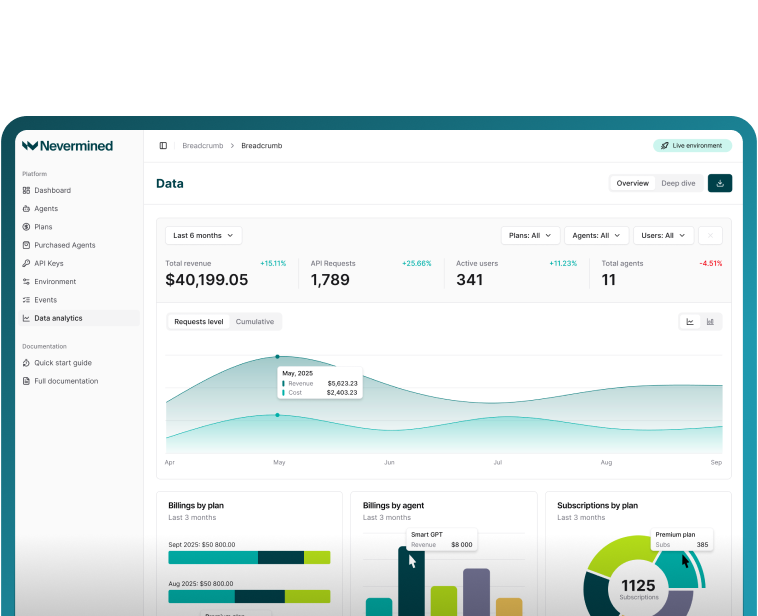
See Nevermined
in Action
Real-time payments, flexible pricing, and outcome-based monetization—all in one platform.