MENU


AI shopping agents from Amazon, OpenAI, and Perplexity are beginning to research, compare, and initiate purchases, but fully autonomous checkout remains early and uneven. The problem? Traditional checkout and fraud controls were built around human users, which makes it difficult to distinguish authorized AI agents from unwanted automation. Much of today's payment infrastructure assumes a human is directly approving checkout, creating authentication barriers like CAPTCHAs, 2FA, and 3D Secure that can interrupt AI agents during autonomous transactions. As the AI agent market grows at a 46.3% CAGR through 2030, teams need purpose-built card delegation infrastructure for delegated card spending, real-time metering, and autonomous settlement. This guide examines 12 platforms enabling AI agents to transact autonomously while maintaining security and compliance.
AI agents are autonomous software systems capable of perceiving their environment, making decisions, and executing actions without continuous human oversight. Unlike traditional automation that follows rigid scripts, AI agents adapt to changing conditions, handle exceptions, and pursue goals across multiple steps. In commerce, this translates to agents that can research products, compare prices, negotiate terms, and complete purchases independently.
Traditional payment processors require human involvement at critical junctures. Security measures like CAPTCHAs and anti-botting mechanisms can interrupt automated access. Perplexity's autonomous shopping efforts have faced public pushback from Amazon, highlighting the friction between AI shopping agents, merchant controls, and automated purchasing. Existing fraud and bot-detection systems can struggle to distinguish authorized AI agents from unwanted automation, creating friction for agentic commerce.
The micro-transaction challenge compounds these issues. AI agents can generate high volumes of small, frequent transactions, which increases the need for granular metering, low-friction authorization, and settlement models designed for machine-to-machine activity. Batch settlement rails such as ACH may be poorly suited for use cases that require immediate authorization, metering, or settlement feedback inside an agent workflow.
Category: Agent-Native Payments Infrastructure for AI Agents, Multi-Agent Systems, and AI Services
Nevermined is purpose-built payments infrastructure for AI agents, enabling developers, AI companies, and enterprises to monetize autonomous services through metering, access control, pricing, and settlement. Unlike traditional payment processors that were designed around human checkout flows, Nevermined is built for agent-to-agent commerce, API-based consumption, and autonomous machine transactions. It lets builders register agents, define pricing and rate limits, meter usage, enforce access, and receive payments every time an agent, model, tool, workflow, dataset, or service is called.
Nevermined supports cost-based, usage-based, and outcome-based pricing models, giving AI service providers more flexibility than standard card or subscription billing platforms. The platform works across multiple emerging agent payment standards, including MCP, Google's A2A, x402, and AP2-aligned workflows, so teams can build today without betting on a single protocol winner. It also supports fiat and crypto settlement, making it suitable for both enterprise buyers and crypto-native agent ecosystems.
Nevermined stands out because it was designed specifically for autonomous AI commerce. It does not simply adapt a traditional payment stack for agents. Instead, it wraps agents, APIs, tools, datasets, files, models, and other AI resources with authentication, metering, access control, pricing, and settlement.
That makes it especially well suited for AI builders who need to monetize high-frequency, low-value, or dynamic interactions. These include API calls, model calls, autonomous agent tasks, dataset access, tool usage, multi-agent workflows, and agent-to-agent service purchases.
Nevermined enables AI agents to purchase services from other agents without requiring human approval for every transaction. Developers can define permissions, budgets, rate limits, and pricing rules in advance, then let agents transact within those boundaries. This is critical for multi-agent systems where one agent may need to call another agent, buy data, trigger a tool, or consume an API as part of a larger autonomous workflow.
Nevermined supports multiple pricing models that are better aligned with AI-native services than standard flat subscriptions. Builders can charge per API call, per model interaction, per usage unit, per outcome, or through credit-based consumption. This flexibility helps developers align revenue with the value their agents actually deliver.
Nevermined supports major emerging agent payment and interoperability protocols, including Google A2A protocol, MCP, x402, and AP2-aligned workflows. This broad protocol support helps developers stay compatible as the agent commerce ecosystem evolves.
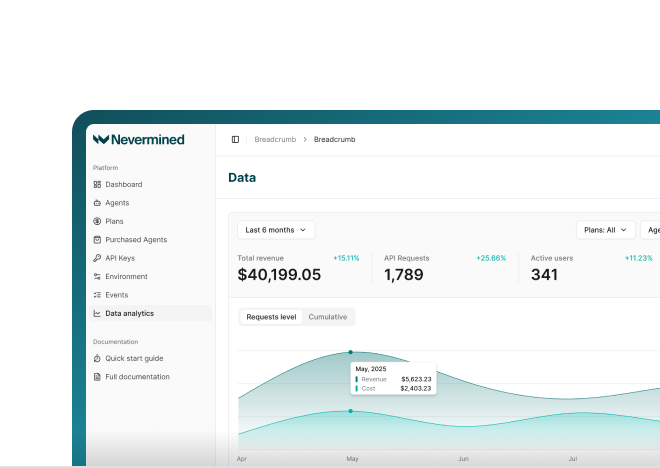
Nevermined delivers bank-grade enterprise-ready metering, compliance, and settlement so every model call turns into auditable revenue. Its infrastructure highlights ledger grade metering, dynamic pricing engine, credits-based settlement, 5x faster book closing, and margin recovery.
Nevermined gets you from zero to a working payment integration in 5 minutes, with SDKs for both TypeScript and Python. This makes it practical for developers who want to monetize agents quickly without building custom billing, metering, access control, and settlement infrastructure from scratch.
Nevermined is not limited to live AI agents. It can also protect and monetize static resources such as datasets, files, images, documents, and pre-trained models. This gives AI companies a single infrastructure layer for monetizing both interactive services and valuable digital assets.
Valory cut deployment time of their payments and billing infrastructure for the Olas AI agent marketplace from 6 weeks to 6 hours using Nevermined, clawing back $1000s in engineering costs.
Free tier available. Stablecoin payments are listed at 1% flat, while fiat payments are documented as 2% plus applicable Stripe fees. Enterprise pricing is available for custom needs.
AI companies, SaaS teams, developers, and enterprises building autonomous agent systems, AI marketplaces, multi-agent workflows, paid APIs, AI tools, data products, and AI-powered services that need granular metering, flexible pricing, access control, and real-time settlement.
Category: AI-Native Billing and Payment API
Dodo Payments is a payment platform designed for developers who want billing infrastructure with AI-friendly API patterns. It positions itself around AI-native workflows, Merchant of Record coverage, and tools that help agents or developers interact with payment documentation more easily. Its approach is especially relevant for teams that want tax, compliance, and payment operations handled by a Merchant of Record rather than building those functions internally.
4% + $0.40 for domestic US transactions; +1.5% for international transactions; no monthly fees.
Developers who want an AI-friendly billing API with Merchant of Record coverage, especially when tax and compliance handling are a priority.
Category: Traditional Payment Processor with AI Agent Extensions
Stripe is a major online payment processor offering payment acceptance, billing, subscriptions, invoicing, fraud prevention, and global money movement tools. For companies already using Stripe, it can be a practical option for extending existing payment infrastructure into AI-adjacent use cases. Its broad API coverage and developer ecosystem make it flexible for teams that are willing to build custom agent-specific logic on top of standard payment rails.
Stripe lists standard US online card pricing at 2.9% + $0.30 per successful domestic card transaction, with Stripe Billing pay-as-you-go pricing listed at 0.7% of Billing volume. Pricing varies by country, payment method, and product configuration.
Businesses already using Stripe that want to add AI-adjacent payment features through custom development while keeping their existing payment stack.
Category: Autonomous AP Software with Agent Cards
Ramp Bill Pay is a finance automation and corporate spend platform focused on accounts payable, expense management, and business payments. Its AI capabilities are designed to help finance teams automate invoice intake, line-item coding, fraud checks, approval recommendations, and payment workflow optimization. Rather than focusing on open agent-to-agent commerce, Ramp is oriented toward enterprise finance operations and controlled corporate spend.
Custom enterprise pricing.
Finance teams and enterprises that want to automate accounts payable, invoice workflows, and corporate spend management.
Category: AI Agent Commerce API
Crossmint Agentic Payments helps AI agents and applications execute purchases through programmatic payment infrastructure. It supports agent checkout flows for traditional commerce environments and provides tools for scoped permissions, spending controls, merchant access, and payment execution across certain agentic commerce use cases.
Crossmint is relevant for AI shopping agents and consumer commerce applications that need agents to buy physical goods, software, flights, or other products through supported merchant environments. Its focus is commerce execution, while Nevermined is broader infrastructure for monetizing AI agents, AI services, APIs, datasets, and agent-to-agent transactions.
Crossmint lists transaction-based and tiered pricing for checkout and payment products, with some products requiring custom pricing.
AI shopping agents and consumer commerce applications that need to buy goods or services from supported merchant environments.
Category: Card Network Agentic Payment Infrastructure
Mastercard Agent Pay is Mastercard’s agentic payment framework for enabling trusted AI agent transactions across card network infrastructure. It applies Mastercard’s tokenization and payment network experience to agent commerce, helping create verification and authorization mechanisms that can be used when AI agents transact on behalf of users or businesses.
Commercial terms are not publicly standardized and may depend on the payment flow, integration partners, and implementation model.
Large enterprises, banks, wallets, payment providers, and merchants that need network-level support for trusted AI agent card transactions.
Category: Card Network Agentic Payment Infrastructure
Visa Intelligent Commerce is Visa’s framework for enabling AI agents to transact with trust, security, and verification. It focuses on agent authentication, payment tokenization, spend controls, and merchant confidence when interacting with AI-driven commerce flows.
Visa’s Trusted Agent Protocol, developed with Cloudflare, helps merchants verify agents and distinguish trusted agent traffic from malicious bots. Visa’s developer resources also include agent-focused tools for connecting AI agents with payment links, invoicing APIs, and MCP-based workflows.
Commercial terms are not publicly standardized and may depend on partners, use case, and implementation model.
Enterprises, merchants, financial institutions, and payment providers that need agent authentication, tokenization, and network-level trust infrastructure.
Category: Wallet-Based Agentic Payment Solution
PayPal Agent Toolkit brings agentic commerce capabilities into PayPal’s consumer wallet and merchant network. It is designed to help developers connect AI agents to PayPal commerce APIs so agents can support order creation, payment handling, shipment tracking, and buyer authentication workflows.
Because PayPal already has broad consumer recognition, it can be valuable for applications where trust and familiar payment credentials matter. Its focus is wallet-based commerce and PayPal API enablement, while Nevermined is more directly aligned with AI-native monetization, agent metering, credits, access control, and settlement for autonomous agent interactions.
PayPal pricing varies by payment method. PayPal lists 2.99% + $0.49 for credit and debit card transactions under PayPal Checkout, while PayPal and Venmo transactions may use different rates.
Consumer-facing AI commerce applications that want to use PayPal as a trusted wallet-based payment method.
Category: Crypto-Native Agent Payment Protocol
Coinbase x402 is a crypto-native payment protocol designed around HTTP 402 payment flows. It enables agents, APIs, and services to request payment directly through web interactions, allowing machine-to-machine payments for digital resources and services. This makes it especially relevant for usage-based API calls, agent services, and micropayments.
The protocol is focused on instant settlement through stablecoins and blockchain infrastructure. Its x402 facilitator model has gained attention as an important mechanism for machine-to-machine payments.
x402 is an open protocol. Costs depend on the chosen network, token, facilitator, and implementation.
Crypto-native applications, API providers, and agent services that need instant settlement, micropayments, and machine-to-machine payment flows.
Category: Crypto Payment Gateway for AI Agents
0xProcessing is a crypto payment gateway that supports digital asset payments for businesses and automated systems. Its AI agent payment positioning focuses on high-volume, small, frequent transactions, making it relevant for agent services that need programmable crypto payment rails.
The platform is especially useful for teams that want crypto payment processing, wallet controls, AML screening, and configurable payment controls in one gateway. It is more focused on crypto payment acceptance than full agent monetization infrastructure.
Pricing is not clearly disclosed on the AI payments page. Teams should confirm current pricing directly with 0xProcessing.
Crypto-native businesses and AI applications that need programmable crypto payment acceptance, per-agent wallet controls, and transaction monitoring.
Category: Agent Payments and Wallet Infrastructure
Skyfire focuses on payments and identity infrastructure for AI agents, including agent wallets, spending controls, and transaction workflows. It is designed to simplify how agents hold and spend funds while giving teams controls over spending and transaction behavior.
Skyfire is most relevant for teams that need the wallet and payment layer of agent transactions rather than a complete monetization platform. It can help teams give agents controlled payment capabilities in crypto-based or stablecoin-backed environments.
Current pricing is not clearly disclosed on Skyfire’s homepage. Teams should confirm current pricing directly with Skyfire.
Developer teams that need agent wallet infrastructure and crypto payment abstraction without building wallet management from scratch.
Category: SaaS Billing with Merchant of Record
Paddle is a Merchant of Record and SaaS billing platform that helps software companies manage payments, subscriptions, tax, and compliance. It is not specifically built for autonomous agent commerce, but its simpler API surface and Merchant of Record model can be useful for SaaS teams that want to reduce operational payment complexity.
Paddle is most relevant for software businesses that sell subscriptions or usage-based products and want tax handling, payment operations, and checkout infrastructure managed externally.
5% + $0.50 per transaction.
SaaS companies that want Merchant of Record coverage, subscription billing, and simpler payment operations for software products.
AI agents can execute a wide range of transactions depending on the platform capabilities and authorization policies. These include API purchases, subscription payments, marketplace orders, and B2B invoice settlements. Agents can operate within predefined spending limits, merchant categories, and time windows set by the delegating user or enterprise.
For AI-native billing, auditability typically depends on verifiable usage records, clear pricing rules, and reconciliation between usage and billed amounts. Nevermined is designed to support auditable metering, payment validation, and settlement across agent interactions. Network-level solutions from Visa and Mastercard add agent registries and trusted agent protocols for verification.
Yes, several platforms support agent-to-agent payments. Nevermined enables transactions between AI agents through ERC-4337 smart accounts with session keys and delegated permissions. Users can authorize payment permissions with defined limits, durations, and settlement rules, allowing agents to transact within those boundaries. This extends basic pay-per-request flows with programmable settlement, credits, policies, and delegated permissions.
Many conventional billing tools are built around subscriptions, checkout, invoices, and usage-based billing, while agent-native billing requires more granular pricing and settlement patterns. Nevermined supports flexible payment models, including credits-based charging per request or API call, time-based subscription access, dynamic pricing based on request complexity or token count, and hybrid models. This flexibility lets builders align price to actual value delivered.
Integration speed varies by platform. Nevermined gets you from zero to a working payment integration in 5 minutes, with SDKs for both TypeScript and Python. Traditional processors like Stripe require more custom development for agent-specific features. Network-level solutions from Visa and Mastercard focus on trusted agent recognition, agent verification, and payment acceptance frameworks, often involving merchants, networks, and infrastructure partners.
See Nevermined
in Action
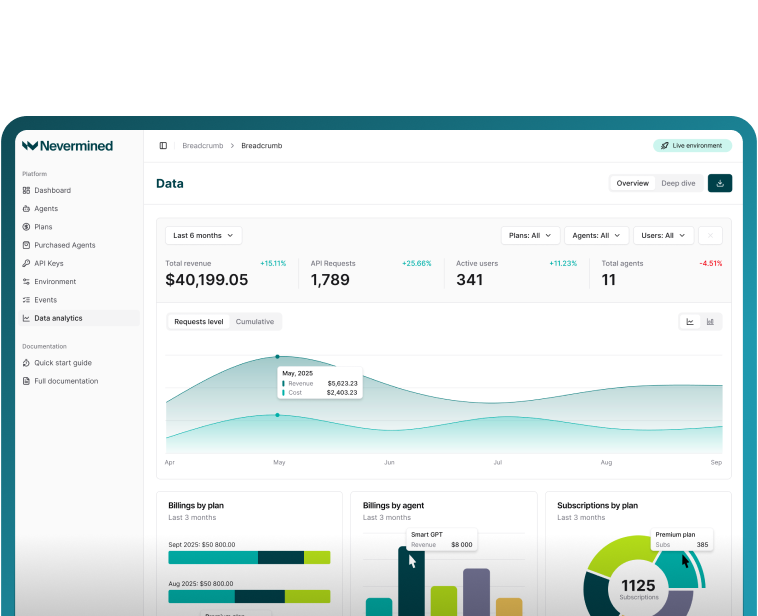
Real-time payments, flexible pricing, and outcome-based monetization—all in one platform.