MENU


The AI agent market is projected to grow from $7.63 billion in 2025 to $182.97 billion by 2033, representing a 49.6% compound annual growth rate. This signals a fundamental shift in how businesses operate and generate revenue. Yet most companies building AI agents struggle with a critical challenge: most traditional billing stacks aren't optimized for autonomous systems that execute hundreds of micro-transactions in seconds. Companies can accelerate their path to profitability by leveraging Nevermined's payment infrastructure purpose-built for AI agents, handling real-time metering, flexible pricing models, and instant settlement without the engineering burden of custom billing systems.
AI agents fundamentally break seat-based economics. A single agent "conversation" can trigger hundreds of micro-activities with sub-cent costs, making unit economics unreadable under traditional SaaS billing models. The infrastructure gap becomes apparent as more AI companies adopt hybrid or usage-based pricing models to match their cost structures.
Traditional payment processors often require extensive custom development for AI-specific use cases. Engineering teams frequently spend significant time building access control, subscription management, and usage tracking systems that still cannot handle:
BCG's research on AI agents' business impact emphasizes the observe-plan-act capabilities that differentiate agents from traditional software. These capabilities demand billing systems that can observe usage, plan pricing dynamically, and act on settlement instantly.
The future of commerce extends beyond human-to-human transactions. AI agents transacting with other agents require entirely new payment systems that support emerging standards like Google's Agent-to-Agent (A2A) protocol and Model Context Protocol (MCP). Nevermined's direct integration with x402 as an extension to the protocol enables these advanced agent payment capabilities that legacy infrastructure cannot provide.
Pricing AI agents requires moving beyond the subscription models that dominated SaaS for two decades. As pricing expert Madhavan Ramanujam notes in his AI monetization research, "AI founders need to tackle monetization from day one. Two reasons: cost dynamics to navigate, and value capture. If you don't capture value from day one, you're training customers to expect more for less."
Cost-inferred pricing tracks every request and bills accordingly. This model works best for:
Nevermined Pay supports usage-based models with automatic cost capture through integration with major LLM providers, ensuring margin gets locked in at the pricing rule level.
Charging for results achieved aligns vendor incentives with customer success. This approach suits:
Outcome-based pricing is growing rapidly as more AI companies align their revenue with the value they deliver to customers.
Percentage of ROI or value generated represents the most sophisticated approach. Salesforce's pricing evolution from a simple per-conversation model to a more granular Flex Credits system reflects a broader industry shift toward more complex, value-aligned billing that captures value proportional to customer benefit.
Most successful AI companies combine approaches. A typical structure includes:
This layered approach avoids leaving money on the table while providing customers with cost predictability.
Enterprise procurement teams require audit-ready transparency before approving AI agent deployments. The McKinsey analysis of agentic organizations emphasizes that governance and embedded guardrails separate successful implementations from failed projects.
Nevermined's tamper-proof metering system creates buyer trust through independent verification. The architecture ensures:
This approach can help meet the compliance demands that Microsoft's Azure Framework identifies as critical for enterprise AI adoption.
Bank-grade metering delivers the audit trails that regulated industries demand. For financial services, healthcare, and legal applications, immutable usage logs provide:
Managing AI agents across multiple environments, swarms, and marketplaces creates identity fragmentation that complicates billing and governance. Nevermined ID solves this through universal agent identification.
Cryptographically-signed wallet addresses and decentralized identifiers (DIDs) can provide agents with the same ID across:
One lookup returns live metadata, pricing, and authorization rules without re-wiring between systems.
Zero-effort deployment enables one-line SDK calls to issue and publish agent IDs. Auto-discovery via Google's A2A protocol allows instant agent connection, with direct linking to pricing plans eliminating additional configuration overhead. This streamlined approach supports the 23% of organizations already scaling their AI agent deployments.
Speed determines winners in the AI agent market. Valory cut deployment time of their payments and billing infrastructure for the Olas AI agent marketplace from 6 weeks to 6 hours using Nevermined, clawing back thousands in engineering costs.
The Nevermined SDK available in TypeScript and Python enables a three-step integration process taking under 20 minutes:
Comprehensive technical documentation provides implementation guides, sample applications, and best practices. The plug-and-play API libraries work with any agent framework, eliminating the need to build payment infrastructure from scratch.
Enterprise reluctance toward minimum commitments stalls AI adoption. Finance teams struggle with complex sub-cent charge reconciliation that traditional billing produces. Flex Credits solve both problems through prepaid consumption-based units.
Credits enable predictable spend management:
The credit model charges for micro-actions and rewards successful outcomes. Whether the value metric is completed calls, booked meetings, or processed documents, credits align price directly to customer benefit. This approach addresses the Gartner prediction that over 40% of agentic AI projects will be canceled by the end of 2027 due to escalating costs, unclear business value, and inadequate risk controls.
The AI ecosystem requires seamless connectivity between agents, frameworks, and infrastructure. Nevermined integrates across the technology stack, working alongside major LLM providers and agent frameworks in the market.
Technical integrations span:
Open-protocol-first design builds compatibility with emerging standards. As A2A and MCP evolve, the architecture adapts without rebuilds or vendor lock-in. The x402 integration provides advanced agent payment capabilities aligned with where the industry is heading.
Enterprise AI platforms operating at global scale require infrastructure that matches their compliance and performance standards. Nevermined's enterprise solutions deliver bank-grade metering, compliance, and settlement capabilities.
Every model call turns into auditable revenue through:
The infrastructure enables 5x faster book closing through automated reconciliation and margin recovery through precise cost attribution. Finance teams gain visibility into profitability at the request level, not just the customer level.
David Minarsch, CEO at Valory (builders of Olas), stated: "We knew AI agents need to be able to transact, so over a year ago we tapped into Nevermined. Nevermined was, and continues to be, the best solution for AI payments." Richard Blythman, Co-Founder at Naptha AI, noted: "Whenever I need to understand AI agent monetization, I turn to the Nevermined team. They're world class and leading the agentic payments space."
Agent-to-agent commerce involves autonomous AI systems transacting without human involvement for each transaction. Unlike traditional B2B payments requiring purchase orders, approvals, and manual reconciliation, agent commerce demands instant settlement, micro-transaction support, and machine-readable verification. Traditional payment processors lack the APIs and settlement speed required for agents completing thousands of transactions per minute across multi-agent orchestration systems.
Beyond revenue, sustainable monetization requires tracking cost-to-revenue ratio per request, margin by customer segment, credit burn rate velocity, and outcome achievement rates. Real-time visibility into these metrics enables pricing adjustments before profitability erodes. Companies should also monitor customer acquisition cost relative to lifetime value, with particular attention to how usage patterns change after initial adoption periods.
Flex Credits translate variable AI consumption into fixed prepaid commitments that align with enterprise procurement cycles. Finance teams approve a credit budget, departments draw down against that allocation, and real-time dashboards show burn rate against remaining balance. This approach eliminates surprise overruns while providing the flexibility to scale usage within approved budgets.
Enterprise buyers typically require SOC 2 Type II certification for security controls, GDPR compliance for data protection, and industry-specific certifications depending on the vertical. Financial services may require PCI DSS compliance, while healthcare applications need HIPAA-compliant handling of protected health information. Immutable audit logs and cryptographic verification of transactions support compliance across regulated industries.
Start with usage tracking in pilot mode to understand consumption patterns and cost structures before activating billing. Use this data to design pricing that covers costs with appropriate margin while remaining competitive. Implement tiered pricing that rewards higher usage volumes, and consider outcome-based components for high-value use cases. The transition should include customer communication about value delivered during pilot and clear explanation of the pricing model going live.
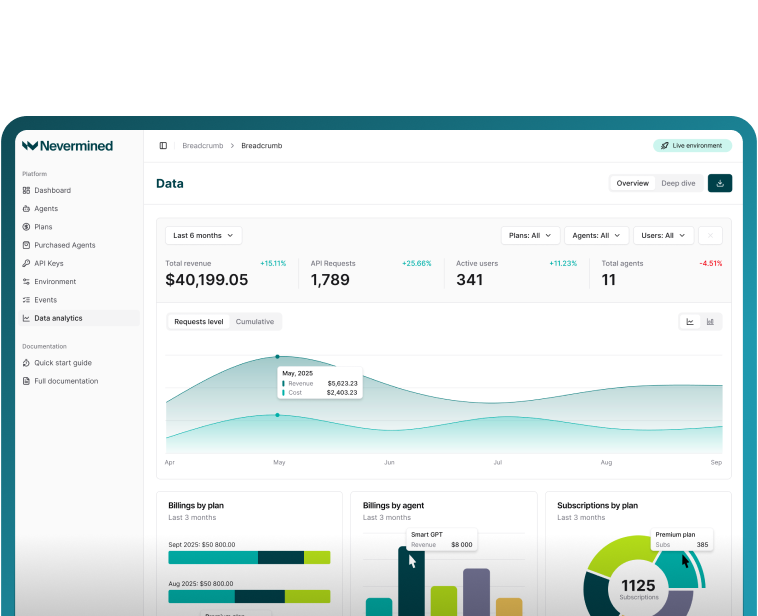
See Nevermined
in Action
Real-time payments, flexible pricing, and outcome-based monetization—all in one platform.