MENU


The AI agents market is projected to grow from USD 7.84 billion (2025) to USD 52.62 billion (2030). Yet while model capabilities accelerate, most AI companies still price their agents like traditional SaaS products, leaving substantial revenue on the table. Cost-based pricing offers a path forward, enabling AI builders to capture value from every token, API call, and GPU cycle their agents consume. For companies ready to monetize autonomous workflows, Nevermined's payment infrastructure provides the metering, billing, and settlement capabilities that traditional payment processors cannot deliver.
Seat-based and subscription pricing models that powered the SaaS era cannot accommodate the economics of AI agents. The fundamental problem lies in how AI workloads differ from traditional software usage.
When an AI agent processes a request, it may call multiple LLM APIs, query vector databases, execute tool calls, and coordinate with other agents. A simple lookup might cost fractions of a cent, while a complex research task could consume many cents or more. This orders-of-magnitude variance breaks flat-rate pricing models entirely.
Traditional payment processors require extensive custom development for AI-specific use cases:
Companies spend weeks building billing infrastructure when they should focus on their core AI capabilities.
The agentic economy introduces another challenge legacy systems cannot handle: autonomous transactions between AI agents without human involvement. When one agent purchases capabilities from another, traditional payment flows requiring human authorization become bottlenecks.
This shift demands payment infrastructure built specifically for AI workloads, supporting emerging standards like A2A (Agent2Agent)—which originated at Google and is now under Linux Foundation stewardship—and Anthropic's Model Context Protocol (MCP) that enable agent discovery and communication.
Cost-based pricing creates direct correlation between computational resources consumed and charges to customers. Rather than guessing at flat rates, AI builders can meter every token, API call, and GPU cycle to ensure margins remain protected.
Accurate cost calculation requires tracking multiple expense categories:
Four pricing model categories have emerged to capture these costs, with specific pricing varying by use case and value delivered:
Billing disputes represent a critical threat to AI agent businesses. Research shows billing frictions including failed payments can drive up to 50% of subscription churn. Customers who cannot verify their charges lose trust and leave.
Tamper-proof metering addresses this challenge through:
This zero-trust reconciliation model satisfies both individual developers and enterprise finance departments requiring complete billing transparency.
While cost-based pricing protects margins, the most successful AI agent companies layer outcome-based and value-based models to capture a share of the value they create for customers.
Outcome-based pricing charges for results achieved rather than resources consumed. An SDR agent might charge per meeting booked. A support agent might charge per successful resolution. A code review agent might charge per bug identified.
This approach can deliver compelling economics. According to Bessemer's State of AI data, AI agent gross margins vary widely—from approximately 25% for "AI Supernovas" to around 60% for "Shooting Stars"—highlighting how pricing to value rather than just cost can protect and expand margins.
Value-based pricing takes this further by charging a percentage of ROI or value generated. When an AI agent demonstrably saves a customer $100,000 annually, capturing 10-20% of that value represents fair exchange for both parties.
The most effective pricing strategies combine multiple models:
This hybrid approach avoids the common problem of leaving money on the table with flat pricing while still providing budget certainty customers demand.
Reliable monetization requires reliable identity. When agents transact autonomously, verifying that the right agent received the right payment for the right service becomes essential.
Persistent agent identification through cryptographically-signed wallet addresses and decentralized identifiers (DIDs) creates the foundation for trusted commerce. Each agent maintains a unique identity that:
This infrastructure enables agent discovery through protocols like A2A, allowing agents to find, evaluate, and transact with each other based on verified capabilities and pricing.
The agentic economy requires financial rails purpose-built for autonomous transactions. Traditional payment processors lack three critical capabilities that AI agent commerce demands.
First, agent-to-agent native payments enable transactions between agents without human intervention. A research agent can purchase data from a scraping agent, which can pay a verification agent, all settled instantly without manual approval workflows.
Second, support for emerging standards like A2A (Agent2Agent) and Anthropic's MCP ensures compatibility as the ecosystem evolves—as evidenced by Google Cloud's Agent Payments Protocol (AP2) working with these standards. An open-protocol-first approach prevents vendor lock-in and positions companies for long-term success.
Third, third-party billing authority provides neutral arbitration between AI vendors and buyers. When disputes arise, having an independent system of record with tamper-proof metering resolves conflicts quickly and fairly.
Settlement flexibility matters too. Modern AI payment infrastructure supports both fiat and cryptocurrency rails, including direct integration with the x402 protocol for advanced agent payment capabilities that enable instant, programmable settlements across blockchain networks.
Flex Credits represent prepaid consumption-based units that customers redeem against actual usage. This model solves multiple friction points in AI agent monetization.
Credits align price to value by enabling charges for micro-actions while rewarding successful outcomes. Customers see exactly how their purchased credits translate into agent capabilities.
Key benefits include:
For finance teams, credits transform chaotic micro-transaction tracking into clean prepaid accounts with clear consumption visibility.
Many AI agent companies lack systematic pricing approaches and spend months building custom billing systems instead of shipping product improvements. This represents both a problem and an opportunity.
Purpose-built AI billing infrastructure dramatically compresses deployment timelines. Where custom development requires weeks and significant engineering investment—with median annual wages for software developers at USD $133,080 (May 2024)—AI-native platforms enable rapid deployment.
The implementation process simplifies to:
For detailed implementation guidance, Nevermined's documentation provides step-by-step SDK integration instructions with examples for common AI frameworks.
Modern AI billing platforms integrate directly with popular frameworks in the ecosystem, including those from major LLM providers and agent orchestration tools. Automatic capture of token usage and compute costs eliminates manual tracking and ensures accurate billing from day one.
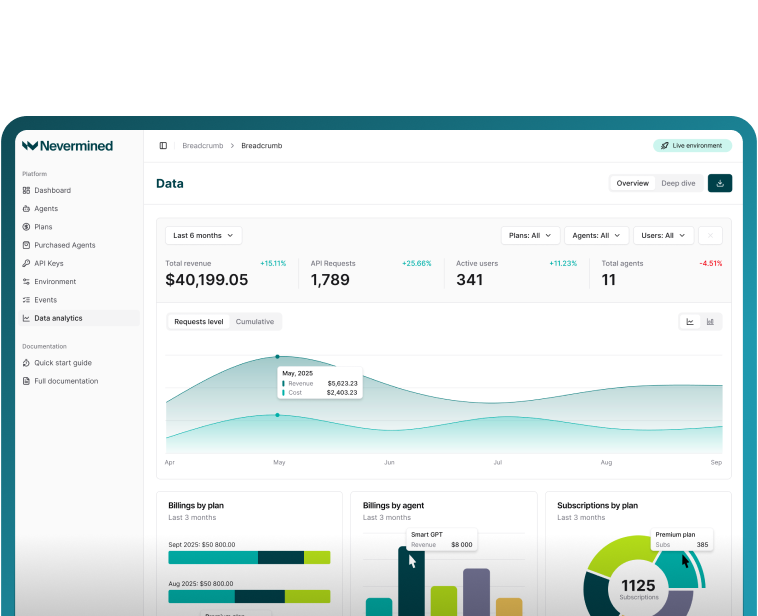
Effective cost-based pricing requires continuous measurement of agent performance, user behavior, and revenue analytics. Without visibility into these metrics, companies cannot optimize pricing or identify growth opportunities.
Key performance indicators for AI agent monetization include:
This observability surfaces hidden costs and missed opportunities. Perhaps a particular workflow type consumes significantly more resources than expected. Perhaps certain customers would pay premium rates for faster processing. Without data, these insights remain invisible.
Research demonstrates significant productivity gains from AI assistance in specific contexts. Studies show approximately 40% faster completion and roughly 18% quality increase for writing tasks, about 14% productivity increase on average in call-center settings, around 55% faster task completion in coding experiments, and roughly 25% faster with over 40% higher quality in consulting experiments. Capturing a fair share of this value requires understanding exactly where and how agents create impact.
As the agentic economy matures, success increasingly depends on ecosystem connectivity rather than isolated capabilities.
The AI agent landscape now includes thousands of specialized agents across sales, support, development, research, and countless vertical applications. No single agent can do everything. The winners will be those who integrate seamlessly with complementary capabilities.
This reality demands payment infrastructure that supports:
An open-protocol approach avoids the rebuilds and migrations that proprietary systems inevitably require as standards evolve.
For AI builders serious about monetization, Nevermined provides the infrastructure to implement cost-based, outcome-based, and value-based pricing models without building billing systems from scratch.
Nevermined Pay delivers bank-grade, enterprise-ready metering, compliance, and settlement so every model call turns into auditable revenue. The platform features ledger-grade metering that tracks every request in real-time, a dynamic pricing engine supporting flexible pricing rules, and credits-based settlement that simplifies customer financial management. Companies report 5x faster book closing and margin recovery through precise cost attribution.
The x402 integration enables advanced agent payment capabilities for organizations requiring blockchain settlement options alongside traditional fiat rails.
Nevermined ID provides universal agent identification via DIDs and wallet addresses, enabling persistent, cryptographically secure identities essential for reliable agent-to-agent transactions. Auto-discovery through A2A protocol allows agents to find and transact with each other based on verified capabilities.
For companies ready to explore AI agent monetization, Nevermined's solutions offer paths for solo developers, AI startups, and enterprise platforms alike.
Traditional payment processors require extensive custom development for AI-specific billing scenarios. They cannot natively handle the sub-cent transactions, orders-of-magnitude cost variance between simple and complex workflows, or agent-to-agent payments that AI workloads demand. Companies typically spend weeks and significant engineering resources building custom metering and billing logic before they can monetize at all.
Model inference prices are falling dramatically—Stanford reports declines on the order of ~9x to ~900x per year in some comparisons—which erodes margins for companies using fixed pricing based on current costs. Cost-based pricing with built-in margin percentages automatically adjusts as underlying costs change. More importantly, layering outcome-based or value-based components on top of cost recovery ensures revenue scales with value delivered rather than resources consumed.
Flex Credits provide prepaid consumption-based units that customers redeem against actual usage. They transform unpredictable micro-transactions into clean prepaid accounts with real-time burn rate visibility. Credits can be reallocated across users, departments, or agents without contract renegotiation, and they address enterprise procurement concerns around minimum commitments and complex sub-cent charge reconciliation.
Tamper-proof metering cryptographically signs every usage record at creation and pushes it to an append-only log. This makes records immutable and independently verifiable. Any developer, customer, auditor, or agent can confirm that usage totals match billed amounts per line-item. This transparency builds trust and reduces the billing disputes that can drive significant customer churn.
Yes, agent-to-agent native payments enable fully autonomous transactions between AI agents. This capability requires purpose-built payment infrastructure that supports emerging standards like A2A (Agent2Agent) for agent discovery and Anthropic's Model Context Protocol for agent communication. Traditional payment flows requiring human authorization cannot accommodate these autonomous workflows.
The optimal model depends on value attribution clarity. For FTE replacement scenarios with clear productivity gains, agent-based pricing works well. For discrete, measurable actions, action-based pricing provides precision. For complex processes with defined outcomes, outcome-based pricing captures strong margins. Most successful companies use hybrid approaches combining base fees with usage and success components to balance predictability with value capture.
See Nevermined
in Action
Real-time payments, flexible pricing, and outcome-based monetization—all in one platform.