MENU


Credit-based pricing has emerged as a leading monetization approach for AI agents, addressing the fundamental problem that traditional billing systems cannot handle: a single AI interaction can trigger hundreds of micro-transactions with sub-cent costs that make unit economics unreadable. For AI builders looking to monetize autonomous agents without burning weeks on custom billing infrastructure, Nevermined's payment platform offers real-time metering, flexible pricing models, and instant settlement that captures revenue from every agent action.
Traditional payment processors were built for predictable transactions: subscription renewals, seat licenses, and straightforward product purchases. AI agents operate differently. A single customer request might invoke multiple LLM calls, tool executions, and external API queries, each with variable computational costs that change based on context complexity.
The mismatch between AI workloads and traditional billing creates several problems:
The market is responding to these limitations. Companies across the AI ecosystem, from LLM providers to agent frameworks like LangChain and CrewAI, increasingly require payment infrastructure that handles micro-transactions at scale. 62% of organizations expect greater than 100% ROI on agentic AI investments, but capturing that value requires billing systems designed for autonomous operation.
Credit-based pricing operates through prepaid consumption units that customers redeem against actual usage. Unlike subscriptions that charge regardless of activity or pure usage-based models that create unpredictable bills, credits provide a middle ground: predictable budgets for buyers and fair compensation for providers.
The fundamental design decision is defining what one credit represents. Two primary approaches dominate:
Both models work when properly implemented. The key is ensuring customers understand how credits map to real actions, such as "100 credits equals approximately 50 support tickets resolved" rather than abstract token counts.
Enterprise buyers particularly value credit systems because they provide:
Implementing credit-based pricing requires infrastructure that traditional billing platforms lack: real-time metering at massive scale, immutable audit trails, and flexible pricing rule engines.
Every billable action must be captured, timestamped, and stored in a way that prevents tampering. This requires:
AI billing requires high-volume, low-latency event ingestion while maintaining audit-ready transparency. This tamper-proof architecture satisfies enterprise procurement teams requiring zero-trust reconciliation.
For enterprise deployments, Nevermined Pay delivers bank grade enterprise ready metering, compliance, and settlement so every model call turns into auditable revenue. The platform provides ledger grade metering, a dynamic pricing engine, credits based settlement, 5x faster book closing, and margin recovery through comprehensive cost tracking.
Credit-based pricing delivers different benefits depending on company stage and scale.
Early-stage AI companies cannot afford months of billing infrastructure development. The contrast is stark: Valory cut deployment time of their payments and billing infrastructure for the Olas AI agent marketplace from 6 weeks to 6 hours using Nevermined, clawing back $1000s in engineering costs.
For startups, this acceleration means:
Large organizations require audit trails that prove billing accuracy. Credit systems with immutable usage logs reduce billing disputes significantly compared to opaque usage-based pricing because any developer, user, auditor, or agent can verify that usage totals match billed amounts per line-item.
As AI agents increasingly operate autonomously and transact with other agents, payment infrastructure must support machine-to-machine commerce without human intervention.
Each autonomous agent requires a persistent identity that travels across environments and marketplaces. Decentralized Identifiers (DIDs) paired with cryptographically-signed wallet addresses provide:
Emerging standards like Google's Agent-to-Agent (A2A) protocol enable instant agent discovery and connection. Payment capabilities can be layered via extensions like the A2A x402 extension that leverage HTTP 402 "Payment Required" patterns. When combined with Model Context Protocol (MCP) for standardized tool integration, agents can negotiate services, exchange value, and settle payments autonomously.
Nevermined's x402 integration extends these capabilities by providing advanced agent payment rails that work across both fiat and crypto settlement options, enabling truly autonomous commerce.
The implementation path for credit-based pricing varies dramatically based on platform choice and technical requirements.
Modern AI billing platforms provide SDK libraries in TypeScript and Python that reduce integration to straightforward steps:
For detailed implementation guidance including SDK installation and configuration, see the Nevermined documentation.
Comprehensive metering must capture all cost components:
Companies that only meter input and output tokens may underprice their services because internal token consumption can represent 50-90% of total tokens in complex agent workflows.
Pure credit systems work as starting points, but mature AI companies layer additional pricing dimensions to maximize revenue capture.
Three pricing models can be combined within credit frameworks:
Intercom's Fin AI agent demonstrates this approach by charging $0.99 per resolved ticket as an outcome fee layered on top of base credit consumption, enabling more predictable unit economics on the outcome portion.
The most sophisticated AI companies avoid leaving money on the table with flat pricing by:
Credit-based pricing represents the current best practice, but the landscape continues to evolve as agent capabilities expand.
Agent swarms present unique billing challenges: a single user request might trigger dozens of specialized agents collaborating autonomously. Infrastructure must track value creation across the entire workflow while attributing revenue appropriately to each agent's contribution.
Many AI agent companies currently lack systematic pricing approaches, creating opportunity for early movers who implement robust billing before competitors. Companies with proper credit infrastructure can monetize multi-agent collaborations from day one rather than retrofitting billing after launching.
Protocol standards will determine which platforms survive the consolidation phase. Companies building on open standards like A2A and MCP avoid painful rebuilds as the ecosystem matures. An open-protocol-first approach ensures compatibility with emerging standards while preserving flexibility to adopt new capabilities.
For AI builders evaluating credit-based pricing infrastructure, Nevermined addresses the specific challenges that general-purpose billing platforms cannot solve.
The platform handles the complete monetization cycle: defining pricing rules and margins, metering every request in real-time, settling payments instantly in fiat or cryptocurrency, and providing observability into agent performance and revenue analytics. This eliminates the weeks of custom development required when building on top of traditional payment processors.
Three capabilities differentiate Nevermined for AI-native use cases:
The platform serves the full spectrum of AI builders, from solo developers needing plug-and-play monetization to enterprise AI platforms requiring bank-grade compliance. For teams ready to capture revenue from every agent interaction without building billing infrastructure from scratch, Nevermined provides the fastest path from integration to revenue. Explore the solutions page or contact the team to evaluate fit for your use case.
Traditional payment systems handle predictable, human-initiated transactions like subscriptions and product purchases. AI agent credit-based pricing addresses the unique challenge that a single agent interaction can trigger hundreds of micro-transactions with variable costs based on computational complexity. Credit systems provide prepaid consumption units that align billing with actual usage while giving customers predictable budgets and providers fair compensation for resources consumed.
Credit expiration policies significantly impact customer perception and churn rates. Best practice aligns expiration with commitment periods: monthly plans include monthly rollover, annual plans include annual rollover. Companies like Cursor and Replit faced backlash when transitioning from unlimited models to credits with restrictive expiration. Allowing at least one rollover cycle and communicating policies clearly upfront reduces disputes and improves retention.
Enterprise deployments should prioritize platforms with SOC 2 reports, GDPR compliance with data processing agreements, and for regulated industries, HIPAA Business Associate Agreements where applicable. Critical technical requirements include immutable audit trails with append-only architecture, AES encryption (FIPS 197) at rest, TLS 1.2 or higher per NIST guidance for data in transit, and role-based access controls with SSO integration for team management.
Size credit packages to cover at least three complete use case executions, giving customers enough runway to experience value before exhausting credits. Analyze your cost structure to understand the average and maximum resource consumption per interaction, then price packages that protect margins while appearing accessible. Daily credit refreshes, like the 5 credits per day model, encourage consistent usage and reduce purchase friction for new customers.
Credit systems actually simplify enterprise procurement by providing trackable, predictable spend categories. Finance teams prefer reconciling credit consumption against prepaid packages rather than auditing thousands of sub-cent charges. Credits can be allocated across departments, teams, or specific agent deployments without renegotiating master agreements. The key is offering flexible package sizes and overage policies that accommodate enterprise usage patterns while maintaining billing simplicity.
See Nevermined
in Action
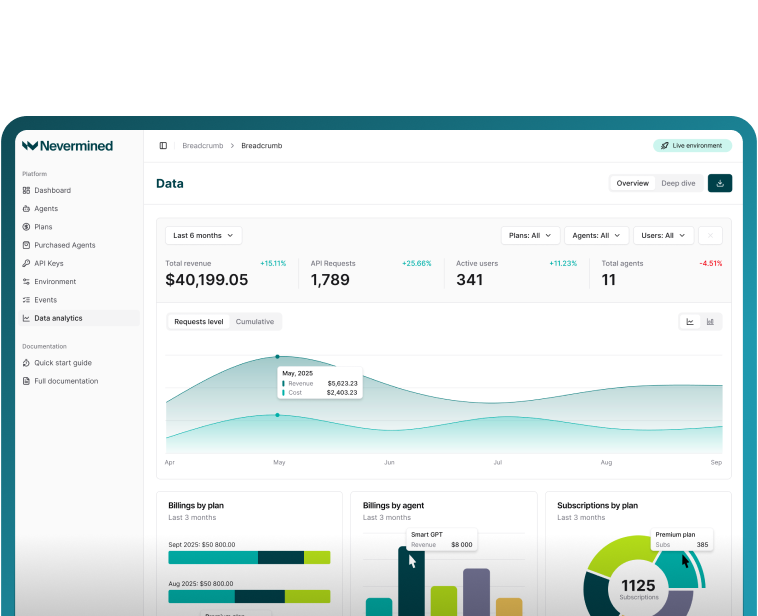
Real-time payments, flexible pricing, and outcome-based monetization—all in one platform.