MENU


Flexible credits represent a fundamental shift in how AI agents are monetized, moving away from static subscriptions toward consumption-based models that align costs with actual value delivered. As the agentic economy matures, traditional seat-based pricing fails to capture the reality that a single AI interaction can trigger hundreds of micro-activities with sub-cent costs. Companies building AI agents need infrastructure capable of metering every token, API call, and GPU cycle while maintaining predictable budgets for buyers. Nevermined Pay provides the billing infrastructure specifically designed for this new paradigm, enabling real-time metering, flexible pricing models, and instant settlement in fiat or cryptocurrency.
The agentic economy represents a new paradigm where AI agents operate autonomously, execute multi-step workflows, and transact with other agents without human intervention. This creates billing challenges that legacy payment processors were never designed to handle. A single customer query might trigger dozens of internal reasoning steps, external API calls, and database operations, each with distinct cost implications.
Traditional subscription models break down in this environment for several reasons:
The emergence of protocols like Google's Agent2Agent (A2A) and Anthropic's Model Context Protocol (MCP) further accelerates the need for standardized billing infrastructure. These protocols enable agent discovery and communication but require corresponding financial rails for value exchange. More than 90% of CIOs report that managing AI costs limits their ability to drive business value, highlighting the urgency of solving this pricing challenge.
Flex Credits solve the monetization paradox by creating a unified currency for AI agent operations. Organizations prepay for credits that draw down as agents perform specific actions, providing cost predictability while maintaining alignment with actual usage.
The credit model charges for micro-actions and rewards successful outcomes rather than billing for raw compute consumption. Credit-based pricing has emerged as a dominant model because it addresses several critical business needs:
Enterprise finance teams require budget predictability that traditional usage-based billing cannot provide. With Flex Credits, organizations prepay a defined amount, monitor burn rate in real-time, and avoid surprise overruns. This approach transforms variable AI costs into manageable line items.
Salesforce Agentforce Flex Credits are priced at $500 per 100,000 credits, with each meaningful action consuming around 20 credits (roughly $0.10 per action). This granularity enables precise cost modeling while keeping individual charges above the minimum thresholds for traditional payment processing.
For teams ready to implement credit-based monetization, Nevermined's documentation provides comprehensive guides for configuring credit plans, setting margin percentages, and defining consumption rules.
Moving from flat-rate subscriptions to value-aligned pricing requires understanding three distinct pricing models that can be mixed and matched based on business requirements.
Four core AI agent pricing models have emerged for the agentic economy:
The choice between models depends on value attribution clarity and workload predictability. Outcome-based models can achieve strong margins when clear measurement of delivered outcomes exists.
Effective pricing captures margin at every transaction without requiring manual intervention. The process involves:
Technical SDK integration can be completed in under 20 minutes with specialized platforms like Nevermined.
Enterprise procurement teams demand audit-ready transparency before committing to AI agent deployments. Billing disputes represent a significant source of churn, with transparent metering dramatically reducing conflicts compared to opaque billing systems.
Tamper-proof metering creates buyer trust through independent verification. Every usage record is signed and pushed to an append-only log at creation, making it immutable. The exact pricing rule is stamped onto each agent's usage credit, allowing any developer, user, auditor, or agent to verify that usage totals match billed amounts per line-item.
Key transparency features include:
Zero-trust reconciliation means neither the buyer nor seller must trust the other party's billing claims. An independent system verifies every transaction, eliminating disputes and accelerating enterprise sales cycles. This approach satisfies compliance requirements in regulated industries including healthcare, finance, and government contracting.
Technical implementation should not be a barrier to proper monetization. Modern billing platforms provide low-code SDKs that reduce integration time from weeks to minutes.
The typical integration process involves three steps:
Valory cut deployment time of their payments and billing infrastructure for the Olas AI agent marketplace from 6 weeks to 6 hours using Nevermined, clawing back $1000s in engineering costs. This acceleration comes from pre-built components handling credit ledgers, wallet management, and consumption tracking.
For detailed implementation guides, visit the official documentation which covers plan creation, agent registration, and endpoint protection workflows.
Autonomous agent commerce requires persistent, verifiable identities that work across networks and marketplaces. Without standardized identification, agents cannot establish trust or settle payments.
Decentralized Identifiers (DIDs) are decentralized identifiers resolvable to DID documents containing verification methods, service endpoints, and authentication mechanisms. Each agent receives a unique identifier at registration that maintains consistency across swarms and marketplaces without re-wiring. A single lookup returns live metadata, pricing information, and authorization rules.
Key identity capabilities include:
Support for Google's A2A protocol enables instant agent connection through auto-discovery mechanisms. Direct linking to pricing plans eliminates additional configuration when agents begin transacting. Combined with advanced agent payment capabilities, these standards form the foundation for agent-to-agent commerce at scale.
Different business stages require different approaches to billing infrastructure. The key is selecting solutions that scale with growth without requiring re-architecture.
Three primary customer segments have distinct requirements:
Enterprise deployments require capabilities beyond basic metering:
Advanced integration capabilities enable micropayments and cross-chain settlements that traditional rails cannot support.
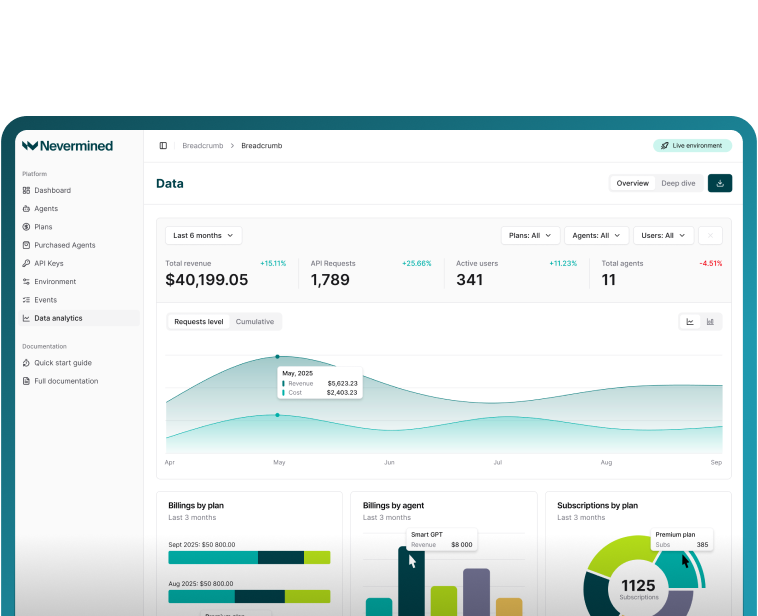
Metering data becomes strategic when transformed into actionable insights. Visibility into agent performance, user behavior, and revenue patterns enables informed scaling decisions.
Effective dashboards surface hidden costs and missed opportunities by tracking:
The Quick-Complex-Expensive framework reveals common cost distribution patterns observed in production deployments. In one observed pattern, approximately 60% of interactions resolve quickly with minimal credit consumption, 15% succeed after complex multi-step processes, and 25% become expensive attempts that consume disproportionate resources before escalating to human support.
Understanding these patterns enables targeted optimization. Implementing action limits (the 6-action rule) prevents runaway costs from sophisticated agents that try multiple approaches before acknowledging failure.
Nevermined provides payments infrastructure specifically designed for the agentic economy, addressing fundamental billing limitations that traditional payment processors cannot handle for AI workloads. The platform combines Nevermined Pay for monetization with Nevermined ID for universal agent identification, creating a complete solution for AI builders.
What sets Nevermined apart:
The platform has enabled AI companies to accelerate their path to revenue. For teams ready to implement proper AI agent monetization, contact Nevermined to schedule a demo and see how the platform can accelerate your deployment.
Credit rollover policies vary by implementation and should align with commitment terms. Monthly plans typically offer one-month rollover periods, while annual commitments extend rollover to match the contract term. Some platforms allow indefinite rollover while others implement use-it-or-lose-it policies. The key is defining clear policies upfront and communicating them transparently to avoid customer disputes.
Implement the 6-action rule by configuring hard limits that escalate interactions to human support after six unproductive actions. Track actions-per-interaction by query type to identify patterns requiring optimization. Set cost ceilings per interaction type to prevent single queries from consuming disproportionate resources. Monitor your AI efficiency score (successful actions divided by total actions) as a primary performance indicator.
Hybrid models combining platform fees with included credits and overage charges are increasingly common. This approach provides baseline revenue predictability for providers while giving customers flexibility for variable workloads. Many providers structure pre-commit arrangements with discounts for baseline commitments and true-up at term end, balancing predictability with consumption alignment.
Enterprise deployments typically require SOC 2 Type II certification at minimum, with regulated industries needing additional certifications. Healthcare applications require HIPAA compliance with Business Associate Agreements. Financial services may need PCI-DSS compliance if handling payment card data. Government contracts often require FedRAMP authorization. Verify specific certifications with vendors based on your industry requirements and data handling needs.
AI-native billing platforms support both fiat and cryptocurrency settlement, enabling cross-border agent payments without traditional banking friction. For enterprise deployments, configure local currency billing to eliminate customer exposure to exchange rate volatility. Platforms with virtual wallet capabilities can hold balances in multiple currencies, settling in the currency most appropriate for each transaction party.
See Nevermined
in Action
Real-time payments, flexible pricing, and outcome-based monetization—all in one platform.