MENU


Data-driven analysis of the explosive growth trajectory reshaping autonomous AI systems and the infrastructure required to monetize every agent interaction
The AI agent market stands at an inflection point where explosive growth collides with inadequate monetization infrastructure. With the global market projected to surge from $7.92 billion in 2025 to $236.03 billion by 2034, enterprises face a critical challenge: traditional payment systems cannot process the micro-transactions, per-token billing, and autonomous agent settlements defining this new economy. Nevermined's payment infrastructure fills this gap, providing AI builders, SaaS teams, and enterprises the ability to price, meter, and settle every agent interaction in real time through flexible credits, subscriptions, and fiat or crypto rails.
McKinsey research confirms that 88% of organizations now use AI in at least one business function in 2025, up from 78% the prior year and a massive leap from 20% in 2017. This near-universal adoption signals that AI agents have moved from experimental technology to operational necessity.
Beyond basic AI adoption, 62% of organizations are at least experimenting with AI agents, with 23% actively scaling agentic AI in at least one business function while an additional 39% have begun experimenting.
The commitment to AI agents is nearly universal. KPMG research shows 88% of companies are exploring or piloting AI agents. This indicates that the vast majority of businesses are engaged in some form of AI agent exploration or deployment.
Precedence Research calculates the global AI agents market at USD 7.92 billion in 2025, establishing the baseline for measuring explosive growth in the coming decade.
The same research forecasts growth to approximately $236.03 billion by 2034, accelerating at a compound annual growth rate of 45.82%. This 30x expansion creates massive opportunities for AI builders equipped with proper monetization infrastructure.
Grand View Research projects the market will reach $182.97 billion by 2033, growing at a CAGR of 49.6% from 2026 to 2033. Multiple research firms agree on the trajectory, differing only on the precise magnitude.
A more conservative estimate from MarketsandMarkets projects growth from $7.84 billion in 2025 to $52.62 billion by 2030, registering a CAGR of 46.3%.
BCC Research estimates the global market will reach $48.3 billion by 2030, growing at a CAGR of 43.3% from its $8 billion valuation in 2025.
Investment activity confirms market confidence, with AI agent startups raising $3.8 billion in 2024, nearly 3x the previous year's funding. This capital influx accelerates development across the entire agent ecosystem.
Looking ahead, 92% of firms plan to increase their AI budgets within the next three years, signaling sustained investment that will fuel market expansion.
PwC research reveals that over a quarter of companies plan AI budget increases of 26% or more, with 88% of executives saying their team plans to increase AI-related budgets in the next 12 months due to agentic AI.
Customer service leads AI agent applications, cited by 45.8% of surveyed companies as their primary use case. This concentration creates immediate demand for billing systems capable of tracking millions of customer interactions daily.
In financial services, 70% of institutions use AI agents for fraud detection and risk analysis. These high-stakes applications require the tamper-proof metering and compliance capabilities that Nevermined provides.
Retail adoption is equally strong, with 63% of retailers using AI agents for marketing, inventory management, and customer service operations.
Manufacturing demonstrates similar commitment, with 70% of manufacturers having embedded AI agents into digital workflows for predictive maintenance and quality control.
Healthcare adoption is accelerating, with 42% of EU hospitals using AI agents for diagnosis and triage, with 19% more planning adoption soon.
Marketing teams lead functional adoption, with 80% of marketers using AI agents for copywriting, targeting, and campaign analytics.
GM Insights reports the conversational agent segment accounted for approximately 44% of the market in 2024, expected to grow at over 41% CAGR through 2034.
Currently, single-agent systems hold 59.24% market share, favored for simplicity, lower cost, and suitability for well-defined tasks.
However, multi-agent systems are projected to grow at a CAGR of 48.5% from 2025 to 2030, outpacing overall market growth as enterprises deploy coordinated agent swarms.
The fastest-growing segment is vertical AI agents, expected to grow at 62.7% CAGR from 2025 to 2030 as domain-specific solutions gain traction in BFSI, healthcare, and legal sectors.
The machine learning technology segment led the market and accounted for 30.56% of global revenue share in 2025, underpinning the AI capabilities agents leverage.
The NLP segment dominates with 38% share in 2024, expected to grow at over 43% CAGR from 2025 to 2034.
Strong ROI expectations drive adoption, with 62% of companies anticipating 100% or greater returns from AI agent deployments. Nevermined's dynamic pricing engine helps capture this value through usage-based, outcome-based, and value-based pricing models.
Despite high expectations, only 25% of AI initiatives have delivered expected ROI over the past few years. This gap between expectation and reality stems partly from inadequate monetization infrastructure.
IBM research reveals that only 47% of IT leaders said their AI projects were profitable in 2024, with one-third breaking even and 14% recording losses.
Companies that fully account for technical debt in their AI business cases project 29% higher ROI than those that do not, highlighting the importance of proper infrastructure planning.
PwC research shows 66% of organizations adopting AI agents report increased productivity. Nevermined's credits system enables businesses to monetize these productivity gains through prepaid consumption units.
Beyond productivity, 57% report cost savings from AI agent deployment, creating measurable value that proper billing infrastructure can capture.
Tenet research confirms companies using AI agents report 55% higher operational efficiency and an average cost reduction of 35%.
The scale of agent activity is accelerating fast. Gartner predicts that agentic AI will autonomously resolve 80% of common customer service issues without human intervention by 2029. Traditional payment systems cannot handle the micro-transactions these interactions will generate at scale.
Performance improvements are significant, with AI agents resolving inquiries 52% faster and improving response time by 37%. These efficiency gains require real-time metering to translate into revenue.
Gartner projects that AI agents will intermediate $15 trillion in B2B spending by 2028. This massive transaction volume demands purpose-built payment infrastructure like Nevermined's facilitator.
McKinsey Global Institute research projects AI-powered agents and robots could generate roughly $2.9 trillion in U.S. economic value per year by 2030.
Trust remains a barrier, with 28% of executives ranking lack of trust in AI agents as one of their top three challenges. Tamper-proof metering with cryptographically signed records addresses this concern directly.
Security concerns persist, with 31% of companies restricting AI agent access to sensitive data, allowing it only under human supervision.
At the executive level, 44% of CEOs in the retail and ecommerce sector say data security and privacy are the biggest challenges when using AI in their businesses.
Gartner predicts that by 2028, 25% of enterprise breaches will be traced to AI agent abuse, emphasizing the need for robust audit trails.
Deloitte research shows only 21% of companies planning agentic AI have a mature model for governance of autonomous AI agents, creating opportunity for infrastructure providers with built-in compliance.
Integration momentum is strong, with 82% of enterprises planning to integrate AI agents within the next three years. Nevermined's agent-to-agent payment capabilities enable these organizations to build monetizable multi-agent systems.
Adoption is already well underway. PwC research shows 79% of executives say AI agents are already being adopted in their organizations, confirming that agentic AI has moved from pilot to production.
Current deployment validates projections, with 79% of executives reporting AI agents are already being used in their organizations.
The scale shift is dramatic, with Gartner predicting AI agents will outnumber human sellers by 10x by 2028, requiring payment systems designed for machine-to-machine commerce.
A Microsoft Research study on GitHub Copilot shows AI coding assistants help programmers complete tasks 55.8% faster, demonstrating the productivity gains at stake.
Developer adoption confirms this productivity, with GitHub Copilot used by over 15 million developers, making it the most widely adopted AI development tool.
Enterprise adoption follows, with Copilot Studio adopted by more than 230,000 organizations, including 90% of the Fortune 500.
Multi-agent frameworks gain traction, with nearly half of Fortune 500 firms having adopted CrewAI's agents for complex workflow automation as of 2024.
Regional analysis shows North America dominated with 41% share in 2024, establishing the primary market for AI agent monetization solutions.
The U.S. market specifically was $1.56 billion in 2024 and is projected to reach $69.06 billion by 2034, growing at 46.09% CAGR.
The broader North America market surpassed $2.23 billion in 2024 and is expanding at 45.97% CAGR during the forecast period.
Asia Pacific represents the fastest-growing region, accounting for around 20% of the market with a CAGR of nearly 35%.
The enterprises segment dominated with 67.10% share in 2024, confirming that enterprise-grade infrastructure is essential for the majority of market participants.
Gartner projects 40% of enterprise applications will integrate task-specific AI agents by end of 2026, up from less than 5% today.
Further ahead, 33% of enterprise software applications will include agentic AI by 2028, up from less than 1% in 2024.
By 2028, at least 15% of day-to-day work decisions will be made autonomously by agentic AI, up from 0% in 2024.
Organizations successfully monetizing AI agents share these implementation characteristics:
Key technical priorities include:
The Nevermined documentation provides comprehensive implementation guides, sandbox environments for testing, and API references.
The AI agent market is experiencing explosive growth driven by near-universal enterprise adoption, with 88% of organizations now using AI in at least one function. Strong ROI expectations fuel investment, as 62% of companies anticipate 100% or greater returns from AI agent deployments. Additionally, AI agent startups raised $3.8 billion in 2024, nearly 3x the previous year, signaling sustained investor confidence. The shift toward autonomous operations across customer service, financial analysis, and manufacturing workflows continues accelerating adoption.
AI agents generate micro-transactions at machine speed, often sub-cent in value, that traditional payment processors cannot handle efficiently. By 2028, AI agents will intermediate more than $15 trillion in B2B spending, requiring infrastructure capable of processing millions of autonomous transactions daily. Standard payment systems require human approval for each transaction, creating impossible bottlenecks when agents operate autonomously. Purpose-built solutions like Nevermined enable agent-to-agent payments through ERC-4337 smart accounts with session keys and delegated permissions, eliminating these friction points.
Nevermined uniquely supports three flexible pricing models that most competitors cannot match. Usage-based pricing charges per-token or per-API-call with guaranteed margins for predictable revenue. Outcome-based pricing charges for results like completed tasks or booked meetings, aligning cost with value delivered. Value-based pricing calculates charges as a percentage of ROI generated, enabling premium pricing for high-impact agent interactions. The dynamic pricing engine enables cost-plus-margin automation where platforms define exact margin percentages locked onto usage credits.
Every usage record in Nevermined is cryptographically signed and pushed to an append-only log at creation, making it immutable and verifiable. The exact pricing rule stamps onto each agent's usage credit, allowing developers, users, auditors, or agents to verify that usage totals match billed amounts per line-item. This zero-trust reconciliation model directly addresses the trust concerns that cause 28% of executives to rank lack of trust as a top challenge. Independent verification capabilities enable businesses to build confidence in autonomous agent transactions without requiring constant human oversight.
Protocol-first architecture ensures compatibility as the AI agent ecosystem evolves rapidly. Nevermined provides native support for x402 (HTTP payment protocol), Google's Agent-to-Agent (A2A) protocol, Model Context Protocol (MCP), and Agent Payments Protocol (AP2). This protocol-agnostic approach avoids vendor lock-in that plagues proprietary systems while enabling seamless integration with major AI platforms. As multi-agent systems grow at 48.5% CAGR and vertical AI agents expand at 62.7% CAGR, interoperability becomes essential for capturing value across complex agent workflows.
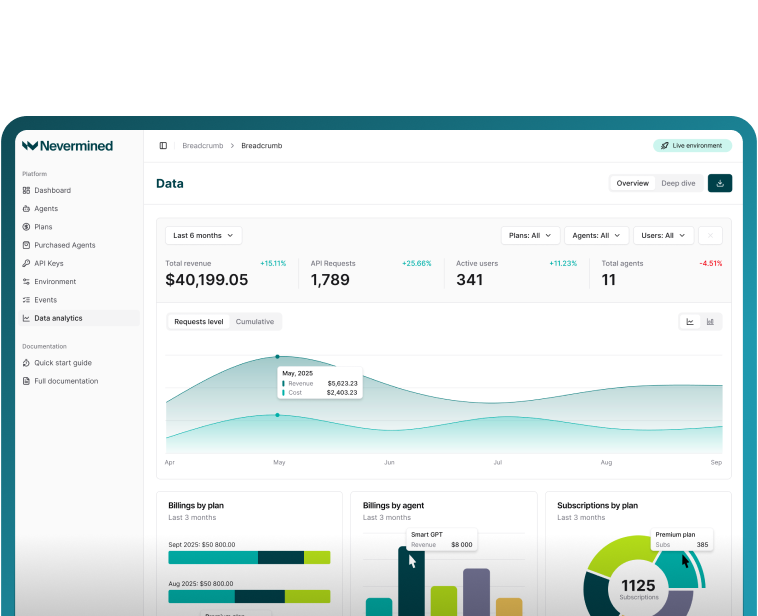
See Nevermined
in Action
Real-time payments, flexible pricing, and outcome-based monetization—all in one platform.