MENU


Data-backed analysis of the multi-billion dollar AI agent economy and the infrastructure powering autonomous agent transactions
The AI agent swarm market represents one of the fastest-growing segments in enterprise technology, yet most builders struggle to capture revenue from autonomous multi-agent systems. Traditional billing infrastructure fails when a single swarm interaction triggers hundreds of micro-activities with sub-cent costs. Nevermined Pay addresses this challenge by providing real-time metering, flexible pricing models, and instant settlement for every agent interaction. The statistics below reveal why purpose-built monetization infrastructure has become essential for AI agent swarm profitability.
The global AI agent market established a $5.4 billion baseline in 2024, creating the foundation for explosive growth in agent-to-agent transactions. This valuation reflects early adoption patterns across enterprise and developer segments.
Multiple market reports project the AI agent market will reach between $50-216 billion range within the next decade. This growth trajectory demands payment infrastructure capable of handling exponentially increasing transaction volumes.
Industry analysts at MarketsandMarkets project the global AI agents market will grow from $7.84 billion in 2025 to $52.62 billion by 2030 at a compound annual growth rate of 46.3%. This growth rate exceeds most enterprise software categories.
Research from Grand View indicates the AI agent market will reach $47.1 billion by 2030, growing at a compound annual growth rate of 44.8%. These projections underscore the urgency for robust monetization infrastructure.
Long-range forecasts from Roots Analysis show the global AI agents market rising from $9.8 billion in 2025 to $220.9 billion by 2035, representing a CAGR of 36.55%. Builders who establish monetization frameworks now will capture disproportionate market share.
Enterprise adoption is accelerating rapidly, with 82% of enterprises planning to integrate AI agents within the next three years. This adoption wave requires billing systems that handle per-token, per-API-call, and per-GPU-cycle pricing with guaranteed margins.
Market analysis indicates 85% of enterprises are expected to implement AI agents by the end of 2025. The compressed timeline intensifies demand for payment infrastructure that deploys in hours rather than weeks.
Leadership commitment is strong, with 88% of executives either exploring or scaling agent-led workflows inside their operations. This executive sponsorship accelerates budget allocation for agent monetization platforms.
Current adoption data shows 78% of global organizations already use some form of AI tools in daily operations. The transition from basic AI tools to autonomous agent swarms represents the next adoption curve.
Investment in AI agent infrastructure nearly tripled, with startups raising $3.8 billion in 2024. This capital influx signals strong investor confidence in the agentic economy thesis.
The ROI outlook is exceptional, with 62% of companies anticipating a full 100% or greater return on investment from their AI agent deployments. Achieving these returns requires precise cost tracking and margin management that Nevermined's solutions provide.
Early adopters are already validating projections, with companies deploying swarms reporting ROI exceeding 100%. These returns depend on accurate metering and billing infrastructure.
Long-term projections indicate AI is expected to increase overall business profitability by approximately 38% by 2035. Capturing this profitability requires monetization systems that track every micro-action.
Organizations implementing agentic AI report a 6-10% revenue increase. These gains compound when paired with usage-based billing that captures value from every agent interaction.
Enterprise case studies demonstrate significant impact, with Verizon reporting a 40% sales increase after deploying a Google AI sales assistant. Such outcomes validate investment in agent monetization infrastructure.
AI technologies, including agentic systems, are projected to contribute around $15.7 trillion to the global economy by 2030, representing roughly a 26% increase in global GDP. This macroeconomic impact creates opportunities for platforms facilitating agent transactions.
The global swarm intelligence market, valued at $61.25 billion in 2025, is projected to grow to $1,182.81 billion by 2034, exhibiting a CAGR of 38.95% from 2026 to 2034. This growth requires enterprise-grade metering and compliance capabilities.
Mordor Intelligence reports swarm intelligence market size was $0.08 billion in 2025 and is forecast to reach $0.37 billion by 2030, expanding at a 36.03% CAGR. The rapid growth necessitates scalable billing infrastructure.
Industry concentration data shows transportation and logistics held 28% of the swarm intelligence market share in 2024. Vertical-specific pricing models help capture value in concentrated markets.
The fastest-growing segment is smart cities and mobility, exhibiting a 41.51% CAGR through 2030 in swarm intelligence adoption. This segment benefits from outcome-based pricing models.
Architecture preferences show edge and on-device deployments commanded 46.10% share of the swarm intelligence market in 2024. Distributed architectures require billing systems that track usage across multiple nodes.
Valory cut deployment time of their payments and billing infrastructure for the Olas AI agent marketplace from 6 weeks to 6 hours using Nevermined, clawing back $1000s in engineering costs. This case demonstrates the efficiency gains available through purpose-built agent monetization platforms.
Workflow automation is widespread, with 64% of organizations applying AI agents for automating repetitive business workflows. These automated workflows generate micro-transactions requiring instant settlement capabilities.
Document processing use cases show 58% of organizations use AI agents for summarizing emails, documents, and meetings. Each summarization task represents a billable event in usage-based models.
Governance complexity is increasing, with 51% of enterprises using two or more methods to control or manage their AI agent tools. Unified billing platforms simplify this complexity.
Compliance requirements show 29% of companies require oversight mechanisms such as human validation, logs, or approval workflows. Tamper-proof metering systems satisfy these audit requirements.
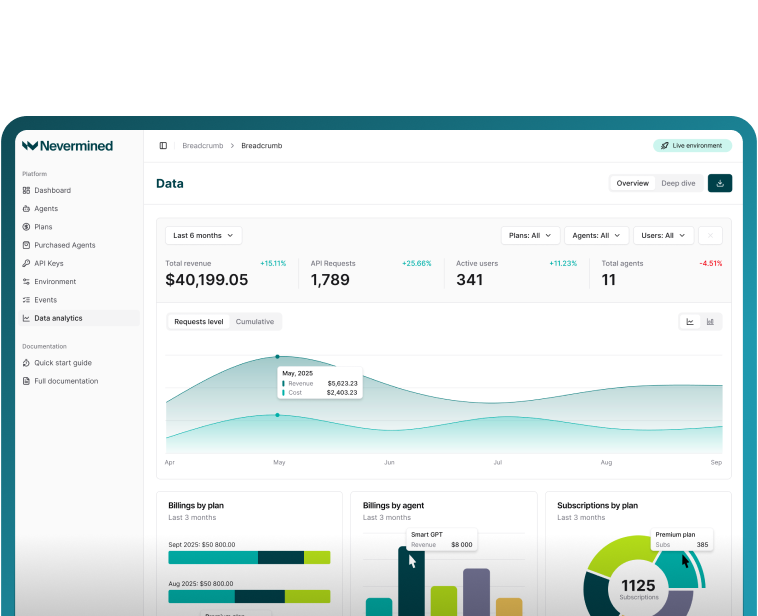
Nevermined Pay delivers bank-grade enterprise-ready metering, compliance, and settlement so every model call turns into auditable revenue. The platform features ledger-grade metering, a dynamic pricing engine, credits-based settlement, 5x faster book closing, margin recovery, and x402 integration for advanced agent payment capabilities.
Trust considerations show 71% of users prefer that AI agent responses be reviewed or approved by a human, especially in critical tasks. Transparent billing builds the trust necessary for broader adoption.
Efficiency gains are substantial, with ServiceNow's AI agent integration leading to a 52% reduction in time required to handle complex customer service cases. These efficiency improvements create opportunities for outcome-based pricing.
Developer productivity data shows AI coding tools have led to productivity boosts of 15-126%, especially in coding, documentation, and testing. Value-based pricing captures a percentage of these productivity gains.
Platform adoption is strong, with GitHub Copilot users globally across individual developers and enterprise teams. This scale demonstrates market appetite for AI-assisted workflows.
Enterprise penetration shows 230,000 organizations use GitHub Copilot for Business. Large-scale deployments require billing systems that handle complex enterprise agreements.
For teams seeking detailed implementation guidance, Nevermined's documentation provides step-by-step SDK integration instructions for TypeScript and Python environments.
Regional concentration shows North America currently dominates the AI agent landscape, accounting for roughly 40% of global market share. Multi-currency settlement capabilities serve this diverse geographic market.
Growth trajectory data indicates Asia-Pacific is projected to be the fastest-growing region with an annual growth rate of nearly 50%. Global payment rails including fiat and crypto options serve emerging markets.
Market-specific forecasts show the Indian AI market is projected to reach $17 billion by 2027, up from approximately $8 billion in 2025. Credits-based systems provide predictable spend for cost-conscious markets.
The United States AI agents market is expected to reach a projected revenue of $13.46 billion by 2030, with a CAGR of 43.3% from 2025 to 2030.
Vertical market data shows the global AI agents financial service market size was $490.2 million in 2024, projected to reach $4,485.5 million by 2030, growing at a CAGR of 45.4%.
Retail adoption is accelerating, with 76% of retailers increasing their investment in AI agents over the next year. Retail-specific pricing models address industry-unique requirements.
Healthcare represents a major vertical, with AI valued at $20.9 billion in 2024, estimated to reach $148.4 billion by 2029 at a CAGR of 48.1%.
The global conversational AI market size was estimated at $11.58 billion in 2024, estimated to reach $41.39 billion by 2030. Conversational interfaces require per-interaction billing models.
Education sector data shows the global AI in education market was estimated at $2.21 billion in 2024, projected to reach $5.82 billion in 2030, growing at a CAGR of 17.5%.
Application-specific data shows UAV swarms led with a 38.10% share of the swarm intelligence market in 2024. Specialized applications benefit from outcome-based pricing tied to mission completion.
According to NIST, 40% of organizations have incorporated swarm intelligence for enhancing their AI capabilities in spontaneous decision-making. Autonomous decisions require immutable audit trails.
The U.S. Department of Transportation reports 60% of organizations in the logistics industry have incorporated swarm intelligence to optimize fleet management and trade routes.
Algorithm preferences show ant colony optimization captured 37% share of the swarm intelligence market size in 2024. Different optimization approaches require flexible metering capabilities.
Consumer acceptance data shows 44% of consumers would prefer interacting with AI for simple service tasks like bookings or tracking. Consumer-facing agents require transparent, trustworthy billing practices.
Generational differences show 32% of Gen Z are comfortable letting AI agents make certain decisions, including recommendations and purchases. This comfort level accelerates adoption of autonomous agent transactions.
Marketing adoption is mature, with 88% of marketers using AI agents in their daily roles, with 93% leveraging it to generate content faster.
Executive awareness is high, with 84% of business leaders recognizing the potential for artificial intelligence to disrupt traditional ways of working.
Industry-specific adoption shows nearly 90% of video game developers use AI agents, representing a highly penetrated vertical.
Future projections indicate that by 2029, 80% of service issues are expected to be resolved entirely by autonomous agents without human intervention.
Gartner forecasts that one-third of enterprise software tools will include agentic capabilities by 2028. This integration wave creates demand for embedded billing capabilities.
For builders ready to monetize their AI agent swarms, Nevermined offers the infrastructure needed to meter, price, and settle every autonomous agent interaction in real time.
AI agent swarms generate revenue through multiple pricing models: usage-based (per-token, per-API-call, per-GPU-cycle), outcome-based (charging for results achieved like leads generated or tickets resolved), and value-based (percentage of ROI or value generated). With 62% of companies expecting 100%+ ROI, the key is implementing billing infrastructure that captures value from micro-actions while maintaining margin visibility.
Multi-agent systems typically employ usage-based pricing that tracks every token and API call, subscription models with tiered access levels, and outcome-based pricing tied to measurable results. The $3.8 billion invested in AI agent startups in 2024 reflects growing sophistication in these monetization approaches.
Tracking individual agent performance requires real-time metering systems that log every interaction to immutable records. With 64% of organizations automating workflows through AI agents, observability dashboards that surface hidden costs and revenue analytics have become essential for margin management.
Agent-to-agent payments enable autonomous transactions between agents without human involvement, critical as the market grows toward $47.1 billion by 2030. These payments require support for emerging standards like Google's A2A protocol and instant settlement capabilities in both fiat and cryptocurrency.
Nevermined provides tamper-proof metering where every usage record is signed and pushed to an append-only log, enabling zero-trust reconciliation. This transparency satisfies the 29% of companies requiring oversight mechanisms and builds trust with enterprise procurement teams requiring audit-ready documentation.
See Nevermined
in Action
Real-time payments, flexible pricing, and outcome-based monetization—all in one platform.