MENU


AI agent monetization is the framework that enables developers and companies to charge for autonomous AI systems that perform tasks, make decisions, or complete workflows on behalf of users. Unlike traditional SaaS pricing that charges for software access, AI agent monetization prices the value created by autonomous actions, tying revenue to tasks completed, outcomes delivered, or economic impact generated. For builders entering the agentic economy, this represents both an enormous opportunity and a critical infrastructure challenge that traditional payment processors were never designed to solve.
AI agent monetization fundamentally differs from traditional software pricing because autonomous systems generate usage patterns that seat-based or subscription models cannot accommodate. A single agent interaction might involve simple queries costing fractions of a cent alongside complex multi-step workflows costing ten cents or more. This cost variance makes traditional unit economics unreadable, and agents operating around the clock without session boundaries render flat pricing economically unsustainable.
The market opportunity is substantial. MarketsandMarkets projects the AI agents market to grow from $7.84 billion in 2025 to $52.62 billion by 2030 at a 46.3% CAGR. Separately, a Grand View Research release projects the market will reach $50.31 billion by 2030 at a 45.8% CAGR, while Grand View's main market report forecasts $182.97 billion by 2033 at a 49.6% CAGR from 2026 to 2033. Investment validates this trajectory, with AI agent startups raising $3.8 billion in 2024, nearly tripling 2023 funding according to CB Insights.
Traditional payment processors present fundamental problems for AI agent commerce:
These limitations help explain why, even as AI feature adoption has surged, monetization has lagged. A 2023 SaaS benchmark survey found that 77% of SaaS companies had launched AI features or had them on the roadmap, but only 15% had monetized AI. The infrastructure gap, not the pricing strategy alone, determines whether AI builders can capture value.
The gap between AI adoption plans and successful monetization reveals the core challenge builders face. Capgemini found that 82% of organizations intend to integrate AI agents within one to three years, yet monetization infrastructure still lags behind adoption. Traditional payment infrastructure can require weeks of custom development for AI-specific use cases, burning engineering resources that should improve agent capabilities.
For builders, proper monetization infrastructure provides several critical benefits:
The economic case for AI is compelling. PagerDuty found that 62% of companies expect more than 100% ROI from agentic AI implementations. Salesforce's State of Sales report found that 83% of sales teams with AI saw revenue growth, while 81% of sales teams were experimenting with or had fully implemented AI. But capturing that value requires infrastructure capable of tracking, billing, and settling the micro-transactions that comprise agent workflows.
Common AI monetization approaches include several fundamental frameworks that builders should understand. Recent SaaS benchmark data suggests hybrid models can outperform on net revenue retention, and the optimal model depends on product economics, customer segment, and value realization:
This model treats AI agents as FTE replacements, charging monthly fees based on capability tiers. The approach targets headcount budgets, which are typically far larger than IT spending, and works well for legal, HR, and customer service automation where agents replace specific roles.
Charges accumulate per discrete task, such as per-minute rates for voice or per-page rates for document processing. While transparent, this model faces commoditization pressure as AI costs decline rapidly, with inference costs dropping 280x between November 2022 and October 2024 according to Stanford HAI.
Bundles multi-step processes into single charges, such as a fixed fee per qualified candidate or per meeting booked. This model captures more value than action-based pricing by tying charges to completed workflows rather than individual steps.
Charges only for results, completely decoupling price from technology costs. Intercom's Fin AI agent exemplifies this approach, charging $0.99 per outcome, where an outcome is defined as either a resolution or a successful procedure handoff. This pricing model creates a virtuous cycle where superior outcomes justify premium pricing while still undercutting less effective competitors.
Infrastructure supporting multiple models simultaneously enables builders to serve diverse customer segments and evolve pricing as agent capabilities mature. Hybrid approaches that combine usage-based, event-triggered, and subscription elements offer maximum flexibility.
Agent-to-agent commerce represents the next frontier for AI monetization. Gartner projects that by 2028, 90% of B2B buying will be AI agent intermediated, pushing over $15 trillion of B2B spend through AI agent exchanges.
This shift requires infrastructure supporting:
Traditional payment processors requiring wallet pop-ups for each request cannot support this model. ERC-4337 smart accounts with session keys and delegation enable transactions without manual authorization. It is worth noting that x402 implementations can also be automated; an AWS implementation demonstrated automated request-pay-resubmit behavior with sub-2-second settlement. Whether any given implementation interrupts workflows depends on architectural choices, and Nevermined's integration removes friction by supporting both patterns natively.
For agents to be truly autonomous, they need access to resources and self-custody of their assets. In a CoinDesk opinion article, David Minarsch argued that programmable blockchains provide the ideal substrate for agents to acquire services programmatically across third-party platforms without fragmentation breaking seamless AI support.
Trust and infrastructure readiness represent primary barriers blocking enterprise adoption of autonomous AI payments. Accenture reported that 85% of financial institutions believe their current systems and scaling plans are insufficient to handle high-volume, autonomous agent-initiated transactions. Separately, Deloitte found that trust was the single most cited barrier to agentic AI adoption in finance and accounting, with 21.3% of respondents naming it the top obstacle, underscoring that no single barrier dominates but trust leads the pack.
The problem intensifies with outcome-based pricing, where vendors define success inconsistently. A well-known pitfall is that customer abandonment can be mislabeled as resolution, inflating reported success rates while creating fundamental billing disputes and driving churn.
The solution requires cryptographically signed usage records pushed to append-only logs at creation. This approach enables:
Enterprise procurement teams block deployment without this verification capability. Deloitte's AI Report found that only 21% of companies report having a mature model for agent governance, creating opportunity for infrastructure providers that solve the trust problem.
Integration speed separates profitable AI businesses from those bleeding margin on development costs. Traditional payment processors can require weeks of custom development for AI-specific use cases. Purpose-built infrastructure reduces this dramatically.
The deployment advantage compounds through several mechanisms:
The time savings are substantial. Valory cut deployment time of their payments and billing infrastructure for the Olas AI agent marketplace from 6 weeks to 6 hours using Nevermined, clawing back $1000s in engineering costs. This 168x time advantage separates those capturing market share during the critical 2025 to 2027 window from those still building basic infrastructure.
Protocol fragmentation threatens to create walled gardens as major players launch competing standards for agent communication and payments. Google's A2A protocol, Model Context Protocol (MCP), x402 HTTP payment protocol, and Agent Payments Protocol (AP2) each address different aspects of agent interoperability.
Infrastructure providers building compatibility with multiple protocols from day one capture disproportionate market share as the ecosystem matures. The protocol-first approach provides:
Those betting on a single standard risk obsolescence when agent ecosystems converge differently than predicted. Protocol-agnostic infrastructure provides insurance against this uncertainty while enabling builders to focus on agent capabilities rather than payment plumbing.
Comprehensive AI monetization extends beyond payment processing to include agent identity and performance visibility.
A common design pattern is to assign agents cryptographically controlled identities, potentially combining wallets, decentralized identifiers (DIDs), and attestations. DIDs can make identity more portable across systems, though specific implementation requirements vary by environment. This identity layer enables:
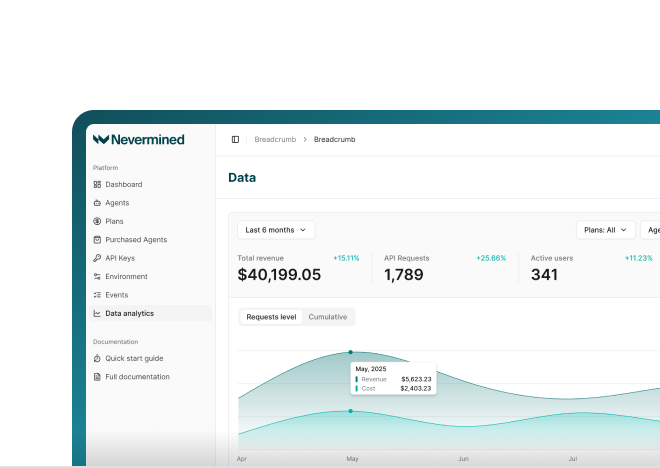
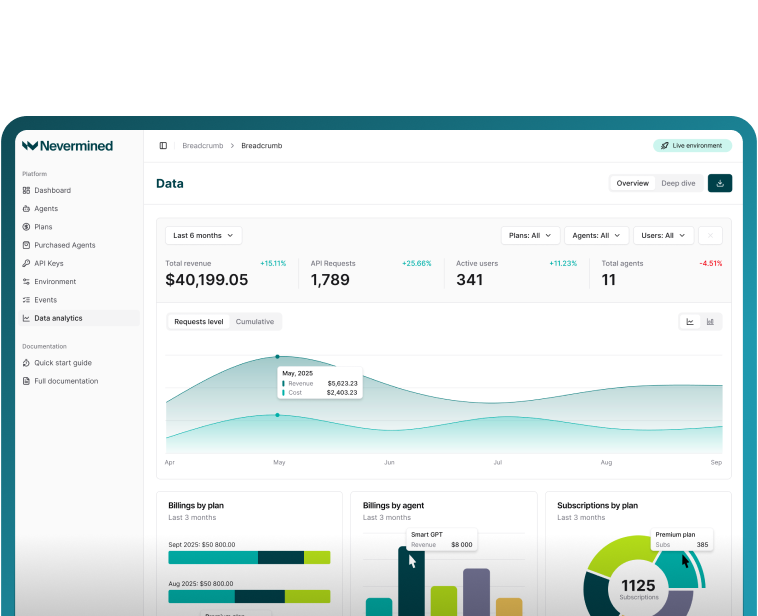
Observability dashboards provide visibility into agent performance, user behavior, revenue analytics, hidden costs, and growth opportunities. Real-time metering tracks every request, billing by cost, usage, or event according to chosen model.
Finance teams receive trackable recurring billing instead of complex sub-cent charge reconciliation. Users prepay credits, monitor burn rate in real-time, and avoid surprise overruns. This transparency builds trust while enabling data-driven optimization of agent economics.
Nevermined provides payments infrastructure specifically designed for AI agents and autonomous systems. The platform delivers billing, metering, and settlement capabilities that enable AI developers to monetize agent interactions through usage-based, outcome-based, and value-based pricing models.
Nevermined delivers bank-grade enterprise-ready metering, compliance, and settlement so every model call turns into auditable revenue. Key capabilities include ledger-grade metering, dynamic pricing engine, credits-based settlement, 5x faster book closing, and margin recovery.
The platform serves three customer segments:
Partners trust Nevermined for mission-critical infrastructure. David Minarsch, CEO of Valory, stated: "We knew AI agents need to be able to transact, so over a year ago we tapped into Nevermined. Nevermined was, and continues to be, the best solution for AI payments." Richard Blythman, Co-Founder of Naptha AI, noted: "Whenever I need to understand AI agent monetization, I turn to the Nevermined team. They're world class and leading the agentic payments space."
For builders ready to monetize AI agents without building payment infrastructure from scratch, Nevermined provides the fastest path from concept to revenue.
AI agent monetization solves the fundamental mismatch between how AI agents generate value and how traditional payment systems operate. Traditional processors charge flat fees that make sub-dollar transactions unprofitable, yet AI agents generate hundreds of micro-interactions per session. Purpose-built monetization infrastructure enables per-token and per-API-call pricing that scales profitably while protecting margins through dynamic pricing engines that lock exact percentages onto usage credits.
Yes, AI agents can transact autonomously through ERC-4337 smart accounts with session keys and delegation. Users authorize payment policies once, defining boundaries for transaction amounts, frequencies, and purposes. Agents then interact freely within those boundaries without requiring wallet pop-ups or manual approvals for each transaction. Security comes from cryptographic verification, programmable authorization logic, and configurable expiration windows that limit exposure.
Protocol-first architecture ensures compatibility with multiple emerging standards simultaneously, avoiding vendor lock-in that plagues proprietary systems. As Google's A2A, Model Context Protocol, x402, and Agent Payments Protocol compete for adoption, developers using protocol-agnostic infrastructure can support whichever standards gain traction without rearchitecting their payment systems. This approach reduces technical debt and provides insurance against betting on the wrong standard.
Outcome-based pricing charges only for results delivered rather than resources consumed, completely decoupling price from technology costs. While usage-based models charge per token or API call, outcome-based approaches charge per successful resolution, booked meeting, or qualified lead. This alignment with customer value removes adoption friction because customers only pay when they receive tangible results. However, outcome-based pricing requires careful metric definition to avoid disputes about what constitutes success.
AI builders should prioritize tamper-proof metering with cryptographically signed usage records pushed to append-only logs at creation. This creates audit trails that help satisfy regulatory requirements across jurisdictions, including the EU AI Act's record-keeping obligations for high-risk AI systems and GDPR accountability principles that require organizations to demonstrate compliance. Additional requirements include explainable transaction records for regulatory review, data governance frameworks supporting anonymization and consent management, and the ability to export metering data via API or CSV for independent verification by auditors or customers.
See Nevermined
in Action
Real-time payments, flexible pricing, and outcome-based monetization—all in one platform.