MENU


Data-driven analysis of market growth, pricing models, and billing infrastructure shaping how AI builders capture value from autonomous agent interactions
The AI agent economy is experiencing unprecedented growth, yet most builders struggle to monetize their agents effectively. Traditional subscription models fail when a single conversation triggers hundreds of micro-activities with sub-cent costs. Nevermined's payments infrastructure addresses this gap by enabling usage-based billing, instant settlement, and agent-to-agent transactions that legacy payment processors cannot handle. With the global AI agents market projected to grow from about $5.4 billion in 2024 to $50.31 billion by 2030, the infrastructure powering this economy determines who captures value and who leaves money on the table.
The current market valuation establishes the foundation for what analysts predict will be a ten-fold expansion within five years. This baseline reflects enterprise investment, startup activity, and increasing production deployments across industries.
Grand View Research projections projects the global AI agents market will grow from $5.40 billion in 2024 to $50.31 billion by 2030, reflecting a 45.8% CAGR from 2025 to 2030. This expansion creates massive opportunities for builders who establish effective monetization infrastructure early..
The compound annual growth rate outpaces most technology sectors, driven by enterprise adoption and autonomous workflow automation. This growth rate demands scalable billing systems that can handle exponential transaction volumes.
A May 2025 PwC survey of 300 senior executives reveals that 88% plan to increase AI-related budgets in the next 12 months specifically because of agentic AI capabilities. This budget expansion creates immediate demand for billing infrastructure that can meter autonomous agent interactions.
The adoption rate among enterprises demonstrates that AI agents have moved beyond pilot programs into production deployments. A May 2025 PwC survey found that only 18% of companies report no AI agent usage at all.
Companies adopting AI agents experience quantifiable productivity gains, validating investment decisions and accelerating further deployment. This measurable value creation supports premium pricing for high-performing agents.
The Simon-Kucher survey indicates outcome-based monetization will dominate AI agent pricing strategies, charging for results achieved rather than access granted. This model requires metering systems that track successful outcomes, not just API calls.
Usage-based pricing enables per-token, per-API-call, and per-GPU-cycle billing that aligns costs with value delivery. Nevermined Pay supports this model through real-time metering that tracks every request and settles payments instantly.
The hybrid approach allows AI builders to start with cost-covering baselines and layer success fees where appropriate. This flexibility prevents the common problem of leaving money on the table with flat subscription pricing.
Outcome-based pricing in action: Intercom's Fin AI agent charges only when customers confirm their answer is satisfactory or exit without requesting further assistance. This model increased Fin's share of support tickets from 15% to 45% within five months.
Enterprise AI platforms like Salesforce implement workflow-based usage pricing that was originally framed around per-conversation fees before evolving toward credit-based models that still charge per meaningful interaction rather than traditional seat licenses.
Time-based usage pricing provides an alternative model for AI agents performing sustained work tasks. This approach suits development, research, and analysis use cases where value accumulates over time.
Credit-based systems offer prepaid consumption models that provide predictable spend while maintaining usage-based flexibility. Flex Credits from Nevermined operate similarly, enabling credit allocation across users, departments, or agents without renegotiating licenses.
Implementation studies show rapid return on investment when AI agents are properly deployed and metered. Capturing this ROI requires billing infrastructure that tracks value creation accurately.
Beyond productivity, over half of companies experience direct cost reductions from AI agent implementations. These savings validate premium pricing for agents that demonstrably reduce operational expenses.
Speed improvements in decision processes represent quantifiable value that supports value-based pricing models. Metering systems must capture these outcomes to justify pricing structures.
Customer experience gains from AI agents translate directly to retention and revenue metrics. Billing platforms need to link agent performance to business outcomes for accurate value capture.
Despite ranges from free to $50,000+, the effective monthly pricing sweet spot serves most business applications. This range requires granular metering to ensure profitability at various usage levels.
Underestimated expenses including API calls, compute resources, and integration work significantly impact unit economics. Transparent metering from platforms like Nevermined surfaces these costs before they erode margins.
Long-term returns compound as AI agents optimize over time and usage scales. Capturing this value requires billing systems that can grow with agent deployments.
By 2028, about one-third of enterprise applications will incorporate agentic AI capabilities. This integration density demands payment infrastructure supporting agent-to-agent transactions without human involvement.
Gartner projects that agentic AI will enable autonomous decision-making for a significant portion of daily workflows. This automation requires billing systems that can meter and settle transactions between AI systems.
Integration with systems ranks as the top requirement for AI agent success. Payment infrastructure must integrate seamlessly with existing enterprise stacks.
The data integration complexity of AI agent deployments demands billing systems that can operate across multiple data environments. Nevermined ID provides universal agent identification via cryptographically-signed wallet addresses that persist across networks.
Enterprises prefer flexibility in AI agent deployment, combining custom development with purchased solutions. This hybrid approach requires interoperable payment rails supporting diverse agent architectures.
Token-based pricing from major LLM providers, using legacy GPT-4’s 2023 rates as an example, establishes the cost foundation for AI agent economics. Builders must meter and mark up these costs accurately to maintain margins, even as newer models become cheaper.
Output token costs under the original GPT-4 pricing ran roughly double input costs, significantly impacting agent economics for response-heavy applications. Real-time cost tracking prevents margin erosion as teams choose between legacy and newer, lower-cost models.
Per-interaction costs for 500-2,000 token conversations, calculated using legacy GPT-4 rates, establish baseline economics for support agents. Pricing above these historical costs with guaranteed margin requires precise metering
Operational savings from AI agent deployment, often a 40-60% reduction in support ticket volume, validate investment while establishing value-based pricing benchmarks. These reductions in workload must be tracked and attributed correctly
Quick wins from AI deployment demonstrate immediate value that supports premium pricing. Outcome tracking enables success-based billing models.
Voice interaction pricing varies significantly based on complexity and integration requirements. Per-minute metering captures value accurately across use cases.
The infrastructure modernization requirement creates opportunities for plug-and-play billing solutions that reduce deployment complexity. Nevermined's documentation enables integration in under 20 minutes.
Integration platform limitations slow AI agent deployment and create demand for purpose-built infrastructure. Specialized payments platforms eliminate weeks of custom development.
Development investment for custom agents creates pressure to monetize effectively from launch. Pre-built billing infrastructure accelerates time-to-revenue.
Implementation costs for low-code solutions represent friction that delays monetization. SDK-based approaches minimize professional services requirements.
Payback periods for AI agent investments depend heavily on billing infrastructure efficiency. Faster billing deployment accelerates the path to profitability.
Rapid ROI for sales agents validates investment decisions and supports aggressive growth strategies. Capturing this value requires billing systems ready at launch.
Significant enterprise investment demands enterprise-grade billing infrastructure with audit capabilities. Nevermined's solutions provide bank-grade metering and compliance at global scale.
High prototype volumes require billing infrastructure that scales from experimentation to production without re-architecture.
Security concerns at the leadership level require tamper-proof metering systems with immutable audit trails. Cryptographic integrity prevents billing disputes and fraud.
Practitioner security concerns exceed leadership awareness, indicating ground-level friction that delays deployment. Secure-by-design billing infrastructure removes this barrier.
Cost reduction focus requires transparent billing that demonstrates ROI clearly. Real-time cost tracking enables optimization and validates investment.
Satisfaction metrics as success indicators support outcome-based pricing models that charge for results achieved.
Transformational expectations signal sustained investment in AI agent capabilities. This transformation requires payment infrastructure built for autonomous agent economies.
Competitive differentiation from AI agents drives urgency in deployment and monetization strategies. First-movers with effective billing capture market share.
Low trust in financial tasks highlights the need for transparent, auditable billing systems that build confidence. Third-party billing authority from neutral platforms creates buyer trust.
Trust deficits in AI agent deployment require billing infrastructure that provides zero-trust reconciliation. Every usage record must be verifiable by any party.
Security and cost concerns tie as top challenges, demanding billing systems that address both simultaneously. Secure metering with transparent pricing resolves both issues.
Rapid role transformation expectations accelerate billing infrastructure requirements. Organizations cannot wait for legacy payment systems to adapt.
Operating model disruption predictions demand payment infrastructure that can evolve with changing business models. Flexible pricing rails support this transformation.
Competitive anxiety drives urgency in AI agent deployment decisions. Billing infrastructure that enables rapid launch provides competitive advantage.
The core challenges include security concerns cited by 62% of practitioners, integration complexity requiring 8+ data sources for 42% of deployments, and tech stack upgrades affecting 86% of enterprises. Traditional payment processors lack agent-native integrations and cannot handle sub-cent micro-transactions efficiently.
39% of companies expect outcome-based pricing that charges for results achieved, while 36% favor usage-based metrics charging per token, API call, or GPU cycle. Value-based pricing captures a percentage of ROI generated. Hybrid approaches combining these models work best, allowing builders to cover costs while capturing upside from successful outcomes.
Traditional processors require extensive custom development for AI-specific use cases, lack support for emerging standards like Google's A2A protocol and MCP, and cannot process agent-to-agent payments without human involvement. The sub-cent transaction costs typical in AI workflows make standard payment processing economically unviable. The absence of real-time metering prevents accurate usage tracking.
With purpose-built infrastructure like Nevermined, developers can integrate payment capabilities in under 20 minutes using low-code SDKs in TypeScript or Python. This contrasts with custom development costs of $10,000-$100,000+ and multi-week timelines required for building billing infrastructure from scratch.
AI agents deliver 300-500% ROI within six months of proper implementation, with Year 2+ returns reaching 400-600% for well-maintained systems. 66% of companies report measurable productivity increases and 57% achieve cost savings. Most implementations reach break-even within 3-9 months when billing infrastructure captures value effectively.
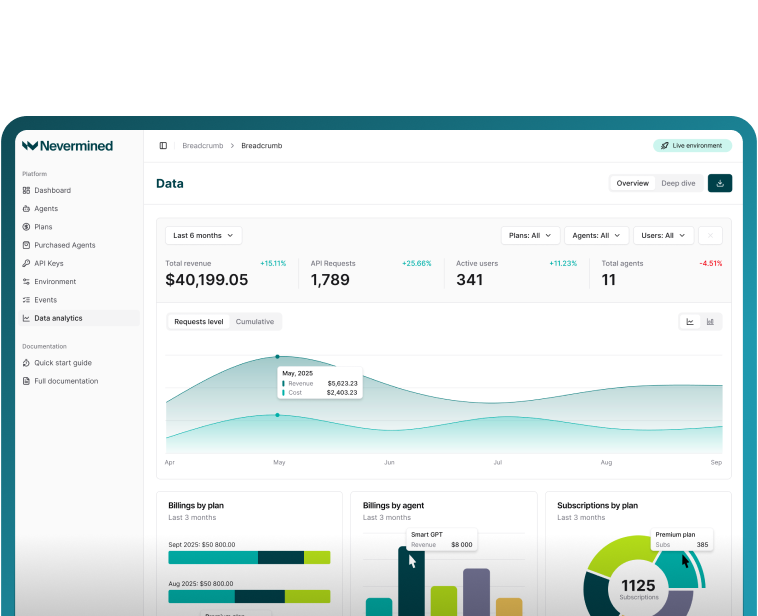
See Nevermined
in Action
Real-time payments, flexible pricing, and outcome-based monetization—all in one platform.