MENU


The agentic economy is rewriting how software gets priced. With worldwide AI spending projected to reach $2.022 trillion in 2026, a 37% increase from 2025, businesses can no longer rely on seat-based subscriptions or flat monthly fees to capture value from autonomous AI agents. A single agent conversation can trigger hundreds of micro-activities with sub-cent costs, making traditional SaaS pricing models fundamentally incompatible with AI workloads. Companies need payments infrastructure built specifically for the agent economy, and Nevermined's platform provides the real-time metering, flexible pricing models, and instant settlement rails that AI builders require.
The fundamental economics of AI agents break traditional software pricing. When a customer support agent resolves a ticket, it might consume tokens from multiple LLM calls, execute several API requests, query knowledge bases, and trigger workflow automations. Each action carries variable costs that compound unpredictably.
Gartner forecasts that 40% of enterprise applications will include agentic AI by 2026. This shift creates billing requirements that legacy payment processors were never designed to handle:
Seat-based and subscription models create three critical problems for AI businesses:
Traditional payment processors require extensive custom development for AI-specific use cases. Companies report burning weeks on access control and subscription setup before launching a single paid feature.
Nevermined provides payments infrastructure specifically designed for AI agents, enabling usage-based billing, instant settlement, and agent-to-agent transactions. The platform functions as the financial rails for the emerging agentic economy.
Nevermined Pay handles monetization through real-time metering, flexible pricing models, and instant payouts in fiat or cryptocurrency. The platform supports transactions between agents without human involvement, including native support for Google's Agent-to-Agent (A2A) protocol and Model Context Protocol (MCP).
Nevermined ID provides universal agent identification via cryptographically-signed wallet addresses and decentralized identifiers (DIDs). These persist across networks and marketplaces, enabling:
The platform also integrates with the x402 protocol, enabling advanced agent payment capabilities for autonomous agent-to-agent commerce.
Pricing AI agents requires matching the billing model to how the agent creates value. Hybrid pricing is becoming the market standard, but the optimal model depends on workload predictability and outcome measurability.
Five pricing models dominate the 2026 landscape:
Usage-Based Pricing charges directly for consumption. Examples include:
Outcome-Based Pricing ties charges to measurable business results. This model works best when attribution is clean, such as tickets resolved, meetings booked, or fraud cases flagged. Outcome-based pricing extends sales cycles but delivers highest value alignment when successful.
Per-Agent Pricing treats AI agents like digital employees with monthly fees. Pricing ranges from $29 to $500 per agent per month for standard agents, with rumors of premium specialized agents commanding significantly higher rates.
Hybrid Pricing combines predictable base fees with variable usage layers. This approach balances budget predictability with flexibility, explaining why OpenView projected 61% of SaaS companies would adopt usage-based pricing by 2023.
Credit-Based Pricing uses prepurchased credits that burn at variable rates across different actions. Ibbaka predicts credit-based pricing will become the dominant model for new AI-native products.
Nevermined Pay supports all five models, allowing businesses to start with cost-covering baselines and layer success fees where appropriate.
Enterprise procurement teams require audit-ready transparency before approving AI agent spend. The variable nature of token-based costs makes buyers skeptical of vendor-reported usage numbers.
Nevermined's metering system creates buyer trust through independent verification:
This zero-trust reconciliation model satisfies enterprise compliance requirements. For enterprise AI platforms, Nevermined Pay delivers bank-grade, enterprise-ready metering, compliance, and settlement so every model call turns into auditable revenue. The platform features ledger-grade metering, a dynamic pricing engine, credits-based settlement, 5x faster book closing, and margin recovery.
Credit systems solve the tension between usage-based value alignment and enterprise budget predictability.
Flex Credits operate as prepaid consumption-based units redeemed directly against usage. They address multiple enterprise concerns:
This model addresses enterprise reluctance toward minimum commitments that stall adoption. Finance teams get trackable recurring billing instead of complex sub-cent charge reconciliation.
Clay's credit model, for example, charges 1,000 credits for $149, with each enrichment action consuming 1 to 10 credits depending on complexity. This abstraction simplifies customer understanding while maintaining accurate cost attribution.
Implementation complexity remains a primary barrier to AI monetization. Enterprise implementations typically require significant time investments for full billing infrastructure deployment with traditional platforms.
Nevermined offers a low-code SDK available in TypeScript and Python. The three-step integration process takes under 20 minutes:
For detailed implementation guidance, the Nevermined documentation provides comprehensive tutorials and API references. The SDK integrates directly with popular LLM providers to automatically capture token usage and compute costs, eliminating manual instrumentation.
As agent swarms become common, identity management determines whether payments can flow correctly between autonomous systems.
Nevermined ID provides persistent agent identification through three components:
One lookup returns live metadata, pricing, and authorization rules. This eliminates the re-wiring required when agents move between marketplaces or join new swarms.
Speed to market determines competitive advantage in AI. Companies that spend months building billing infrastructure lose ground to competitors shipping features.
Valory cut deployment time of their payments and billing infrastructure for the Olas AI agent marketplace from 6 weeks to 6 hours using Nevermined, clawing back $1000s in engineering costs.
Measured productivity improvements from AI agent implementations vary significantly by deployment type and use case. Richard Blythman, Co-Founder at Naptha AI, noted: "Whenever I need to understand AI agent monetization, I turn to the Nevermined team. They're world class and leading the agentic payments space."
Legacy payment processors lack the agent-native capabilities required for autonomous AI commerce.
Traditional platforms present several limitations:
Nevermined addresses these gaps with native support for cost, usage, and outcome-based pricing models. The platform automatically meters every request to capture revenue while maintaining the x402 integration for advanced agent payment capabilities.
James Young, Founding Member of Mother, said: "Early on building Mother, we realized agent-to-agent payments get super complicated. Nevermined's solution is the perfect fit."
Setting appropriate prices requires understanding variable costs, user expectations, and competitive positioning.
LLM costs have dropped dramatically. Stanford's AI Index reports that inference costs have fallen on the order of ~9x to ~900x per year depending on the workload. Token prices vary heavily by provider and model, with OpenAI publishing detailed pricing and DeepSeek offering competitive rates.
This deflation means pricing strategies must account for:
Nevermined offers a free tier with "Get Started Free" access to begin testing agent monetization immediately. The pricing calculator tool estimates appropriate agent pricing in 60 seconds based on third-party tool costs, user expectations, and query volume.
For AI builders serious about capturing value from autonomous agents, Nevermined provides purpose-built infrastructure that traditional payment processors cannot match.
The platform serves three distinct customer segments with tailored solutions. Solo developers and solopreneurs get plug-and-play API libraries and composable payment flows. AI agent startups gain faster time-to-market than building custom billing. Enterprise AI platforms receive bank-grade metering, compliance, and settlement at global scale.
Nevermined's competitive advantages include:
David Minarsch, CEO at Valory, stated: "We knew AI agents need to be able to transact, so over a year ago we tapped into Nevermined. Nevermined was, and continues to be, the best solution for AI payments."
Explore Nevermined's solutions to see how the platform can accelerate your agent monetization strategy.
Select usage-based pricing when your agent's workload varies unpredictably and cost attribution is straightforward. Choose outcome-based pricing when you can clearly measure business results like tickets resolved or meetings booked. Many successful implementations use hybrid models combining a base fee with usage or outcome bonuses to balance predictability with value alignment.
Implementation typically requires budgeting for additional costs beyond platform fees. Key expense categories include integration development, employee training, ongoing maintenance, and security certifications for enterprise requirements. The specific amounts vary significantly based on your deployment scale, existing infrastructure, and compliance needs.
Credit policies vary by provider. Some platforms allow credits to roll over indefinitely, while others expire after 30, 60, or 90 days. When evaluating credit-based billing, examine rollover policies, minimum purchase requirements, and whether credits can be reallocated between team members or departments without additional fees.
Robust metering requires high-volume data ingestion capable of handling thousands of events per second, de-duplication logic to prevent double-billing, schema flexibility for new metrics, and horizontal scaling for AI workloads. Building compliant metering infrastructure from scratch typically requires significant time and engineering resources, though platforms like Nevermined reduce this to hours.
Implement usage alerts at 50%, 75%, and 90% of thresholds. Offer soft caps that throttle usage before hard limits trigger. Allow customers to set spend limits and provide forecasting tools that predict end-of-month costs. Customer-facing dashboards showing real-time usage and accumulated costs build trust and reduce billing disputes.
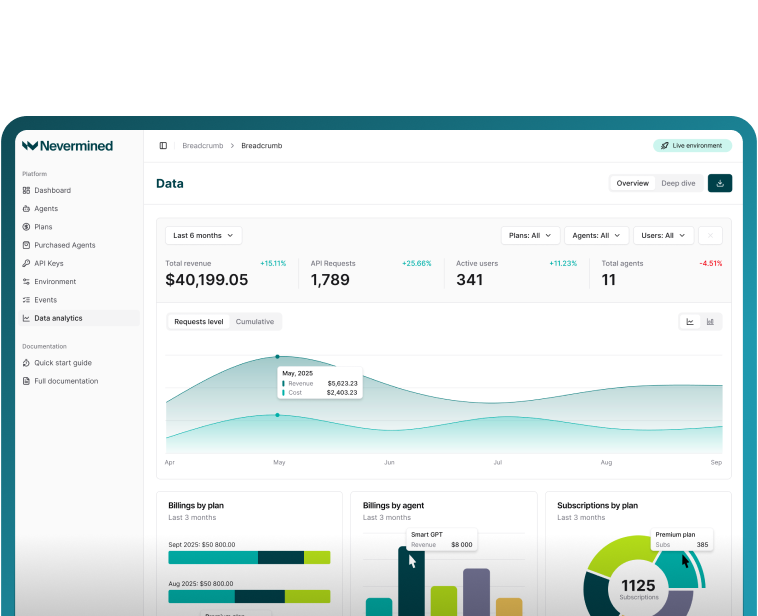
See Nevermined
in Action
Real-time payments, flexible pricing, and outcome-based monetization—all in one platform.