MENU


Comprehensive data analysis revealing how specialized payment infrastructure accelerates AI monetization, builds trust through transparency, and unlocks the trillion-dollar agent-to-agent economy
The agentic economy is projected to reach $3 trillion to $5 trillion globally by 2030, yet traditional payment processors lack the infrastructure to handle autonomous agent transactions. While ChatGPT serves 800 million weekly active users ready for monetization, only 16% of US consumers currently trust AI to make payments. Nevermined addresses this gap with purpose-built payment rails that enable real-time metering, tamper-proof billing, and agent-to-agent transactions, capabilities that legacy systems simply cannot deliver for AI workloads.
McKinsey projects the global agentic commerce market will reach $3 trillion to $5 trillion in revenue by 2030. This unprecedented growth creates fundamental infrastructure requirements that traditional payment processors cannot satisfy. AI agents execute hundreds of micro-transactions per conversation, with sub-cent costs that make conventional billing models unworkable. Nevermined's platform enables per-token, per-API-call, and per-GPU-cycle pricing that aligns directly with AI consumption patterns.
The US B2C retail segment alone represents up to $1 trillion in potential orchestrated revenue from agentic commerce by 2030. This massive domestic opportunity requires payment infrastructure capable of handling autonomous purchasing decisions, dynamic pricing negotiations, and instant settlement across agent networks.
The existing non-cash payments infrastructure handles 3.4 trillion transactions annually with $1.8 quadrillion in total transaction value. Agent-to-agent commerce will layer on top of this foundation, requiring parallel systems designed specifically for autonomous transactions without human intervention. Traditional processors lack the metering granularity and real-time settlement capabilities that AI workloads demand.
The duration of tasks that AI models can reliably complete has progressed from seconds to more than 30 human hours of execution capability. AI models now demonstrate this extended capability, while Claude 3.7 Sonnet operates with a 59-minute time horizon. These extended autonomous operations require payment systems that can meter and bill continuously without human checkpoints.
The duration of tasks that large language models can reliably complete with at least 50% success rate has been doubling every seven months since 2019. This exponential capability growth means payment infrastructure must anticipate increasingly complex agent interactions. What requires basic API metering today will demand sophisticated multi-agent transaction orchestration tomorrow.
With nearly 5.6 billion users connected to the internet in 2025, approximately 68% of the world's population, the potential customer base for AI agent services spans nearly every geography and demographic. This compares dramatically to 1999 when just 100 million internet users (under 2% of global population) began exploring e-commerce.
OpenAI's ChatGPT now serves more than 800 million weekly active users, while Google's Gemini-powered AI overviews reach more than 1.5 billion users monthly. This massive user base represents an immediate monetization opportunity for AI builders who can implement billing infrastructure quickly. The Nevermined platform allows developers to register payment plans and begin capturing revenue from these users in minutes.
McKinsey's AI Discovery Survey reveals that 50% of all consumers now use AI when searching online, with 44% of AI search users stating it has become their "primary and preferred" source. This behavioral shift creates immediate demand for AI services that require robust monetization infrastructure to capitalize on user engagement.
Despite massive AI adoption for search and content, only 16% of US consumers trust and use AI to make payments on their behalf. This trust gap represents the critical bottleneck preventing widespread agent-to-agent commerce adoption. Building trust requires transparent, auditable billing systems that allow any party to verify charges independently.
Similarly, only 29% of UK consumers would trust AI to make small, automated payments on their behalf. This international trust deficit underscores the need for payment infrastructure with built-in verification and auditability. Nevermined's tamper-proof metering system addresses this by signing every usage record and pushing it to an append-only log at creation, making billing immutable and independently verifiable.
Regulatory and compliance failures cost organizations $14 billion globally, with anti-money laundering (AML) fines alone hitting a record high of more than $6 billion in 2023. These massive penalty figures drive enterprise demand for billing systems with audit-ready transparency and zero-trust reconciliation capabilities.
The global regulatory technology market is expected to exceed $22 billion by 2025, reflecting massive investment in compliance automation. AI agent payment systems that build compliance and auditability into their core architecture deliver immediate value to organizations facing this regulatory burden.
Despite the clear opportunity, the banking sector globally spends only 10% of technology budgets on AI initiatives. This underinvestment creates openings for specialized payment platforms that focus exclusively on AI workload requirements. Nevermined's purpose-built infrastructure fills the gap that traditional financial institutions are slow to address.
Real-world implementation data from Valory, builders of the Olas AI agent marketplace, demonstrates dramatic time savings. They reduced deployment time from six weeks to six hours using Nevermined, recovering thousands in engineering costs. This 98% reduction in implementation time represents a fundamental shift from building custom billing infrastructure to deploying proven payment rails.
Google introduced its Agent Payments Protocol (AP2) in September 2025 with more than 60 organizational partners including PayPal, Coinbase, Mastercard, American Express, Adobe, and Alibaba. This protocol enables cryptographically signed mandates for agent transactions, demonstrating industry recognition that specialized infrastructure is required for autonomous commerce.
Google's agent-focused shopping infrastructure offers 50 billion product listings through AI Shopping Mode, creating an immediate use case for agent-to-agent transactions. AI agents navigating this catalog need payment rails that support instant checkout without human authorization loops.
Mastercard launched Agent Pay in April 2025 with strategic partnerships including Microsoft (Azure OpenAI Service and Microsoft Copilot Studio), IBM (watsonx Orchestrate), Braintree, and Checkout.com. Their Agentic Tokens leverage enhanced tokenization for secure agent transactions, validating the market opportunity for agent-native payment technology.
Visa announced its Intelligent Commerce initiative in April 2025 with AI platform partners including Anthropic, IBM, Microsoft, Mistral AI, OpenAI, Perplexity, Samsung, and Stripe. The offering provides APIs and SDKs for tokenization, authentication, and transaction controls specifically designed for AI agents.
Universal agent identification requires more than simple API keys. Nevermined ID issues a unique wallet plus DID per agent at registration, maintaining the same identifier across environments, swarms, and marketplaces. This persistent identity enables one lookup to return live metadata, pricing, and authorization rules without constant re-authentication.
Payment security statistics show that virtual cards represent only 9% of fraudulent transactions, demonstrating the effectiveness of tokenized, single-use payment credentials. This security advantage applies directly to agent payments where each transaction can use unique cryptographic credentials.
Nevermined's Flex Credits operate as prepaid consumption-based units that users redeem directly against agent usage. This model solves multiple enterprise challenges: aligning price to value by charging for micro-actions rather than seats, enabling flexible reallocation of credits across users and departments without renegotiating licenses, and providing finance teams with predictable spend through real-time burn rate monitoring.
The rise of programmable money shows in stablecoin transaction volumes projected to grow from $450 billion per month in 2024 to $710 billion by March 2025. This anticipated 58% growth in five months demonstrates rapid adoption of cryptocurrency rails for business transactions. Nevermined supports instant payouts in both fiat and cryptocurrency, providing developers with flexibility in how they receive revenue.
The number of unique stablecoin addresses increased 50% year-on-year to 35 million, indicating broad-based adoption beyond early cryptocurrency enthusiasts. This expanding user base creates natural demand for payment systems that support both traditional and crypto rails within the same infrastructure.
Payment method diversity varies significantly by geography, with account-to-account transfers accounting for 26% of e-commerce payments in Germany while buy now, pay later (BNPL) represents 20% of German transactions. AI agent payment systems must support diverse settlement methods to serve global markets effectively.
PayPal announced a partnership with Perplexity in May 2025 to enable account linking, secure tokenized wallets, and passkey checkout flows specifically designed for AI agents. This move by a major payment processor validates the strategic importance of agent-focused payment infrastructure.
OpenAI introduced its Operator agent in January 2025, integrated directly into ChatGPT's 800 million+ weekly user base. The company co-developed the Agentic Commerce Protocol with Stripe, demonstrating that even AI giants recognize the need for specialized payment infrastructure rather than generic processing.
Specialized providers like Skyfire deliver Agent Checkout capabilities through their KYAPay protocol, with partnerships including APIFY, BuildShip, CarbonArc, and Forter. Their features include verified identities, programmable payment capabilities, spend controls, and reputation tracking, all capabilities that Nevermined delivers alongside superior metering and margin management.
Shopify developed agentic shopping infrastructure that allows agents to tap into product catalogs and build carts across multiple merchants. This merchant-focused approach complements developer-centric platforms like Nevermined that serve AI builders creating agent services rather than retail experiences.
Nevermined maintains native integrations with major AI platforms including OpenAI, Anthropic, LangChain, and CrewAI, enabling developers to implement billing without switching frameworks or tools. This ecosystem integration approach reduces friction compared to payment solutions requiring custom adapters for each LLM provider or agent framework.
The platform's SDK is designed to get you from install to live billing in minutes (the docs show a three-command quickstart), replacing the weeks of custom development that traditional payment processors often require for AI-specific billing.
Nevermined lets developers get started free, removing upfront cost barriers to experimentation. This no-risk entry point allows developers to validate the platform's capabilities with production workloads before committing to paid plans, accelerating adoption among solo developers and startups building AI agents.
Legacy payment systems create critical gaps for AI agent monetization:
Nevermined documentation shows how developers can implement complete AI agent billing in under 20 minutes using the TypeScript or Python SDK, eliminating months of infrastructure development.
Nevermined supports three pricing models that developers can mix and match:
This flexibility allows AI companies to start with cost-covering baselines and layer success fees where appropriate, avoiding the common problem of leaving money on the table with flat pricing.
Nevermined's approach to billing integrity includes:
This transparency model satisfies enterprise procurement teams requiring audit-ready billing without the traditional trust-but-verify approach that creates reconciliation overhead.
Nevermined's low-code SDK enables three-step integration in under 20 minutes:
This developer-first approach eliminates the weeks of custom development that traditional payment processors require for AI-specific billing scenarios.
While major card networks scramble to add agent capabilities to existing infrastructure, Nevermined built agent-to-agent payments from the ground up. The platform supports:
This protocol-first approach future-proofs billing infrastructure against evolving standards while maintaining compatibility with emerging agent communication frameworks.
Nevermined ID's security architecture includes:
This zero-trust identity model enables enterprises to grant payment authority to AI agents with confidence that all transactions trace back to authorized entities.
Enterprise finance teams prefer credit-based systems because they:
This consumption model addresses the enterprise reluctance toward large minimum commitments that often stall AI adoption.
Nevermined's observability dashboard provides:
This data-driven approach transforms billing from a passive accounting function into an active product intelligence tool that informs development priorities and pricing strategy.
Traditional processors like Stripe require extensive custom development for AI-specific use cases, burning weeks on access control and subscription setup while lacking agent-native integrations, MCP support, and agent-to-agent payment capabilities. Specialized platforms like Nevermined provide purpose-built infrastructure for per-token billing, tamper-proof metering, and autonomous transactions that legacy systems simply cannot handle economically or technically.
AI workloads generate hundreds of micro-activities per conversation with sub-cent costs that make traditional billing models unreadable. Agent payment platforms use granular metering that tracks every API call, token, and GPU cycle with guaranteed margin built in.
Comprehensive security requires cryptographically-signed usage records, append-only log architecture, and transparent pricing rules stamped onto each transaction. Nevermined's tamper-proof metering system creates immutable billing data by signing every usage record at creation and pushing it to an append-only log. This zero-trust reconciliation model allows any developer, user, auditor, or agent to independently verify that usage totals match billed amounts per line-item, satisfying enterprise audit requirements.
Agent-to-agent transactions require specialized infrastructure supporting protocols like Google's Agent-to-Agent (A2A) and Model Context Protocol (MCP). Nevermined provides native support for these standards alongside decentralized identifiers (DIDs) that persist across networks and marketplaces. This protocol-first approach enables transactions between agents without human involvement while maintaining cryptographic proof of authenticity and authorization.
Credit systems align price to value by charging for micro-actions rather than seats, enable flexible reallocation across users and departments without renegotiating licenses, and provide predictable spend through real-time burn rate monitoring. Nevermined's Flex Credits solve enterprise reluctance toward minimum commitments that stall adoption while giving finance teams trackable recurring billing instead of complex sub-cent charge reconciliation. Developers benefit from simplified pricing that scales naturally with customer usage rather than arbitrary seat counts.
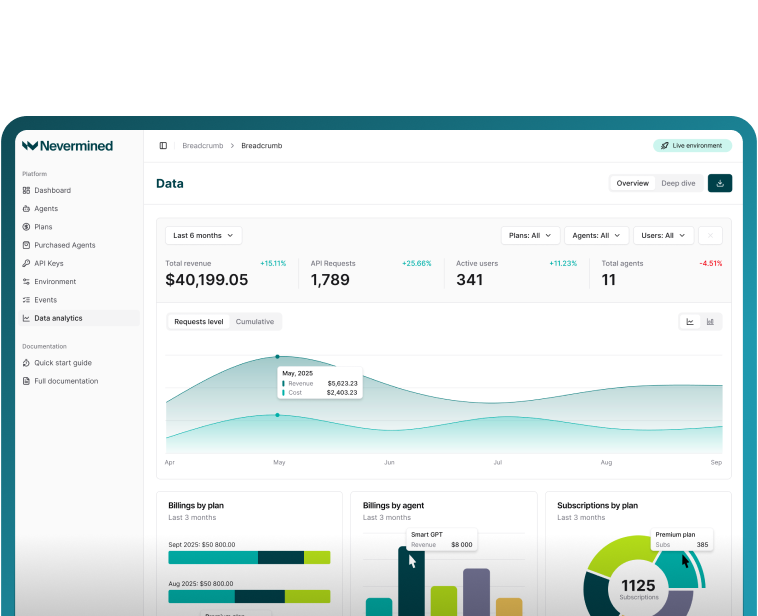
See Nevermined
in Action
Real-time payments, flexible pricing, and outcome-based monetization—all in one platform.