MENU


The agentic economy is reshaping how businesses monetize AI workloads, yet traditional payment processors like Stripe weren't designed for autonomous agent transactions. AI agents generate hundreds of micro-activities per conversation, creating sub-cent costs that make legacy seat-based pricing models unusable. Companies can accelerate their AI monetization strategy by leveraging payment infrastructure designed specifically for AI agents that handles real-time metering, instant settlement, and agent-to-agent transactions without extensive custom development.
Traditional payment processors face fundamental limitations when handling AI agent workloads. A single AI conversation can trigger hundreds of micro-activities, API calls, token processing, tool invocations, each with sub-cent costs that make unit economics unreadable using conventional billing systems. Stripe and similar platforms were built for subscription or transaction-based models, not for metering thousands of autonomous agent interactions per second.
The challenge extends beyond technical capacity. AI agents operate on usage patterns that defy traditional pricing:
Companies attempting to retrofit Stripe for AI agents report burning weeks on access control and subscription setup, with custom development requirements that delay time-to-market. Nevermined addresses these limitations through real-time metering, flexible pricing models, and instant payouts in fiat or cryptocurrency.
Modern AI payment systems deliver three essential capabilities that legacy platforms cannot provide: precise metering, protocol-based interoperability, and verifiable transaction integrity.
Effective AI monetization requires tracking every request at creation, not through batch reconciliation. Leading platforms process 15,000 events/second using webhook-based ingestion, capturing per-token pricing, per-API-call billing, per-GPU-cycle tracking, and cost-plus-margin automation.
Settlement speed matters for agent workflows. The x402 protocol enables 200ms stablecoin confirmation on Base network, compared to 2-3 day traditional ACH settlement that blocks autonomous transactions.
Universal agent identity solves authentication across marketplaces and environments. Nevermined ID provides cryptographically-signed wallet addresses and decentralized identifiers (DIDs) that persist across networks, enabling one-lookup metadata retrieval, auto-discovery via A2A protocol, immutable authentication, and cross-platform consistency.
This identity layer integrates directly with Google's Agent-to-Agent protocol, positioning compliant platforms for the September 2025 launch backed by 60+ partner organizations.
AI payment infrastructure must handle both traditional fiat and emerging crypto rails. Comprehensive platforms support card and ACH processing, stablecoin settlement via Coinbase x402, multi-currency support, and gasless transactions that eliminate crypto fee complexity for users.
AI agents demand pricing models that align cost with value delivery, moving beyond simple per-seat subscriptions.
The simplest approach meters actual consumption and adds a margin. For example: base cost of $0.002 per 1,000 input tokens (roughly GPT-4.1 API pricing as of 2025) plus a 20% markup equals $0.0024 per 1,000 tokens. This model ensures profitability even when underlying service costs fluctuate. Nevermined allows customers to set exact margin percentages and lock them onto usage credits.
More sophisticated models combine base subscriptions with consumption tiers, such as: Free tier with 100 API calls/month, Pro tier at $20/month plus $0.02 per 1,000 tokens beyond included quota, and Enterprise tier with custom volume discounts.
The most advanced approach charges for results rather than resource consumption: $5 per scheduled meeting booked by sales agent, 3% of order value processed by procurement agent, or 10% of cost savings identified by optimization agent. Flex Credits function as prepaid consumption units redeemable against multiple pricing rules within a single billing framework.
Enterprise procurement teams require audit-ready transparency. Tamper-proof metering systems create buyer trust through independent verification.
Every usage record is cryptographically signed at creation and pushed to an immutable ledger, preventing retroactive billing changes, disputed charges, and reconciliation errors. Nevermined's implementation stamps exact pricing rules onto each usage credit, allowing any developer, user, auditor, or agent to verify totals match per-line-item calculations.
Zero-trust models provide third-party verification, blockchain settlement, real-time audit trails, and API/CSV exports for customer-side validation. This verification layer satisfies enterprise compliance requirements without manual audit overhead.
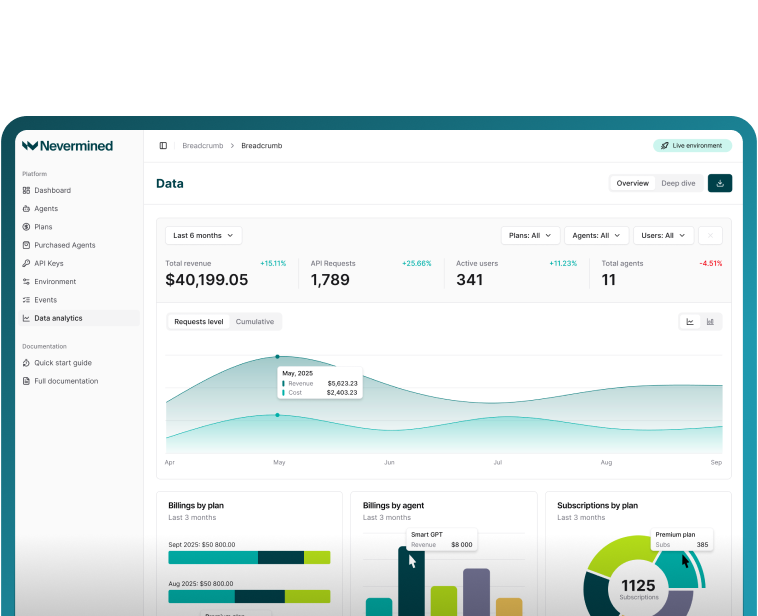
Effective platforms provide real-time usage dashboards, spending alerts, detailed line-item breakdowns, and historical trend analysis. These capabilities transform billing from a black box into a value validation tool.
As AI payment systems handle sensitive financial transactions and business-critical workflows, robust security and regulatory compliance become non-negotiable requirements.
These layered controls protect both operators and users from large-scale unauthorized transactions that could occur before human detection.
Successful AI payment integration requires strategic planning beyond technical implementation. Organizations that approach monetization systematically achieve faster time-to-revenue and higher customer satisfaction.
Before implementing payment infrastructure, define your monetization model based on customer value drivers. Map agent capabilities to customer outcomes, analyze cost structure to ensure positive unit economics, research competitive pricing benchmarks, and design tier progression that encourages upgrades.
This staged approach keeps implementation simple at the start while you gather real-world data to justify more sophisticated pricing models.
Clear, transparent communication turns AI usage-based billing from something confusing into a trusted, value-validated part of your product.
Nevermined's observability features provide built-in customer transparency, reducing support tickets and increasing billing confidence.
AI agent adoption can accelerate rapidly, creating sudden infrastructure demands. Design payment systems with scalability considerations including webhook buffering for traffic spikes, asynchronous metering to prevent API blocking, distributed settlement processing, and multi-region deployment for global customers.
Implementation speed determines time-to-revenue for AI products. Modern payment infrastructure delivers sub-20-minute integration through low-code SDKs.
The fastest path involves installing a payment SDK and configuring pricing rules through API calls. Example implementation using Nevermined's TypeScript SDK:
Step 1: Install SDK
yarn add @nevermined-io/payments openai
Step 2: Register Pricing Plan
const plan = await payments.plans.registerCreditsPlan({
name: "Pro Usage"
}, {
flat: { currency: "USD", amount: 2000 }
}, {
fixedCredits: 100
})
Step 3: Protect Agent Endpoints
await payments.agents.registerAgent({
name: "Research Assistant"
}, {
endpoints: [{ "POST": "https://api.example.com/v1/research" }]
}, [planId])
Total setup time: Under 20 minutes from install to first metered transaction.
Direct integration with OpenAI and Anthropic APIs eliminates custom metering code through automatic token counting, cost calculation, margin application, and invoice generation. This approach works for both direct API usage and agent frameworks like LangChain and CrewAI.
Autonomous commerce between AI agents requires standardized protocols for discovery, authentication, and payment settlement.
The Agent Payments Protocol (AP2) establishes an open standard for secure agent transactions, addressing agent discovery, authorization, and payment execution. Google's September 2025 launch positions AP2 as the dominant standard, with backing from Salesforce, Mastercard, Visa, and 60+ partner organizations.
Anthropic's Model Context Protocol (MCP) standardizes how agents access tools and services, complementing AP2's payment focus. Combined implementations enable capability advertising, dynamic pricing, authenticated tool calling, and cross-agent workflows. Nevermined's support for both AP2 and MCP positions customers for the converging protocol landscape.
Decentralized identifiers (DIDs) provide cross-platform persistence, cryptographic verification, metadata resolution, and compliance support. Nevermined ID issues unique wallets and DIDs at agent registration, with auto-discovery via A2A protocol enabling instant agent connection.
Payment infrastructure generates valuable data about agent performance, customer behavior, and revenue opportunities.
Comprehensive platforms track agent-level profitability, customer cohort analysis, feature attribution, and cost trend monitoring. Nevermined's observability layer surfaces hidden costs and missed opportunities.
Usage data reveals adoption patterns, power user identification, churn indicators, and expansion signals. These insights inform product roadmaps, sales strategies, and customer success interventions.
No AI payment platform operates in isolation. Ecosystem connectivity determines implementation speed and capability coverage.
Native support for OpenAI and Anthropic APIs eliminates custom metering code through automatic token counting and model-specific pricing. Platforms supporting LangChain, CrewAI, and other orchestration frameworks handle multi-step workflows, tool invocation tracking, and memory costs.
While handling AI-specific metering, platforms still rely on traditional payment processors: Stripe integration for fiat payment acceptance, Coinbase x402 for stablecoin settlement, and Adyen support for multi-currency processing. Nevermined achieves this by focusing on metering, pricing, and agent identity while outsourcing payment rails to partners.
AI payment infrastructure serves distinct customer segments with different requirements.
Solo Developers need plug-and-play solutions that work immediately with free tiers, single API integration, and self-service setup. Nevermined's free tier enables solo developers to monetize AI agents without upfront investment.
AI Startups prioritize speed-to-market with sub-20-minute integration, flexible pricing experiments, investor-ready metrics, and scaling support. Startups use low-code payment libraries to maintain focus on agent capabilities rather than billing infrastructure.
Enterprise Platforms require SOC 2 Type II certification, multi-currency support, contract-to-cash automation, and dedicated support. Platforms serving this segment offer enterprise tiers with custom pricing and dedicated infrastructure.
The AP2 protocol requires cryptographically-signed mandates specifying exact spending authority. Platforms enforce these limits at the transaction layer, rejecting requests that exceed authorized amounts. Real-time spending alerts notify users when agents approach limits, and high-value transactions trigger automatic human approval.
Yes, through parallel-run migration. Configure new AI payment infrastructure while maintaining existing Stripe subscriptions, then gradually transition customers in cohorts. Most platforms, including Nevermined, support Stripe as a payment processor while handling AI-specific metering, allowing you to maintain customer payment methods while upgrading billing logic.
Cost-based pricing meters infrastructure consumption and adds a margin. Usage-based pricing charges for consumption regardless of cost using tiered structures. Outcome-based pricing charges for business results rather than resources consumed. Nevermined's Flex Credits enable hybrid models combining all three approaches.
No, modern platforms abstract blockchain complexity through facilitator services. While x402 protocol uses stablecoins on blockchain networks, facilitator services handle wallet creation, transaction signing, and gas fees transparently. SDK integration resembles traditional payment processing with 200ms settlement time instead of 2-3 days.
Tamper-proof metering creates cryptographically verifiable evidence chains. Every usage event receives a unique signature and gets written to an append-only log. When disputes arise, platforms provide timestamped event logs showing specific API calls and pricing calculations. Customers can export raw metering data via API or CSV and verify independently that totals match line-item records.
See Nevermined
in Action
Real-time payments, flexible pricing, and outcome-based monetization—all in one platform.