MENU

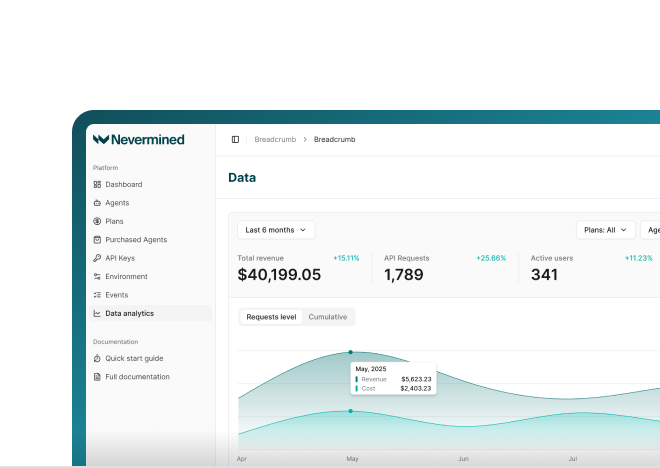

AI agents are fundamentally reshaping how software delivers value, yet most companies still price them using subscription models built for static SaaS products. When a single agent interaction can trigger hundreds of micro-activities with sub-cent costs, traditional billing systems break down completely. The agentic economy demands payment infrastructure purpose-built for variable, high-frequency workloads. Companies can capture the full revenue potential of their AI agents by leveraging Nevermined Pay, which handles real-time metering, flexible pricing models, and instant settlement without forcing developers to build billing infrastructure from scratch.
The agentic economy creates billing challenges that legacy payment systems were never designed to handle. A customer support chatbot might process 50 queries one day and 5,000 the next. A document processing agent could handle 10-page contracts or 500-page regulatory filings. This variability makes flat-rate pricing a losing proposition for both vendors and customers.
Seat-based and subscription models assume predictable, uniform consumption patterns. AI agents break this assumption in several ways:
Companies attempting to force AI agents into subscription models face a difficult choice: price too high and lose price-sensitive customers, or price too low and hemorrhage money on heavy users.
The shift toward autonomous AI systems creates new requirements for payment infrastructure. Agents need to:
These requirements exceed what traditional billing platforms can deliver, creating the need for agent-native payment infrastructure.
Effective AI agent monetization requires matching your pricing model to how customers perceive and receive value. Multiple pricing approaches have emerged as standards in the market.
Cost-inferred pricing charges based on resource consumption, typically measured in:
This model works well when your costs scale linearly with customer usage. Example pricing structures include $0.0003 per token plus a margin percentage, or tiered pricing per thousand tokens with volume discounts at higher bands.
Outcome-based pricing charges for results rather than activity. This aligns vendor and customer incentives directly:
Value-based pricing captures a percentage of the value your agent creates:
This model requires clear attribution and measurement, but delivers the highest revenue potential when agents drive substantial customer outcomes.
Nevermined's platform supports all these models and allows you to layer them together, starting with cost-covering usage charges and adding outcome-based success fees where appropriate.
Building billing infrastructure for AI agents requires solving several technical challenges simultaneously: capturing usage data at high frequency, applying complex pricing rules in real-time, and settling payments across multiple rails.
Nevermined Pay's metering and payment engine tracks every request in real-time, applying your configured pricing rules automatically. The system:
This real-time capability eliminates the reconciliation headaches common with batch-processed billing systems, where delayed usage data causes billing delays and customer disputes.
As AI agents increasingly operate autonomously, they need payment infrastructure that works without human involvement. Nevermined enables agent-to-agent native payments through its x402 integration, which extends payment capabilities for advanced autonomous transactions. This positions companies to monetize agent swarms and fully autonomous workflows from day one, rather than retrofitting billing systems as agent capabilities expand.
Valory cut deployment time of their payments and billing infrastructure for the Olas AI agent marketplace from 6 weeks to 6 hours using Nevermined, clawing back $1000s in engineering costs.
Implementation of usage-based billing can be a multi-stage process requiring careful planning and execution. While traditional approaches can take several weeks or months, Nevermined's low-code SDK enables initial configuration in under 20 minutes.
The integration process follows three steps:
Full implementation details and code examples are available in the Nevermined documentation.
The platform handles common integration requirements automatically:
This approach eliminates the extensive time typically spent on manual billing and invoice creation.
LLM API costs represent a significant portion of AI agent operating expenses. Effective pricing requires understanding these costs deeply and passing them through appropriately to customers.
API pricing varies substantially across providers and models. Key cost optimization strategies include:
Companies in the AI ecosystem, including major providers like OpenAI and Anthropic, set token pricing that AI agent builders must account for in their own pricing models.
Customers increasingly demand visibility into how their spend translates to AI activities. Effective billing systems provide:
Customer dashboards showing real-time usage provide visibility that reduces common billing disputes.
Enterprise procurement teams require billing systems that can withstand scrutiny. Disputed invoices, unclear calculations, and opaque metering create friction that slows deals and damages relationships.
Nevermined's tamper-proof metering system addresses enterprise trust requirements through several mechanisms:
This zero-trust reconciliation model provides the audit-ready transparency that enterprise procurement teams require.
For enterprise AI platforms and vendors, Nevermined Pay delivers bank-grade enterprise-ready metering, compliance, and settlement so every model call turns into auditable revenue. Key enterprise capabilities include:
The x402 integration further extends these capabilities for advanced agent payment scenarios requiring blockchain-level auditability.
Credits-based billing solves several problems that pure usage-based models create for both vendors and customers.
Flex Credits operate as prepaid consumption units that customers redeem against usage. This model provides benefits across multiple dimensions:
Enterprise buyers often resist minimum commitments that stall adoption. Credits provide a middle ground:
Many customers choose auto-recharge when offered, providing predictable revenue for vendors while maintaining customer control.
Different company stages require different levels of billing infrastructure sophistication. Nevermined serves three distinct customer segments with tailored solutions.
Individual builders need plug-and-play solutions that work without dedicated billing expertise:
Companies building vertical specialist agents for sales, coding, customer service, or legal applications need fast time-to-market:
Large-scale operations require bank-grade capabilities:
This segmented approach ensures companies can start with appropriate infrastructure and scale without platform migrations as they grow.
Usage-based pricing introduces variability compared to fixed subscriptions, but hybrid models combining a base fee with usage charges provide stability while capturing upside from heavy users. Most successful AI companies implement usage alerts, spending caps, and credit prepayment options that convert variable consumption into predictable revenue streams. Finance teams can forecast revenue by analyzing historical usage patterns and applying seasonal adjustments.
Beyond tokens and API calls, successful companies track cost-per-outcome metrics like cost-per-resolved-ticket or cost-per-qualified-lead. Customer health indicators including usage trends, feature adoption, and margin contribution by customer segment help identify pricing optimization opportunities. Cohort analysis comparing customers acquired under different pricing models reveals which approaches maximize lifetime value.
Multi-service agents require composite pricing that aggregates costs across all dependencies while maintaining margin. The most effective approach defines internal cost rates for each service, applies them automatically as the agent executes, and presents customers with a simplified unified price. This shields customers from complexity while ensuring you capture costs accurately.
Outcome-based pricing requires clear contractual definitions of what constitutes a billable outcome, attribution rules when multiple factors contribute to results, and dispute resolution procedures for contested charges. Companies should involve legal counsel when designing outcome-based models to ensure agreements properly allocate risk and define measurement methodologies.
International operations face exchange rate risk when costs are incurred in one currency and revenue collected in another. Best practices include pricing in local currencies where possible, implementing hedging strategies for significant exposures, and using payment infrastructure that supports multi-currency settlement. Cryptocurrency rails can provide an alternative for markets with volatile local currencies or limited banking access.
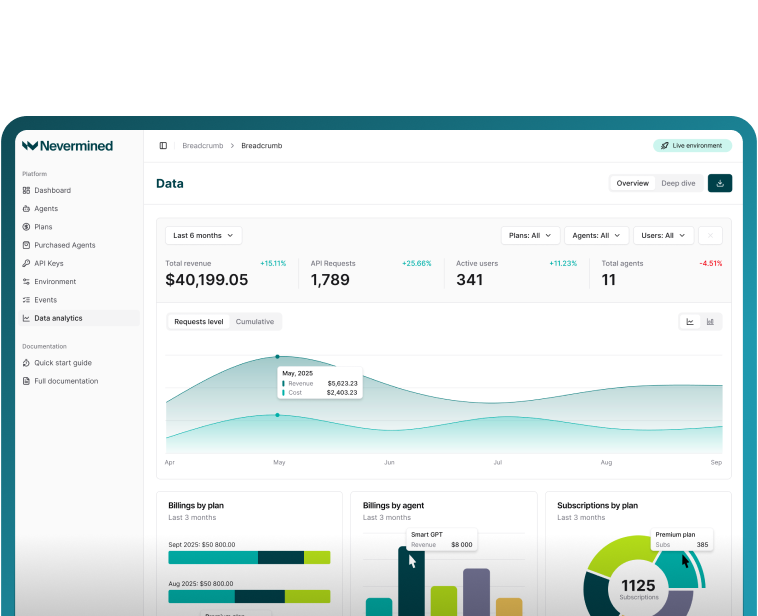
See Nevermined
in Action
Real-time payments, flexible pricing, and outcome-based monetization—all in one platform.