MENU


Traditional seat-based pricing collapses when a single AI SDR agent executes hundreds of micro-activities per conversation, each generating sub-cent costs that make unit economics unreadable. The global AI SDR market is projected to grow from $4.12 billion in 2025 to $15.01 billion by 2030, yet most platforms lack the infrastructure to meter API calls, reconcile real-time costs, and provide transparent pricing that builds enterprise trust. Modern AI payments infrastructure solves this through Flex Credits systems, precise metering, and auditable billing layers designed specifically for AI agent monetization.
The fundamental problem with billing AI SDRs stems from what industry experts call "cost fog." When one AI agent sends emails, enriches contact data, personalizes messages, and books meetings, it generates thousands of distinct billable events. Traditional payment processors require extensive custom development to handle these AI-specific use cases, burning weeks on access control and subscription setup.
The agentic economy introduces complexities that legacy billing cannot address:
Companies using traditional SDR teams face total SDR costs reaching $60,000 per year. AI SDRs promise dramatic cost reductions, but only if platforms can accurately meter and bill for usage without creating administrative nightmares.
Usage-based pricing aligns revenue directly with the value delivered. Instead of charging flat monthly fees regardless of activity, AI SDR platforms can bill per token, per API call, or per GPU cycle with guaranteed margins built into each transaction.
The mechanics of usage-based billing require tracking every meaningful action:
Platforms like Persana AI demonstrate this approach with credit-based models starting at $68/month (plan caps vary), where most actions consume a single credit. This structure gives customers predictable costs while ensuring platforms capture revenue proportional to value delivered.
Real-time metering enables platforms to lock in margins at the transaction level. When an AI SDR calls an LLM API, the billing system immediately calculates the cost, applies the predetermined margin percentage, and records the billable amount. This eliminates the common problem of discovering margin erosion only at month-end reconciliation.
Landbase announced 825% revenue growth in 2025, and the company reports its customers see materially lower costs compared to traditional SDR teams while maintaining full visibility into spending.
Pure usage pricing leaves money on the table when AI SDRs deliver exceptional results. Outcome-based and value-based models allow platforms to capture a share of the value they create.
Outcome-based pricing ties revenue to specific results that customers care about:
This model works particularly well for AI SDR platforms because the value of a booked meeting far exceeds the cost of the API calls that generated it. A platform might charge $0.001 per token for raw usage but $50 for a qualified meeting, creating significant upside when agents perform well.
Value-based pricing takes outcome models further by charging a percentage of ROI or value generated. When an AI SDR books a meeting that converts to a $100,000 deal, value-based pricing captures a meaningful share of that outcome.
The flexibility to mix models proves essential. Successful AI companies start with cost-covering baselines and layer success fees where appropriate. This approach protects margins on every transaction while creating upside when agents deliver exceptional results.
Enterprise procurement teams require proof that they are paying only for actual usage. Without transparent, verifiable billing, large organizations hesitate to adopt AI SDR solutions regardless of their technical capabilities.
Tamper-proof metering creates buyer trust through independent verification. Every usage record should be signed and pushed to an append-only log at creation, making it immutable. The exact pricing rule must be stamped onto each agent's usage credit, allowing any developer, user, auditor, or agent to verify that usage totals match billed amounts per line item.
This zero-trust reconciliation model satisfies enterprise procurement teams requiring audit-ready transparency. When disputes arise, immutable logs provide definitive evidence of actual usage, eliminating the "he said, she said" conflicts that plague traditional billing relationships.
Enterprise AI platforms require bank-grade metering, compliance, and settlement so every model call turns into auditable revenue. Key capabilities include:
The Nevermined platform delivers these enterprise capabilities while supporting the x402 protocol integration for advanced agent payment capabilities, enabling seamless settlement across fiat and crypto rails.
Building custom billing infrastructure for AI agents typically requires six or more weeks of engineering time and tens of thousands of dollars in development costs. Low-code SDKs compress this timeline dramatically.
Modern payment SDKs reduce integration to three steps:
Valory cut deployment time of their payments and billing infrastructure for the Olas AI agent marketplace from 6 weeks to 6 hours using Nevermined, clawing back $1000s in engineering costs. This 99% reduction in implementation time allows AI SDR platforms to focus engineering resources on core product development rather than billing infrastructure.
AI SDR platforms typically build on popular frameworks like LangChain and CrewAI while calling LLM providers like OpenAI and Anthropic. Payment infrastructure must integrate seamlessly with this ecosystem, automatically capturing token usage and computing costs without requiring manual instrumentation of every API call.
The technical documentation provides implementation guides for connecting payment flows to common AI development patterns.
As AI SDRs become more sophisticated, they increasingly interact with other agents, data providers, and services autonomously. These agent-to-agent transactions require payment infrastructure that works without human intervention.
Google's Agent-to-Agent (A2A) protocol and Model Context Protocol (MCP) are establishing standards for agent interoperability. AI SDRs following these protocols can automatically negotiate services, agree on pricing, and settle payments with other agents in real time.
Nevermined's x402 integration extends the protocol with advanced agent payment capabilities, enabling AI SDRs to pay for enrichment data, verification services, and specialized analysis tools autonomously. This capability becomes essential as agent swarms handle complex sales workflows end to end.
Persistent agent identification through cryptographically-signed wallet addresses and decentralized identifiers (DIDs) ensures that AI SDRs maintain consistent identities across environments. Nevermined ID provides:
Flex Credits operate as prepaid consumption-based units redeemed directly against usage. This model solves multiple problems that plague traditional billing approaches.
Credits create natural alignment between price and value:
Enterprise finance teams prefer credit models because they provide trackable recurring billing instead of complex sub-cent charge reconciliation. A customer buying 10,000 credits understands exactly what they are spending, while 10,000 individual $0.001 charges create accounting complexity.
Credit systems eliminate surprise bills by requiring prepayment. When credits run low, platforms can notify customers at 80% consumption, allowing them to purchase additional credits or adjust agent behavior before hitting limits.
This approach addresses enterprise reluctance toward minimum commitments that stall adoption. Teams can start with small credit purchases, validate value, and scale consumption without renegotiating contracts.
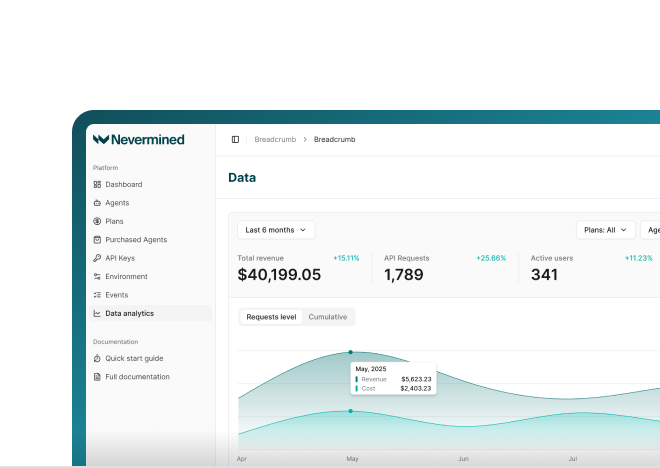
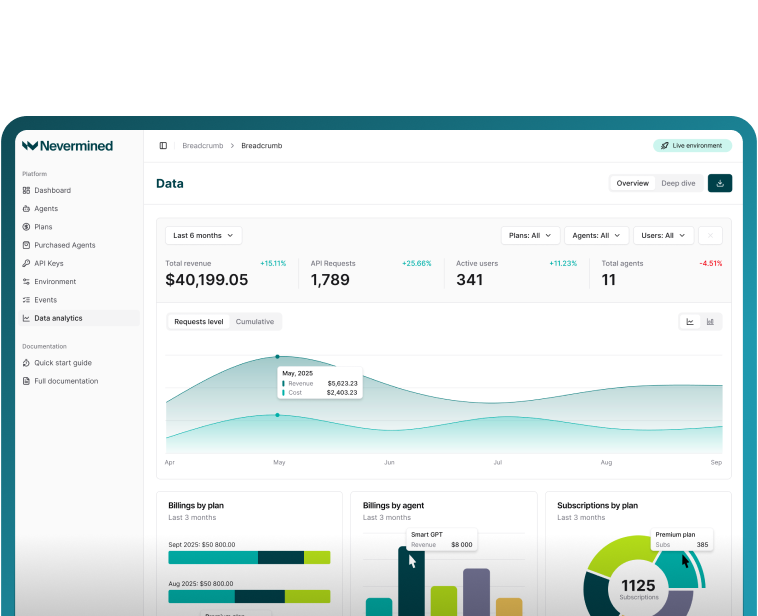
Raw billing data becomes a strategic asset when properly analyzed. Observability dashboards transform metering logs into actionable insights about agent performance, user behavior, and revenue optimization opportunities.
Analytics reveal which agent activities generate the most value:
Platforms that surface hidden costs and missed opportunities can make informed decisions about product development, pricing adjustments, and customer success interventions.
Metering data enables continuous pricing optimization. When analytics show that certain actions deliver outsized value, platforms can adjust pricing to capture appropriate revenue. When costs drop due to more efficient models, platforms can pass savings to customers while maintaining margins.
This data-driven approach to pricing requires comprehensive visibility into agent performance, user behavior, and revenue analytics that only purpose-built billing infrastructure provides.
Traditional payment processors like Stripe require extensive custom development for AI-specific use cases. They lack agent-native integrations, MCP support, and agent-to-agent payment capabilities that AI SDR platforms need.
Generic payment infrastructure creates specific problems for AI workloads:
Building these capabilities from scratch can take 6+ weeks and tens of thousands of dollars in engineering investment, with ongoing maintenance adding substantial annual costs.
AI-native billing platforms deliver immediate advantages:
The total cost of ownership comparison is stark. Custom builds require substantial investment in year one costs, while purpose-built platforms deliver superior capabilities for under $10,000.
Implementing AI billing requires a clear strategy before technical integration. Start by mapping AI agent activities to billable units and selecting appropriate pricing models.
The pricing calculator tool estimates appropriate agent pricing in 60 seconds based on variables like third-party tool costs, user expectations, and query volume. While outputs are directional, they provide a starting point for pricing strategy development.
Key inputs for pricing estimation:
Modern billing platforms provide comprehensive resources for implementation:
The Nevermined documentation provides getting-started guides that walk developers through complete implementation workflows.
Nevermined delivers payments infrastructure specifically designed for AI agents, addressing the fundamental billing limitations that generic payment processors cannot handle for AI workloads.
For AI SDR platforms specifically, Nevermined provides:
The platform supports instant settlement in fiat or cryptocurrency, with Stripe integration for card payments and USDC support for crypto-native customers. Valory cut deployment time of their payments and billing infrastructure for the Olas AI agent marketplace from 6 weeks to 6 hours using Nevermined, clawing back $1000s in engineering costs.
For teams ready to monetize AI SDR agents without building billing infrastructure from scratch, contact Nevermined to explore how the platform fits specific requirements.
Traditional subscriptions charge per seat or per month regardless of usage. AI SDRs execute hundreds of micro-activities per conversation, each with sub-cent costs that traditional billing systems cannot track. A single agent might send emails, enrich contacts, call LLM APIs, and book meetings in one workflow, generating thousands of billable events. Purpose-built AI billing infrastructure meters these activities in real time, applies pricing rules instantly, and provides the audit trails enterprise buyers require.
Transparency requires immutable usage logs that customers can independently verify. Every usage record should be cryptographically signed and pushed to an append-only log at creation. The exact pricing rule must be stamped onto each transaction, allowing customers to confirm that usage totals match billed amounts per line item. Real-time dashboards showing current consumption, burn rates, and projected costs help customers avoid surprise bills.
Flex Credits are prepaid consumption-based units redeemed against usage. Customers purchase credit bundles upfront and consume them as agents execute actions. Providers benefit from predictable revenue and eliminated payment disputes, while customers benefit from budget certainty, flexible allocation across teams or agents, and no surprise overages.
Nevermined provides SDKs that integrate with common AI development patterns. The platform can meter usage from LLM providers and agent frameworks through API instrumentation. Integration typically takes hours rather than weeks due to pre-built components and low-code configuration options.
Nevermined enables agent-to-agent payments through persistent identification (DIDs and wallet addresses), support for Google's A2A protocol, and x402 integration for advanced agent payment capabilities. AI SDRs can autonomously negotiate services, agree on pricing, and settle payments with other agents, data providers, or tools without human intervention.
Yes. Nevermined provides bank-grade metering with ledger-grade transaction records, cryptographic integrity, and immutable audit trails. Every model call turns into auditable revenue with dynamic pricing rules applied consistently. The platform can support SOC 2-aligned controls, GDPR-aligned data handling, and enterprise procurement verification processes.
See Nevermined
in Action
Real-time payments, flexible pricing, and outcome-based monetization—all in one platform.