MENU


Until now, Nevermined plans supported USD (fiat via Stripe) and USDC (on-chain stablecoin). Starting today, EUR (fiat) and EURC (on-chain euro stablecoin on Base) are first-class payment methods.
What this means in practice:
Particularly relevant for European builders and enterprises who need euro-denominated billing without currency conversion overhead.
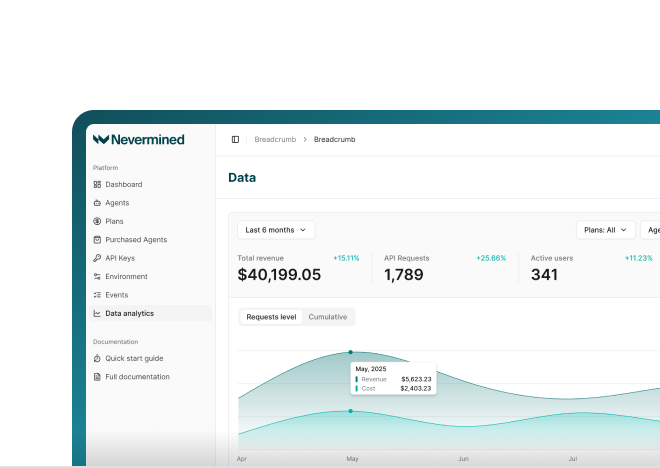
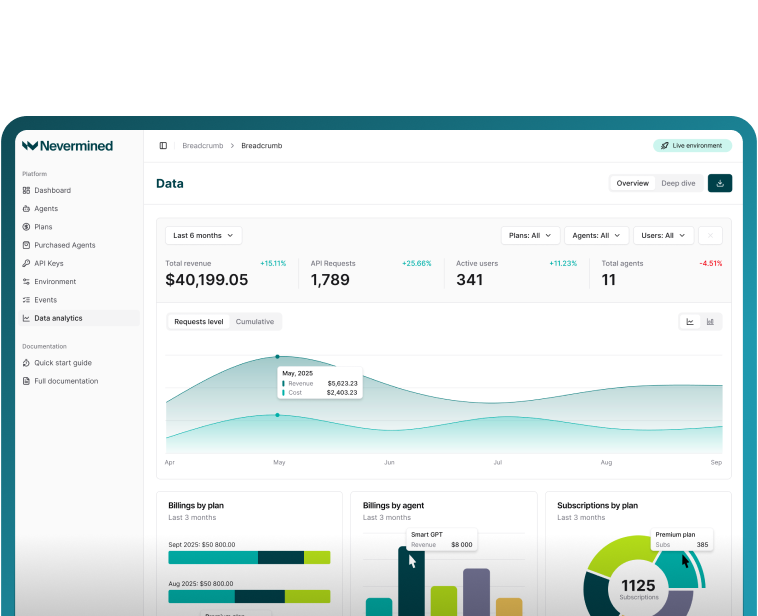
Managing multiple API keys across agents and plans used to be a blind spot — you knew keys existed, but not how they were being used.Nevermined now includes a usage analytics dashboard with:
If you operate multiple agents or share API keys across team members, this gives you the visibility to spot anomalies, track adoption, and debug integration issues without digging through logs.
The security feature that teams managing shared payment infrastructure have been waiting for.
You can now restrict which API keys are allowed to use specific enrolled cards. Cards gain an `allowedApiKeyIds` property, and delegations track which API key created them. The platform enforces these restrictions at both the `verify` and `settle` stages of the x402 payment flow.
Three delegation modes are now supported:
The webapp surfaces this with an Edit Card dialog for managing key restrictions and an API key selector during delegation creation. A new `?accessible=true` query filter lets agents discover only the cards and delegations their key is authorized to use.
Card enrollment previously required VGS (Very Good Security) as an intermediary for PCI compliance. Nevermined now makes VGS optional with a Stripe Elements fallback.
When VGS is disabled, card data flows directly from the browser to Stripe via `SetupIntent` + `confirmCardSetup` — a simpler integration path for teams that don't need the additional tokenization layer.
The card enrollment UI has also been refreshed with clearer layout and better error feedback — the dialog now properly closes and shows a toast on failure instead of silently hanging.
Plan owners can now generate checkout links directly from the plans table. Combined with the new direct plan checkout flow, this lets you share a purchase URL for any plan without requiring buyers to navigate through agent listings first.
The `/auth/cli` route previously only accepted `localhost` and `127.0.0.1` as valid callback URLs. Nevermined now supports an `ALLOWED_CALLBACK_ORIGINS` environment variable so that external deployments (like Vercel-hosted tools or custom CLIs) can authenticate without code changes.
Behind the scenes, a new caching layer with TTL-based in-memory caching and promise coalescing for blockchain reads eliminates approximately 190,000 redundant `eth_call` requests per day. Plan data is cached for 30 seconds, balances for 5 seconds, and plan fees for 60 seconds — with automatic invalidation after writes.
This also resolved an issue where the health check endpoint was triggering a 4.3-second synchronous scrypt operation on every probe, starving the API of capacity.
This release resolves multiple dependency vulnerabilities flagged by Dependabot, including high-severity issues in `tar`, `multer`, and `svgo`, and updates all NestJS packages to their latest versions to patch transitive CVEs in `file-type`, `lodash`, and `js-yaml`.
*These updates are live now. If you're building AI agents with payment capabilities, check out the documentation to get started.*
See Nevermined
in Action
Real-time payments, flexible pricing, and outcome-based monetization—all in one platform.