MENU


AI business automation has shifted from a competitive advantage to essential infrastructure. With 78% of organizations now using AI in at least one business function, up from 55% just one year prior, the tools powering this transformation have matured rapidly. The market has moved decisively from "copilot" assistants to fully autonomous AI agents capable of executing end-to-end workflows without constant human oversight. For businesses building or deploying these agents, understanding the right automation tools, including critical payment infrastructure, determines whether AI initiatives generate sustainable revenue or remain costly experiments.
AI workflow automation combines artificial intelligence with process automation to execute complex, multi-step business tasks with minimal human intervention. Unlike traditional rule-based automation that follows rigid "if-then" logic, modern AI automation systems observe their environment, plan actions, and adapt to changing contexts.
The shift from AI-assisted tools to autonomous agents represents a fundamental change in enterprise technology. Modern AI agents combine:
This evolution means businesses no longer deploy tools that help employees work faster. Instead, they deploy digital workers that execute entire workflows independently. As Kevin Chung, Chief Strategy Officer at Writer, argues, AI is shifting from individual usage to team workflow orchestration, with systems that anticipate needs rather than just follow instructions.
Effective AI automation operates on several principles that distinguish it from traditional software:
For businesses building AI agents, understanding these principles is essential for selecting the right tools, particularly payment and metering infrastructure that can track and monetize autonomous activities.
The AI automation landscape spans multiple categories, each serving distinct business needs. The enterprise AI automation market is growing at a rapid CAGR through 2030, with cloud deployment comprising the majority of new agent infrastructure spend.
The market segments into several categories:
Enterprise Platforms:
AI-Native Platforms:
Workflow Orchestration:
When evaluating AI automation tools, prioritize:
As AI agents proliferate, the ability to monetize their interactions becomes critical. CFOs are now allocating 25% of total AI budgets specifically to AI agents, signaling massive near-term investment in agent-capable platforms.
Traditional payment processors were designed for human-initiated transactions. AI agents create fundamentally different requirements:
These requirements make standard billing platforms inadequate for the agentic economy.
Specialized payment infrastructure addresses these challenges through:
The emergence of standardized agent communication protocols is reshaping how AI systems interact and transact.
Several protocols are gaining adoption across the ecosystem:
Protocol-first architecture ensures compatibility as standards evolve. Platforms supporting these protocols natively, like Nevermined's facilitator, avoid the vendor lock-in that plagues proprietary systems.
When selecting automation tools, evaluate protocol support carefully. The x402 protocol integration enables seamless payment handshakes, while A2A support enables instant agent discovery and connection across platforms.
Deloitte reports that only 21% of companies have a mature model for governance of autonomous AI agents, even as agentic AI usage is poised to rise sharply. This governance gap creates significant compliance risk.
Enterprise AI adoption requires demonstrable accountability. Key requirements include:
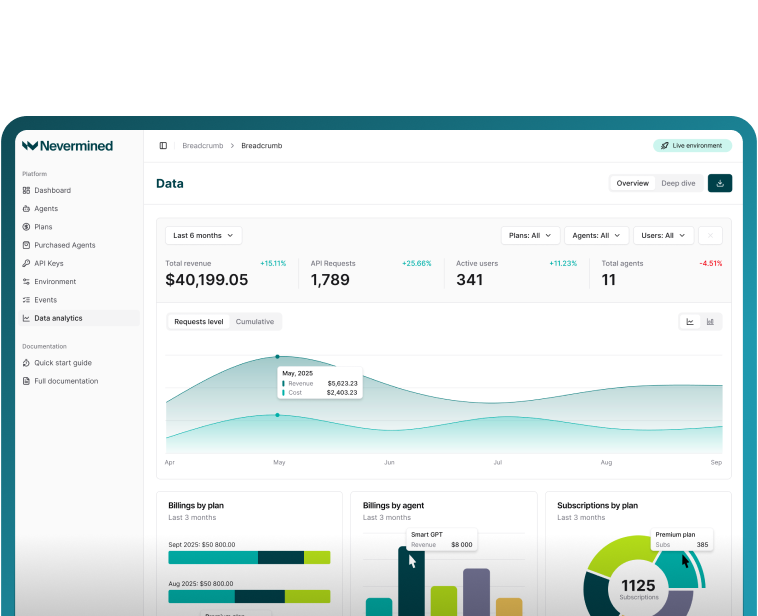
Modern observability platforms provide visibility into agent performance, user behavior, revenue analytics, and hidden costs. Every usage record gets cryptographically signed and pushed to an append-only log at creation, making it immutable. This approach enables developers, users, auditors, or agents to verify that usage totals match billed amounts per line-item.
AI automation has delivered significant efficiency gains across document processing workflows, with organizations reporting substantial reductions in processing time. Yet capturing this value requires sophisticated billing approaches.
Three pricing models dominate AI monetization:
Usage-Based Pricing:
Outcome-Based Pricing:
Value-Based Pricing:
The dynamic pricing engine enables cost-plus-margin automation where platforms define exact margin percentages locked onto usage credits. Credits align price to value by charging for micro-actions and rewarding successful outcomes, enabling flexible scaling across users, departments, or agents without renegotiating licenses.
Implementation speed directly impacts time-to-revenue for AI initiatives. Traditional payment infrastructure builds can consume weeks of engineering resources.
Modern platforms compress implementation timelines dramatically. Nevermined gets you from zero to a working payment integration in 5 minutes, with SDKs for both TypeScript and Python.
The three-step integration process includes:
Valory cut deployment time of their payments and billing infrastructure for the Olas AI agent marketplace from 6 weeks to 6 hours using Nevermined, clawing back $1000s in engineering costs. This acceleration enables AI builders to focus on agent capabilities rather than billing infrastructure.
Autonomous agents require persistent identities and programmable payment capabilities that work across environments and platforms.
Agent identity systems issue each agent a unique wallet plus decentralized identifier (DID) with cryptographic proof of ownership at registration. These portable identities enable:
ERC-4337 smart accounts with session keys enable agent-to-agent payments without human involvement. Users authorize payment policies once, then agents interact freely within defined boundaries. This contrasts with standard implementations requiring wallet pop-ups for each request.
The payment facilitator coordinates authorization, metering, and settlement across fiat, crypto, credits, and smart accounts, executing on-chain verification through smart contracts.
AI automation is driving measurable improvements in customer support resolution times and manual finance reconciliation workflows. Capturing these gains requires robust monitoring and compliance frameworks.
Effective observability platforms track:
Enterprise AI deployments must address:
According to the IBM Institute for Business Value, 93% of executives say factoring AI sovereignty into business strategy will be a must in 2026.
The AI automation opportunity spans multiple customer segments, each with distinct requirements.
Solo Developers and Solopreneurs:
AI Agent Startups:
Enterprise AI Platforms:
Deloitte found that 20% of organizations report generative AI is already increasing revenue, and 74% expect it to increase revenue in the next 24 months. The focus shifts from "can AI work?" to "how do we monetize AI sustainably?" Purpose-built payment infrastructure answers this question.
For AI builders seeking to monetize agent interactions, Nevermined provides purpose-built payments infrastructure designed specifically for autonomous systems. Unlike traditional payment processors retrofitted for AI, Nevermined delivers native support for the protocols, pricing models, and compliance requirements that agentic commerce demands.
Nevermined Pay delivers bank-grade enterprise-ready metering, compliance, and settlement so every model call turns into auditable revenue, featuring:
The platform supports x402, Google's A2A protocol, MCP, and AP2 natively, ensuring compatibility as standards evolve. Integration takes just 5 minutes using TypeScript or Python SDKs, with comprehensive documentation and sandbox environments for testing.
With a 1% transaction fee and free tier for limited volume, builders can start immediately without upfront commitment.
The primary distinction is the shift from "copilot" assistance to fully autonomous execution. Modern AI automation tools combine natural language processing, machine learning, and reasoning capabilities to execute complete workflows independently without constant human oversight. These systems observe their environment, plan multi-step actions, and adapt to changing contexts, representing a fundamental change from rule-based automation that follows rigid logic. This autonomy creates new requirements for monitoring, governance, and payment infrastructure.
Advanced AI agent platforms support three primary pricing models: usage-based pricing for per-token or per-API-call billing, outcome-based pricing that charges only when agents deliver verified results, and value-based pricing that captures a percentage of ROI generated. Credit-based systems enable prepaid consumption units that users can monitor in real-time, avoiding surprise overruns. Dynamic pricing engines allow platforms to define exact margin percentages locked onto usage credits, ensuring predictable economics.
Enterprise AI automation procurement should require SOC 2 Type II certification, ISO 27001 compliance, and GDPR alignment as baseline standards. Additional requirements include fine-grained role-based access controls, immutable audit trails with append-only logging, support for private VPC or on-premises deployment, and zero-data retention policies. Human-in-the-loop approval workflows for sensitive automations and continuous compliance tracking are increasingly expected.
Yes, agent-to-agent payments are possible through smart accounts with session keys and delegated permissions. Users authorize payment policies once, then agents interact freely within defined boundaries using protocols like Google's A2A and x402. This approach eliminates the wallet pop-ups and manual approvals that traditional payment systems require for each transaction. On-chain verification through smart contracts enables atomic "pay plus execute" operations where payment and service delivery happen as a single transaction.
Critical compliance considerations include GDPR requirements for data processing and privacy, audit-ready traceability through immutable logging, and explainability requirements for high-risk decisions in regulated industries. Geographic data residency requirements may mandate storage in specific locations. Organizations should implement role-based access controls with SSO integration, AES encryption at rest, and TLS 1.2 or higher in transit. Human-in-the-loop workflows should be established for decisions requiring human judgment or regulatory oversight.
Join the Autonomous Business Hackathon on March 5 to 6, 2026 in downtown San Francisco to build autonomous businesses where agents make real economic decisions, transact with each other, and run with minimal human oversight.
See Nevermined
in Action
Real-time payments, flexible pricing, and outcome-based monetization—all in one platform.