MENU


AI agents are transforming e-commerce from a human-driven marketplace into an autonomous economy where software systems handle everything from customer support to purchasing decisions. By 2030, the US B2C retail market alone could see up to $1 trillion in orchestrated revenue from agentic commerce, with global projections reaching $3-5 trillion. The challenge for merchants lies not in whether to adopt AI agents, but in building the payment infrastructure that transforms agent interactions into sustainable revenue streams. Traditional card-style payment rails can make micropayments uneconomical due to fees, making purpose-built billing and settlement systems essential for capturing this emerging opportunity.
AI agents in e-commerce are autonomous software systems that plan, execute, and complete multi-step workflows with minimal human intervention. Unlike simple chatbots that respond to predefined triggers, these agents adapt to changing conditions, make contextual decisions, and improve over time without constant supervision.
The distinction matters because it determines your monetization potential. A chatbot answers questions. An agent completes transactions, manages inventory, optimizes pricing, and coordinates with other agents to deliver business outcomes.
Modern e-commerce agents operate across multiple functions:
Each function represents a monetization opportunity. The question becomes how to structure pricing that captures value while remaining competitive.
E-commerce is splitting into two distinct channels. The first involves deploying agents to optimize internal operations. The second involves preparing your platform for external agents to transact on behalf of customers.
Both channels require infrastructure that traditional payment systems cannot provide. When an agent makes a purchasing decision, it needs instant authorization, real-time metering, and rapid reconciliation that traditional batch-processing systems are not designed for. This is where specialized payment solutions become essential.
The default approach to monetizing AI agents mirrors SaaS pricing: charge per API call or monthly subscription. This approach leaves significant revenue on the table because it disconnects price from value delivered.
This model positions AI agents as digital employees replacing human roles. You charge a fixed monthly fee per "digital employee" based on the equivalent cost of human workers.
Action-based pricing charges for discrete actions: per call handled, per email sent, per API request processed. This model provides transparency and aligns costs with actual usage.
Workflow pricing combines base fees with per-workflow charges, recognizing that different processes deliver different business value.
The most sophisticated approach charges only for successful outcomes. This requires clear attribution and measurable results but offers maximum pricing power.
The key insight is that as AI costs continue falling, outcome-based pricing becomes the only model that maintains margins. If inference costs continue to decline materially, usage-based pricing compresses margins to near zero.
Flexible pricing engines allow you to implement multiple models simultaneously, testing which resonates with different customer segments. You might offer action-based pricing for price-sensitive customers while capturing more value from enterprise clients through outcome-based arrangements.
Starting an AI agent business requires matching technical capability to implementation approach. The research identifies three distinct paths based on available resources.
No-code SaaS platforms: Best for limited technical resources and quick deployment needs. Expect roughly 2-4 weeks to production with platforms that abstract complexity.
Low-code hybrid approaches: Suitable for teams with some technical capability who need customization beyond standard templates. Plan for approximately 4-8 weeks implementation.
Custom development: Reserved for teams with strong technical capabilities and unique requirements. These implementations typically take 2-3 months but offer maximum control.
The decision framework depends on your situation:
Speed to market often determines success. Businesses that deploy agents faster capture market share while competitors are still building.
Valory cut deployment time of their payments and billing infrastructure for the Olas AI agent marketplace from 6 weeks to 6 hours using Nevermined, clawing back $1000s in engineering costs.
This acceleration comes from pre-built components:
Nevermined gets you from zero to a working payment integration in 5 minutes, with SDKs for both TypeScript and Python.
Building production-ready agents requires several components working together:
The development guide provides implementation paths for each component.
Trust becomes critical when AI agents handle financial transactions autonomously. Customers need assurance that agents are billing correctly, while regulators require audit trails proving compliance.
Standard payment processors designed for human-initiated transactions lack capabilities agents require:
Building trust in autonomous agent transactions requires three capabilities:
Tamper-proof metering: Every usage record must be cryptographically signed and pushed to an append-only log at creation. This makes records immutable and independently verifiable.
Zero-trust reconciliation: The exact pricing rule stamps onto each agent's usage credit, allowing developers, users, auditors, or agents to verify that usage totals match billed amounts per line-item.
Portable identity: Agents need unique identifiers with cryptographic proof of ownership that work across environments, swarms, and marketplaces without re-wiring.
These capabilities let customers verify they're being billed correctly without trusting the agent or platform blindly. When disputes arise, immutable logs provide definitive evidence of what happened.
Compliance features should include GDPR compatibility with explicit data handling controls and audit-ready traceability built into the system through append-only logging.
The next evolution in e-commerce involves agents transacting with other agents. A customer's shopping agent negotiates with a merchant's pricing agent, completes payment through a payment agent, and coordinates delivery through a logistics agent. No human touches the transaction.
This requires payment infrastructure fundamentally different from human-centric systems.
Agent-to-agent payments require three components working together:
Smart accounts with session keys: Users authorize payment policies once, then agents interact freely within boundaries. ERC-4337 smart accounts with configurable expiration windows enable this pattern.
Protocol support: Multiple protocols enable agent communication. x402 revives HTTP 402 for programmatic microtransactions. Google's Agent-to-Agent (A2A) protocol provides authorization and traceability. The Agent Payments Protocol (AP2) adds digitally-signed mandates defining spending authority.
Delegated permissions: Rather than requiring wallet pop-ups for each request, agents operate within pre-authorized limits. Users set policies like "spend up to $100/day on office supplies" and agents operate autonomously within those boundaries.
Agent-to-agent monetization documentation explains implementation patterns for these capabilities.
Multi-agent systems coordinate complex workflows involving multiple agents from different providers. A typical e-commerce transaction might involve:
Each agent may come from a different provider, requiring standardized payment handoffs. The payment facilitator coordinates authorization, metering, and settlement across these interactions.
Support for Google A2A integration enables auto-discovery where agents find and connect with other agents instantly.
Autonomous transactions unlock efficiencies impossible with human-mediated commerce:
Early adopters of agentic commerce report measurable improvements in both traffic and conversion rates through agent-driven cart recovery and product description generation, with McKinsey noting that AI-driven personalization can lift revenues 5-15%.
Credits systems provide the financial rails for agent-scale transactions. Rather than processing thousands of micro-payments, users prepay credits that agents consume against defined usage policies.
Credits operate as prepaid consumption-based units redeemed directly against usage. The system provides several advantages:
This model aligns price to value by charging for micro-actions and rewarding successful outcomes.
Effective credit management requires visibility into consumption patterns:
Payment patterns documentation explains implementation approaches for credit-based billing.
Smart accounts built on ERC-4337 standards provide programmable authorization logic for agent transactions:
Session keys: Time-limited authorization tokens that agents use without requiring user approval for each action. Configure expiration windows based on risk tolerance.
Spending limits: Define maximum transaction sizes and daily/weekly/monthly caps. Agents operate freely within limits but require escalation beyond.
Conditional authorization: Complex rules like "approve transactions under $50 automatically, require confirmation for higher amounts, and block purchases from unapproved categories."
Batching: Combine multiple operations into atomic transactions, reducing gas costs on blockchain networks.
These capabilities enable sophisticated financial policies without manual oversight of each transaction.
While various approaches exist for monetizing AI agents, Nevermined provides purpose-built payments infrastructure specifically designed for the challenges of agentic commerce.
Nevermined Pay delivers bank-grade enterprise-ready metering, compliance, and settlement so every model call turns into auditable revenue. Key capabilities include:
The platform stands apart through protocol-first architecture supporting x402, Google's A2A protocol, Model Context Protocol (MCP), and Agent Payments Protocol (AP2). This ensures compatibility as standards evolve without requiring infrastructure rewrites.
For e-commerce businesses specifically, Nevermined addresses the complete monetization lifecycle:
For deploying agents internally: Meter every agent action, apply flexible pricing rules, and settle instantly in fiat or cryptocurrency.
For preparing platforms for external agents: Enable agent-readable product catalogs, support autonomous purchasing protocols, and provide the settlement infrastructure agents require.
For multi-agent commerce: Coordinate payments across agent swarms with programmable settlement rules, escrow with conditional release, and revenue splits across multiple parties.
Nevermined gets you from zero to a working payment integration in 5 minutes, with SDKs for both TypeScript and Python. The free tier provides full platform access for limited volume, with transaction-based pricing of 1% per transaction as you scale.
AI agents are autonomous software systems that plan, execute, and complete multi-step workflows with minimal human intervention. In e-commerce, they generate revenue through two primary channels: deploying agents to optimize internal operations like customer support and pricing, and preparing platforms for external agents to transact on behalf of customers. McKinsey reports that AI-driven personalization can lift revenues 5-15%, while Gartner projects agentic AI will lead to a 30% operational cost reduction by 2029 through reduced labor costs and improved service quality.
Outcome-based pricing charges only for successful results rather than usage or time. Traditional models charge per API call, per month, or per user regardless of value delivered. Outcome-based approaches might charge per meeting booked, per conversion generated, or as a percentage of revenue increase. This model requires clear attribution and measurable results but offers maximum pricing power. As AI compute costs continue falling rapidly, outcome-based pricing becomes essential for maintaining margins that usage-based models compress toward zero.
Traditional payment processors designed for human-initiated transactions cannot handle the micro-transaction volume, speed, and authorization patterns AI agents require. Many standard payment rails can include fixed per-transaction costs that make sub-cent agent transactions uneconomical. Human checkouts batch process settlements over hours or days while agents need instant verification. Standard systems require approval clicks while agents need programmable spending policies with delegated permissions. Purpose-built infrastructure provides real-time metering, tamper-proof audit trails, and protocol support for autonomous transactions.
Yes, agent-to-agent payments are possible through smart accounts with session keys and delegated permissions. Users authorize payment policies once, defining spending limits and approval thresholds, then agents interact freely within those boundaries. ERC-4337 smart accounts with configurable expiration windows enable this pattern. Multiple protocols including x402, Google's A2A protocol, and Agent Payments Protocol (AP2) provide the communication layer for agents to negotiate and settle transactions autonomously.
Security and auditability require tamper-proof metering where every usage record is cryptographically signed and pushed to an append-only log at creation. The exact pricing rule stamps onto each agent's usage credit, enabling zero-trust reconciliation where anyone can verify usage totals match billed amounts per line-item. Agents should have unique identifiers with cryptographic proof of ownership that work across environments. GDPR compliance, explicit data handling controls, and audit-ready traceability through immutable logging provide the regulatory framework for enterprise deployments.
Credits are prepaid consumption-based units that agents redeem directly against usage, providing the financial rails for agent-scale transactions. Rather than processing thousands of micro-payments with per-transaction fees, users prepay credits that agents consume according to defined policies. Benefits include flexible scaling where credits reallocate across users or departments without renegotiating licenses, budget predictability through real-time burn rate monitoring, simplified accounting with trackable recurring billing, and instant settlement without payment processing delays per transaction.
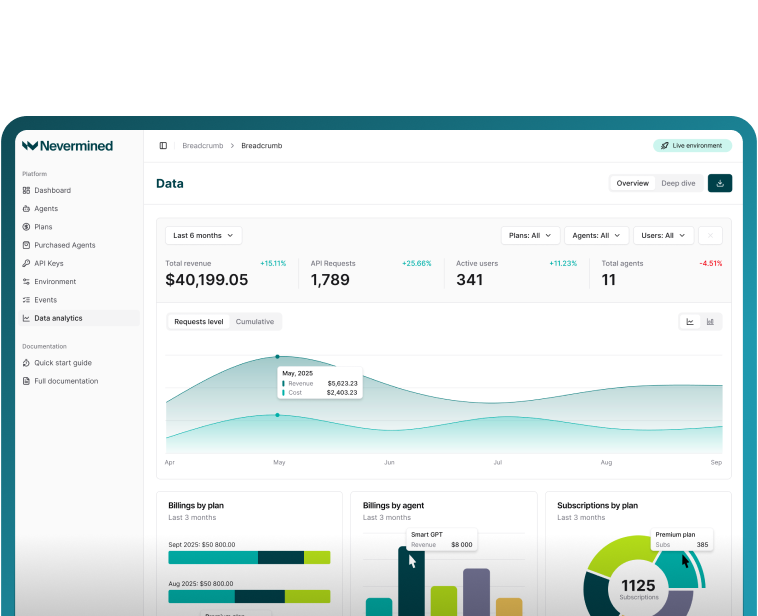
See Nevermined
in Action
Real-time payments, flexible pricing, and outcome-based monetization—all in one platform.