MENU


The real estate AI market reached $222.65 billion in 2024, signaling massive opportunity for professionals ready to monetize autonomous agent services. Unlike basic automation tools, AI agents reason through complex multi-step workflows, handling everything from lead qualification to transaction coordination with minimal human intervention. Modern AI agent payment infrastructure enables real estate professionals to transform these capabilities into recurring revenue streams, charging other agents, platforms, and brokerages for access to their automated services through usage-based, outcome-based, and value-based pricing models.
AI agents in real estate are autonomous software systems that handle property valuations, lead qualification, client communication, and transaction coordination without constant human oversight. These systems operate on an Input-Brain-Action architecture that processes information, reasons through decisions, and executes tasks independently.
The core components include:
What separates AI agents from simple chatbots is their ability to handle multi-step processes autonomously. A lead qualification agent does not just answer questions. It evaluates financial readiness, timeline urgency, and decision authority before routing high-priority prospects to human agents while nurturing lower-priority leads automatically.
Real estate organizations using machine learning successfully have enhanced Net Operating Income by up to 10%, demonstrating the tangible financial impact these systems deliver. The 76% of CRE firms already exploring or implementing AI solutions underscores how rapidly adoption is accelerating across the industry.
Not all AI agent applications generate equal returns. The highest-value opportunities exist where time-intensive manual processes create bottlenecks that compound across your business.
Research shows that the odds of qualifying a lead contacted within five minutes are 21 times higher than those contacted after 30 minutes, yet 80% of agents don't follow up within that window. This gap represents both a problem and a monetization opportunity. Lead qualification agents that respond within seconds and intelligently score prospects based on budget, timeline, and pre-approval status command premium pricing.
Top applications include:
Automated valuation models (AVMs) analyze thousands of data points including comparable sales, property characteristics, market trends, and neighborhood factors. These systems deliver 2.8% median error rates compared to over 33% error rates in traditional appraisals.
Monetization models for valuation services range from $0.50-2 per instant valuation to $99 monthly subscriptions for unlimited access. Properties marketed with AI-enhanced staging sell 73% faster with 25% higher prices, creating clear value propositions for your services.
Transaction coordination involves dozens of steps, multiple parties, and strict deadlines. Missing a single date can derail entire deals. AI agents that extract critical dates from contracts, track completion status, and send automated reminders to all parties deliver 30% productivity increases and 40% fewer errors compared to manual processing.
Building your first revenue-generating AI agent requires selecting the right platform based on your technical capabilities and target market.
No-code solutions like MindStudio enable real estate professionals without development backgrounds to launch AI agents in 15-60 minutes. Visual workflow builders connect conversation blocks, logic gates, and CRM integrations without writing code.
Custom development through frameworks like LangChain and CrewAI provides unlimited flexibility but typically requires several weeks for initial deployment and technical expertise.
Your AI agent needs data connectivity to deliver value:
Starting with the workflow that consumes the most time yields the fastest return on investment. Build one agent well before expanding to additional use cases.
Traditional SaaS pricing models struggle with AI agent services where value varies dramatically based on outcomes and usage patterns. Three distinct approaches enable profitable monetization.
Charge per lead processed, valuation generated, or document analyzed. This model aligns costs with value delivered and works well for services with predictable per-unit costs.
Example structures include:
Charge for results rather than activities. A lead qualification agent that only bills when prospects convert to showings or a transaction coordinator that charges per successful closing aligns your revenue with client success.
This approach commands premium pricing because clients pay only when they receive tangible value. Transaction coordination services using outcome-based models can charge several hundred dollars per completed transaction, aligning your revenue with client success.
Calculate fees as a percentage of ROI generated. If your valuation service helps agents win listings that close at higher prices, capturing a share of that incremental value creates win-win economics.
Nevermined's flexible pricing engine enables cost-plus-margin automation where you define exact margin percentages locked onto usage. This ensures profitability regardless of underlying costs while providing transparent pricing to clients.
When selling AI agent services to other professionals, payment transparency determines whether clients renew or churn. Traditional invoicing cannot provide the granular visibility that sophisticated buyers demand.
Every API call, lead processed, and document analyzed needs cryptographically verifiable tracking. Append-only logs that capture usage at creation enable clients to independently verify that billed amounts match actual consumption.
This zero-trust reconciliation model addresses the fundamental concern about trusting automated systems to manage billing accurately. When clients can audit their usage down to individual transactions, disputes disappear and retention improves.
Dashboards showing burn rate, remaining credits, and projected costs prevent surprise overruns that damage client relationships. Finance teams at your client organizations need trackable recurring billing instead of complex sub-cent charge reconciliation.
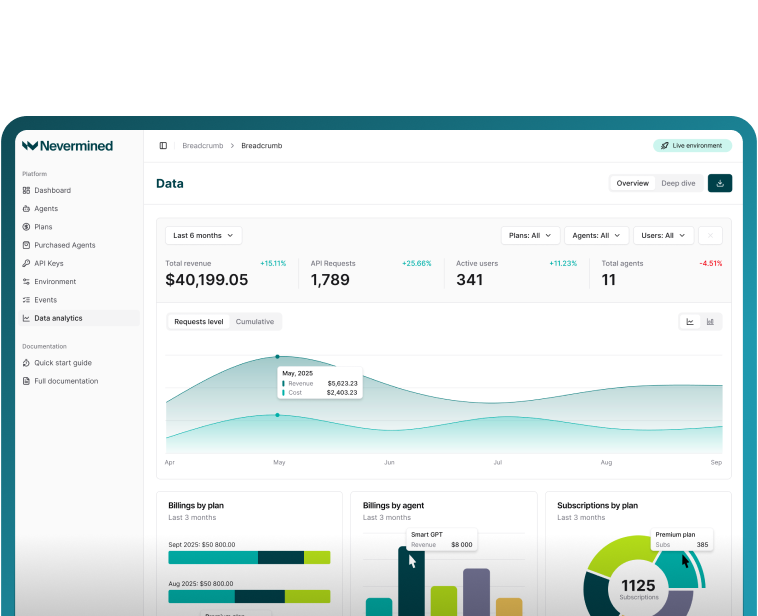
The observability layer should provide visibility into agent performance, user behavior, revenue analytics, and margin tracking. This data enables both you and your clients to optimize their AI agent consumption.
Complex real estate transactions require multiple specialized AI agents working together. A lead qualification agent might hand off to a property valuation agent, which then triggers a transaction coordination agent. Each handoff potentially involves a payment event.
Traditional payment processors require human authorization for each transaction, breaking the autonomous workflow. Standard implementations demand wallet pop-ups or manual approval for every request.
ERC-4337 smart accounts with session keys and delegated permissions enable true agent-to-agent commerce. Users authorize payment policies once, defining spending limits and approved counterparties, then agents interact freely within those boundaries.
This infrastructure supports:
Native support for x402 (HTTP payment protocol), Google's Agent-to-Agent (A2A) protocol, and Model Context Protocol (MCP) ensures your agent services work with the broader ecosystem. As standards evolve, protocol-agnostic architecture prevents vendor lock-in that would limit your market reach.
Speed to market determines whether you capture emerging opportunities or watch competitors establish market position. The difference between weeks and hours of deployment time translates directly to revenue.
Modern payment SDKs enable deployment from zero to working payment integration in 5 minutes using TypeScript or Python. This contrasts sharply with custom billing infrastructure that typically requires weeks of engineering effort.
The integration sequence involves:
Valory cut deployment time of their payments and billing infrastructure for the Olas AI agent marketplace from 6 weeks to 6 hours using Nevermined, clawing back $1000s in engineering costs. This acceleration enabled faster market entry while reducing technical debt.
For solopreneurs and small teams, the calculus is straightforward. Building custom billing infrastructure diverts resources from your core AI agent development. Pre-built payment infrastructure lets you focus on the capabilities that differentiate your service.
Scaling beyond individual AI agents requires building ecosystems where multiple services work together and revenue compounds across your portfolio.
Create platforms where your suite of AI agents serves different client segments. A lead qualification agent for residential agents, a valuation API for appraisers, and a transaction coordinator for title companies can share infrastructure while serving distinct markets.
Revenue optimization requires tracking performance across agents:
Agent swarms handling complex workflows create stickier client relationships than single-purpose tools. When your lead qualification agent seamlessly connects to your market analysis agent and your transaction coordinator, clients face high switching costs.
Revenue splits across agent networks distribute payments automatically when multiple agents contribute to outcomes. This enables partnership models where you share revenue with complementary service providers.
Early adopters implementing comprehensive AI strategies see 15-20% average ROI on their technology investments, with organizations reporting 10-25% margin improvement within 6-12 months.
While numerous platforms exist for building AI agents, monetizing those agents to other professionals requires purpose-built payment infrastructure that traditional processors cannot provide.
Nevermined delivers the complete monetization stack for AI agent services through several key capabilities:
The 5-minute SDK integration using TypeScript or Python means you can launch monetized AI agent services the same day you decide to build them. Valory's experience cutting deployment from 6 weeks to 6 hours demonstrates the practical impact on time-to-revenue.
For real estate professionals serious about building recurring revenue from AI agent services, Nevermined provides the infrastructure layer that transforms technical capabilities into sustainable business models.
AI agents in real estate handle lead qualification, property valuation, transaction coordination, document processing, and client communication. Lead qualification agents respond instantly to inquiries and score prospects based on financial readiness and timeline urgency. Valuation agents analyze comparable sales and market trends to generate instant property estimates. Transaction coordinators track deadlines, manage documents, and send automated reminders to all parties involved in closings.
AI agents generate income through three primary models: usage-based pricing charging per lead or valuation processed, outcome-based pricing billing only when results like booked showings occur, and subscription models providing unlimited access for monthly fees. Lead qualification services typically charge $1-3 per qualified lead, while transaction coordination commands premium per-transaction fees. The key is matching your pricing model to the value delivered.
Modern payment SDKs reduce integration to 5 minutes for experienced developers using TypeScript or Python. The process involves installing the SDK, registering payment plans with pricing rules, and adding validation to your API endpoints. Pre-built connectors eliminate the weeks of custom development that traditional payment infrastructure requires. No-code platforms further simplify deployment for non-technical users.
Yes, smart account architecture with session keys and delegated permissions enables autonomous agent-to-agent transactions. Users authorize payment policies once, defining spending limits and approved counterparties, after which agents transact freely within those boundaries. This supports complex workflows where a lead qualification agent pays a valuation agent, which then triggers a transaction coordinator, all without human intervention at each step.
Three primary pricing models serve different use cases. Usage-based pricing charges per action, ideal for services with predictable per-unit costs like $0.50-2 per property valuation. Outcome-based pricing bills only for results, commanding premium rates for successful transaction closings. Value-based pricing captures a percentage of ROI generated, aligning your revenue with client success. Most successful AI agent businesses combine multiple models to serve different client segments.
See Nevermined
in Action
Real-time payments, flexible pricing, and outcome-based monetization—all in one platform.