MENU


Monetizing AI agents in SaaS demands purpose-built billing infrastructure that traditional payment processors simply cannot deliver. With the multi-agent systems market exploding from $7.2 billion to $375.4 billion by 2034, the opportunity is massive, but so are the challenges. Standard seat-based pricing breaks down when a single AI conversation generates hundreds of micro-transactions with sub-cent costs, making unit economics impossible to track. Modern AI agent monetization platforms solve this by enabling usage-based, outcome-based, and value-based pricing models with real-time metering and instant settlement in fiat or cryptocurrency. This guide breaks down how to capture revenue from every agent interaction while building the trust enterprises require.
AI agents represent autonomous software systems that process data, make decisions, and execute tasks without constant human oversight. Unlike traditional SaaS tools requiring manual input for each action, agents operate independently within defined parameters, handling everything from customer support to complex multi-step workflows.
The SaaS industry is projected to grow from $375.57 billion in 2026, with AI agents driving a fundamental transformation in how software creates and captures value. Microsoft CEO Satya Nadella describes this shift: "The traditional structure of SaaS, essentially CRUD databases governed by business logic, could collapse in agentic AI."
Key characteristics defining monetizable AI agents:
The adoption curve is steep. CIOs reported a 282% AI adoption increase, while 79% of organizations have adopted agentic AI, and 96% of CIOs say their companies either currently use or plan to deploy it within two years.
Traditional payment infrastructure was built for predictable, human-initiated transactions. AI agents break this model completely. A single "conversation" can contain hundreds of micro-activities with sub-cent costs, making standard billing approaches economically unviable.
The fundamental problems include:
GitHub learned this lesson painfully. Their $10/month Copilot subscription loses ~$20 per user per month because flat-rate pricing cannot account for variable AI consumption patterns. Without infrastructure that tracks and bills at the micro-transaction level, AI builders leave significant revenue on the table.
The economics of AI agents demand pricing flexibility that most billing systems cannot provide. Most AI-native companies now offer usage-based pricing components, but the most successful operators combine multiple models.
Three core pricing approaches have emerged:
Usage-Based Pricing Charges per token, API call, or compute resource consumed. This model provides direct cost recovery and scales naturally with customer usage. However, it requires sophisticated metering infrastructure to track every micro-transaction accurately.
Outcome-Based Pricing Charges for results rather than activity. Intercom's Fin agent exemplifies this approach, charging $0.99 per resolution rather than per interaction. This model has become a strong eight-figure ARR business with 393% annualized growth in Q1.
Value-Based Pricing Captures a percentage of ROI or value generated. This model aligns incentives between vendor and customer but requires clear attribution and measurement frameworks.
Outcome-based pricing requires precise definition of what constitutes a billable result. Without clear parameters, disputes derail customer relationships.
Essential elements for outcome-based implementation:
Companies like Sierra.ai charge nothing when tickets escalate to humans, demonstrating confidence in their agent's capabilities while protecting customer value.
Value-based pricing captures a percentage of measurable business impact. A B2B SaaS firm implementing agentic campaign routing achieved 25% lead conversion increase, enabling pricing tied directly to revenue generated.
Value-based models work best when:
The dynamic pricing capabilities required for these models demand infrastructure that can calculate, verify, and settle variable charges in real-time.
Multi-agent systems where AI agents transact directly with other agents represent the next frontier of the agentic economy. The global opportunity for agent-orchestrated commerce could reach $3-5 trillion by 2030, but realizing this potential requires payment infrastructure designed for autonomous transactions.
Major industry players validated this direction in 2025:
These initiatives confirm that legacy payment processors cannot handle autonomous agent-to-agent transactions effectively.
Agent-to-agent commerce requires eliminating human approval bottlenecks while maintaining security controls. Standard x402 implementations require wallet pop-ups for each request, creating friction that breaks autonomous workflows.
Requirements for effective agent-to-agent payments:
The agent-to-agent integration approach enables users to authorize payment policies once, then agents interact freely within those parameters, transforming multi-agent workflows from theoretical to practical.
ERC-4337 smart accounts with session keys enable sophisticated payment logic that traditional wallets cannot support. These accounts allow:
This architecture enables research agents to hire data extraction agents with instant micropayment settlement, all without human involvement in individual transactions.
Speed to market determines success in the fast-moving AI agent space. Traditional billing system implementations take months, while purpose-built platforms can have you live in minutes.
Modern payment infrastructure prioritizes developer experience. The key factors differentiating rapid implementation:
Nevermined gets you from zero to a working payment integration in 5 minutes, with SDKs for both TypeScript and Python. The three-step integration process involves installing the SDK, registering payment plans with pricing rules, and validating API requests while tracking costs.
Access the TypeScript quickstart or Python quickstart to begin implementation immediately.
Valory cut deployment time of their payments and billing infrastructure for the Olas AI agent marketplace from 6 weeks to 6 hours using Nevermined, clawing back $1000s in engineering costs.
Valory CEO David Minarsch noted: "We knew AI agents need to be able to transact, so over a year ago we tapped into Nevermined. Nevermined was, and continues to be, the best solution for AI payments."
This 98% reduction in deployment time demonstrates the difference between building custom billing infrastructure versus leveraging purpose-built solutions. Engineering resources freed from billing complexity can focus on agent capabilities and market differentiation.
Trust remains the critical bottleneck preventing AI agent monetization at scale. Only 16% of U.S. adults use AI to help with paying bills or financial tasks and just 29% of UK consumers would trust AI to make small automated payments on their behalf. Enterprise procurement teams face even higher scrutiny requirements before approving AI agent deployments.
Building trust requires three capabilities:
Audit-ready billing infrastructure creates the transparency enterprises demand. Every usage record must be cryptographically signed and pushed to an append-only log at creation, making it immutable after the fact.
Key transparency features include:
This zero-trust reconciliation model addresses enterprise concerns about trusting AI agents to manage tasks autonomously. Developers, users, auditors, or agents can verify that usage totals match billed amounts per line-item.
The exact pricing rule stamps onto each agent's usage credit through the validation process, creating an unbroken chain of evidence from transaction to invoice.
Compliance considerations span multiple dimensions:
Global non-compliance costs have reached $14 billion, with AML fines alone totaling over $6 billion in 2023. The EU AI Act imposes additional requirements for robust risk management systems, making audit-ready infrastructure essential.
Credit systems solve the fundamental challenge of making micro-transactions economically viable. Rather than processing thousands of sub-cent charges, users prepay credits that are consumed against usage.
The credits-based approach provides benefits across stakeholders:
For Developers:
For Users:
For Finance Teams:
Credits operate as consumption-based units redeemed directly against usage. The implementation approach involves:
Credits align price to value by charging for micro-actions and rewarding successful outcomes. Users prepay, monitor their burn rate in real-time, and maintain control over spending.
The flexible scaling advantage of credits allows reallocation across users, departments, or agents without renegotiating licenses. This proves particularly valuable for:
The subscription access patterns can combine with credits, enabling hybrid models where base subscriptions include credit allowances with top-up options.
Protocol standardization is reshaping the AI agent landscape. Multiple competing standards are emerging, and vendors locked into proprietary systems risk obsolescence as the market converges.
Key protocols shaping the agentic economy:
80% of SaaS companies plan to launch AI features within 18 months, making infrastructure decisions today critical for long-term competitiveness.
Protocol-first architecture provides:
The MCP integration and x402 support demonstrate how protocol-first design enables compatibility without vendor lock-in.
Proprietary billing systems create technical debt that compounds over time. As agent frameworks like LangChain and CrewAI gain adoption, and payment protocols mature, platforms locked into single vendors face painful migrations.
Warning signs of vendor lock-in:
The development guide shows how open architecture supports diverse integration patterns without creating dependencies.
Selecting billing infrastructure impacts far more than accounting operations. The platform you choose determines which pricing models you can offer, how quickly you can iterate, and whether you can capture the full value of your AI agents.
Decision criteria for billing platform selection:
Technical Capabilities:
Business Alignment:
Implementation Factors:
The observability layer increasingly differentiates billing platforms. Beyond processing payments, leading solutions provide visibility into:
BCG's 10/20/70 rule prescribes devoting 10% of resources to algorithms, 20% to technology and data, and 70% to people and processes when deploying AI. Billing infrastructure that provides operational intelligence accelerates this transformation.
Enterprises implementing multi-agent systems effectively report significant operational improvements when the right infrastructure is in place. The right monetization partner helps you capture these gains while protecting margins.
While numerous billing platforms serve the SaaS market, Nevermined provides infrastructure purpose-built for AI agents and the agentic economy. The platform addresses the specific challenges that make traditional payment processors inadequate for AI agent monetization.
Nevermined Pay delivers bank-grade enterprise-ready metering, compliance, and settlement so every model call turns into auditable revenue. Key capabilities include:
The facilitator coordinates authorization, metering, and settlement for AI agents across fiat, crypto, credits, and smart accounts. This unified approach enables:
For solo developers, AI agent startups, and enterprise AI platforms alike, Nevermined eliminates the infrastructure burden that blocks monetization success. The 1% per transaction pricing model aligns costs with revenue, while the free tier enables unlimited testing before commitment.
Access the documentation to start building, or explore use cases to see how other teams monetize their AI agents.
Three dominant pricing models have emerged for AI agent monetization: usage-based (charging per token, API call, or compute resource), outcome-based (charging for results like resolved tickets or booked meetings), and value-based (capturing a percentage of ROI generated). Most successful implementations use hybrid approaches combining base subscriptions with usage or outcome components, providing revenue predictability while capturing upside as customers scale. The optimal model depends on your agent's capabilities and how clearly you can measure and attribute value.
Nevermined provides tamper-proof metering where every usage record is cryptographically signed and pushed to an append-only log at creation, making it immutable. The exact pricing rule stamps onto each agent's usage credit, enabling developers, users, auditors, or agents to verify that usage totals match billed amounts per line-item. This zero-trust reconciliation model addresses enterprise concerns about trusting AI agents with autonomous operations, while the platform maintains GDPR compliance and audit-ready traceability.
Yes, through ERC-4337 smart accounts with session keys and delegated permissions, AI agents can transact directly with other agents within defined boundaries. Users authorize payment policies once, then agents interact freely without requiring wallet pop-ups for each request. Nevermined provides native support for x402 protocol and Google's A2A protocol, enabling instant micropayment settlement for multi-agent workflows where research agents might hire data extraction agents autonomously.
Nevermined gets you from zero to a working payment integration in 5 minutes, with SDKs available for both TypeScript and Python. The three-step integration involves installing the SDK, registering payment plans with pricing rules, and validating API requests while tracking costs. This contrasts sharply with traditional billing implementations that require weeks or months, as demonstrated by Valory reducing deployment time from 6 weeks to 6 hours.
Credits solve the micro-transaction challenge by allowing users to prepay consumption-based units redeemed against usage, eliminating the need to process thousands of sub-cent charges individually. Developers gain predictable revenue and simplified billing, while users get budget predictability, real-time burn rate visibility, and protection from surprise overruns. Finance teams benefit from trackable recurring billing instead of complex sub-cent charge reconciliation, with credits reallocating flexibly across users, departments, or agents without contract renegotiation.
AI agent monetization platforms serve diverse segments including AI agent marketplaces, vertical specialist agents (sales, coding, customer service, legal), multi-agent systems and swarms, AI service providers, and developer tools requiring payment layers. The infrastructure particularly benefits businesses implementing internal AI marketplaces, those needing cost tracking and margin control, and any organization where autonomous agents interact with customers or other agents. Companies expect 171% average ROI from agentic AI investments, spanning from early-stage startups to enterprise platforms.
See Nevermined
in Action
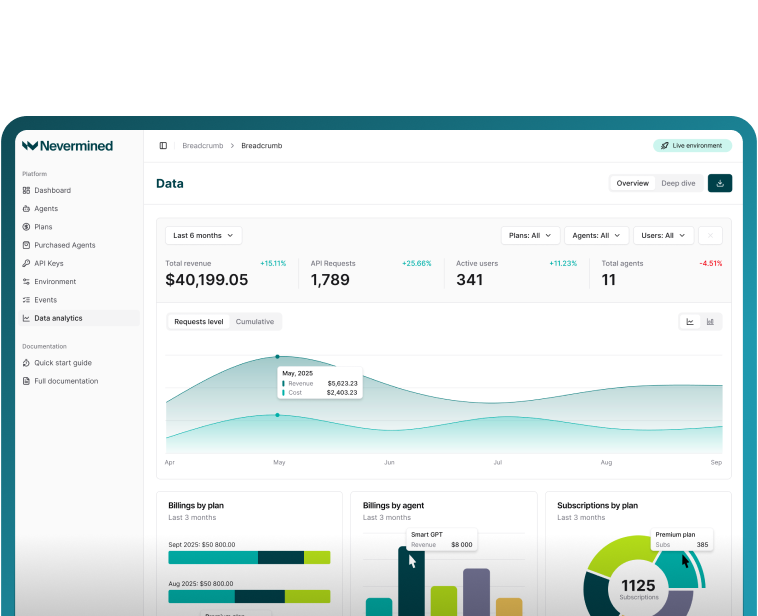
Real-time payments, flexible pricing, and outcome-based monetization—all in one platform.