MENU


AI agents represent the most significant shift in business automation since the introduction of robotic process automation. More than 78% of companies report using gen AI in at least one business function, yet more than 80% report it has had no material impact on earnings. The gap between adoption and results comes down to infrastructure. Traditional payment processors cannot handle the micro-transactions, real-time metering, and autonomous operations that AI agents generate. Modern payment infrastructure designed specifically for agentic commerce enables businesses to price, meter, and settle every agent interaction while maintaining complete audit trails. With AI agents projected to deliver 30-50% process acceleration when properly implemented, the companies that solve the monetization challenge first will capture lasting competitive advantages.
The agentic economy represents a fundamental shift from reactive automation to goal-driven execution. Unlike traditional robotic process automation that follows rigid, rule-based scripts, AI agents combine large language models with machine learning to perceive environments, make decisions, plan multi-step actions, and execute complex workflows autonomously. This distinction matters for businesses seeking genuine transformation rather than incremental improvements.
AI agents operate through a consistent five-stage workflow:
This cycle enables automating complex, judgment-based work that previous technologies could not address. According to BCG research, organizations implementing agentic AI are seeing workflow cycle acceleration of 30-50% and reductions in low-value work time of 25-40%. These agents work 24/7, handle data traffic spikes without extra headcount, and create workflows that were previously impossible to automate.
The challenge lies in monetizing these autonomous interactions. Traditional billing systems designed for human-initiated transactions cannot track the micro-actions that agents generate. This creates a gap between what AI agents can do and what businesses can actually charge for, making purpose-built AI payment infrastructure essential.
Traditional usage-based pricing models charge per token or per API call, but these approaches often fail to capture the actual value AI agents deliver. When an agent books a meeting, closes a sale, or resolves a customer issue, the value created far exceeds the computational cost. Businesses need pricing models that align revenue with outcomes.
Three pricing approaches have emerged for AI agent monetization:
Usage-Based Pricing: Charges per token, per API call, or per compute minute. This model works for predictable, high-volume operations where margins can be calculated precisely. The dynamic pricing engine locks exact margin percentages onto usage credits, guaranteeing profitability on every transaction.
Outcome-Based Pricing: Charges for results rather than activity. An AI sales agent might cost nothing until it books a qualified meeting, then charge a fixed fee per booked appointment. This model shifts risk from the buyer to the provider while creating incentive alignment.
Value-Based Pricing: Takes a percentage of the return on investment generated. If an AI agent optimizes a supply chain and saves $100,000, the platform might capture 10% of documented savings. This approach requires robust tracking and attribution but delivers maximum revenue potential.
Most competitors support only usage-based models. The ability to implement all three approaches through a flexible pricing engine creates significant competitive advantage, especially for platforms serving diverse customer segments. Cost-plus-margin automation ensures platforms maintain profitability regardless of which pricing model customers prefer.
Integration complexity kills most AI initiatives before they deliver value. 97% of organizations using or planning to use generative AI find it hard to prove business value. The implementation roadmap typically spans three phases that many businesses struggle to execute.
The first phase focuses on data assessment and pilot agent deployment:
Multi-agent workflow implementation with governance:
Full orchestration across the business:
Valory cut deployment time of their payments and billing infrastructure for the Olas AI agent marketplace from 6 weeks to 6 hours using Nevermined, clawing back $1000s in engineering costs. This acceleration comes from low-code SDKs that handle the complexity of agent payment infrastructure. Nevermined gets you from zero to a working payment integration in 5 minutes, with SDKs for both TypeScript and Python.
Trust becomes the critical bottleneck when AI agents operate autonomously. How do businesses verify that usage totals match billed amounts? How do customers trust that they are charged fairly for agent interactions? The answer lies in immutable metering systems that create verifiable records of every transaction.
Tamper-proof metering requires several technical components:
This approach addresses the fundamental concern about trusting AI agents to manage tasks autonomously. When an agent executes a transaction, the metering system captures not just the action but the context, pricing rule, and timestamp in a format that cannot be altered.
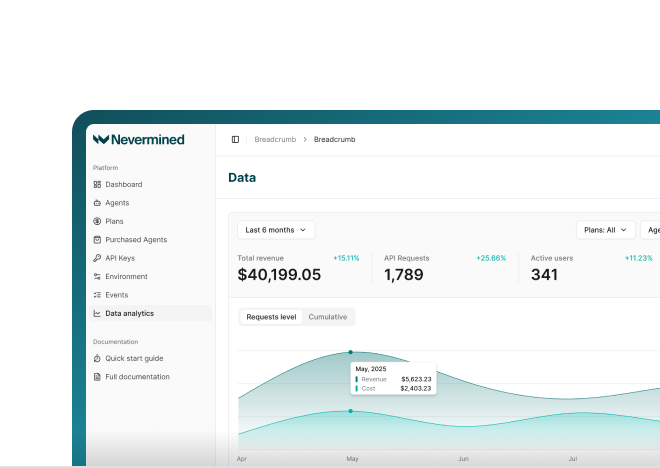
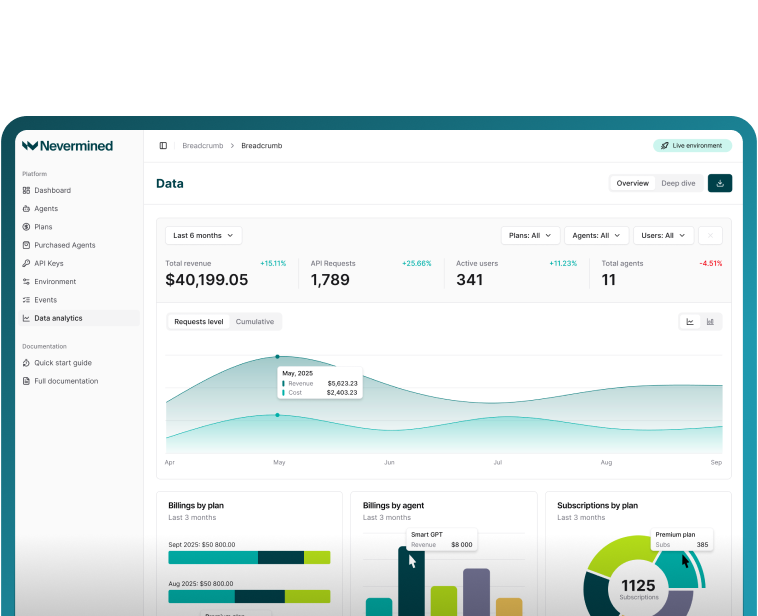
The observability dashboard provides real-time visibility into agent performance, user behavior, revenue analytics, hidden costs, and growth opportunities. Finance teams receive trackable recurring billing instead of complex sub-cent charge reconciliation. API and CSV export capabilities enable independent verification by any party.
The next frontier of automation involves AI agents transacting with each other without human involvement. Multi-agent systems where specialized agents collaborate require payment infrastructure that supports machine-to-machine commerce. Standard payment implementations requiring wallet pop-ups for each request cannot support this architecture.
Agent-to-agent native payments require specific capabilities:
Consider a multi-agent workflow where a research agent gathers data, an analysis agent processes it, and a reporting agent creates deliverables. Each agent might be provided by a different vendor with different pricing. The payment facilitator coordinates authorization, metering, and settlement across all parties, enabling atomic "pay + execute" transactions.
This architecture supports revenue splits across multiple parties, escrow with conditional release, and programmable receipts through minted access credits. Users maintain control through policy boundaries while agents handle the operational complexity of multi-party transactions.
Vendor lock-in represents a significant risk for businesses building AI agent infrastructure. Proprietary systems trap customers in specific ecosystems, limiting flexibility as technology evolves. Protocol-first architecture avoids this trap by building on open standards that ensure interoperability.
Key protocols shaping the agentic economy include:
Protocol-agnostic infrastructure ensures compatibility as standards evolve. Rather than betting on a single protocol, businesses should select platforms supporting multiple standards with the flexibility to adopt new protocols as they emerge.
The agentic AI mesh architecture enables composable, distributed, vendor-agnostic agent ecosystems. This approach features layered decoupling separating logic, memory, orchestration, and interface components. Businesses can swap individual components without rebuilding entire systems, protecting technology investments regardless of how the market evolves.
Credit systems solve a fundamental problem in AI agent commerce: how to charge for micro-actions without overwhelming payment processors or creating reconciliation nightmares. Prepaid credits operate as consumption-based units that users redeem directly against usage, aligning price to value while simplifying billing.
Credits deliver several advantages over traditional billing:
The system works by having users prepay for credits, which then get consumed as agents perform actions. Different actions can consume different credit amounts based on their value or computational cost. An agent booking a meeting might cost more credits than an agent sending a follow-up email, reflecting the different values created.
Real-time metering tracks every request as it happens, billing by cost, usage, or event according to the chosen model. Settlement occurs instantly in fiat or cryptocurrency with both card/ACH processing and stablecoin settlement. This credit system enables scaling without the friction of traditional payment processing.
As businesses deploy multiple AI agents from different providers, identity and attribution become critical challenges. Which agent performed which action? How do you track performance across agent swarms? How do you prevent unauthorized agents from accessing sensitive systems?
Agent identity systems address these challenges through several mechanisms:
The ERC-8004 standard provides the foundation for decentralized agent identities. At registration, each agent receives a unique wallet plus DID with cryptographic proof, creating identities that persist regardless of where the agent operates.
This identity layer enables programmable payment flows where agents trigger transactions autonomously based on pre-authorized rules. Combined with smart account session keys, businesses maintain oversight while enabling the autonomous operations that make AI agents valuable. The documentation provides detailed guidance on implementing identity systems for multi-agent environments.
Visibility into agent operations separates successful deployments from expensive experiments. 66% of executives deploying agents report productivity gains, while 57% report cost savings, but these outcomes require ongoing optimization based on performance data.
Critical metrics for AI agent operations include:
The observability dashboard tracks every request in real-time, providing visibility into user behavior patterns, hidden costs that erode margins, and growth opportunities that standard analytics miss. This data enables continuous optimization of both agent performance and pricing models.
Real examples demonstrate the impact of proper optimization. One implementation achieved 63% reduction in support resolution time. ServiceNow deployments reduced manual workloads by 60%. These results come not just from deploying agents but from continuously refining their operations based on performance data.
Autonomous AI systems create new compliance challenges that traditional governance frameworks do not address. Only 1 in 5 (21%) of companies report having a mature model for governance of autonomous AI agents, yet agentic AI usage is expanding rapidly. Building compliance into infrastructure from day one costs far less than retrofitting after problems emerge.
Key compliance requirements for AI agent deployments:
GDPR and Data Protection: Agents processing personal data need data governance frameworks including anonymization, consent management, and right-to-deletion capabilities. Audit trails must log all interactions while allowing user data control.
Financial Regulations: Agents handling payments or financial decisions must ensure regulatory compliance through automated audit trails, transaction monitoring, and explainable decision-making.
Explainability Requirements: Regulated industries demand agents explain their decisions. As an example policy, organizations may implement confidence thresholds to determine autonomy levels: above 85% certainty allows full autonomy, 70-85% suggests approval requirements, and below 70% triggers escalation. These thresholds should be calibrated to each organization's risk tolerance and regulatory environment.
Human-in-the-Loop Mandates: High-stakes decisions require human validation regardless of agent confidence. Governance frameworks must define which decisions require human approval and implement appropriate controls.
A robust governance framework embeds controls throughout the agent lifecycle across three phases:
Audit-ready traceability built into the payment infrastructure through append-only logging addresses these requirements at the infrastructure layer rather than requiring custom compliance implementations for each deployment.
While numerous platforms offer pieces of the AI agent automation puzzle, Nevermined provides the complete payment infrastructure specifically designed for agentic commerce. The platform addresses the fundamental challenge preventing most AI initiatives from delivering business value: the inability to properly price, meter, and settle autonomous agent interactions.
Nevermined Pay delivers bank-grade enterprise-ready metering, compliance, and settlement so every model call turns into auditable revenue. Key capabilities include:
The platform provides native support for x402, Google's A2A protocol, Model Context Protocol, and Agent Payments Protocol, ensuring compatibility as standards evolve. Smart contract settlement on Polygon, Gnosis Chain, and Ethereum enables both fiat and cryptocurrency payment rails.
Naptha AI Co-Founder Richard Blythman stated: "Whenever I need to understand AI agent monetization, I turn to the Nevermined team. They're world class and leading the agentic payments space." Mother Founding Member James Young noted: "Early on building Mother, we realized agent-to-agent payments get super complicated. Nevermined's solution is the perfect fit."
For businesses ready to move AI agents from experimentation to enterprise-scale value creation, Nevermined's payment infrastructure provides the foundation. The platform handles the complexity of metering, pricing, compliance, and settlement so teams can focus on building AI agents that transform their business. Contact Nevermined to explore how the platform can accelerate your agentic automation journey.
AI agents automate business processes through a five-stage workflow: perception (gathering input from various sources), reasoning (using LLMs to understand context), decision (determining best actions), execution (performing tasks through system integrations), and feedback (learning from outcomes). Revenue generation occurs when businesses charge for agent interactions through usage-based pricing (per token or API call), outcome-based pricing (charging for results like booked meetings), or value-based pricing (percentage of ROI generated). The key is having payment infrastructure that can meter these interactions in real-time and settle transactions instantly.
The primary challenges include handling micro-transactions that traditional payment processors cannot support efficiently, tracking usage across multi-agent workflows where multiple vendors participate, ensuring audit trails satisfy compliance requirements, and aligning pricing with actual value delivered rather than just computational cost. Additionally, 97% of organizations using or planning to use generative AI find it hard to prove business value. Purpose-built payment infrastructure with tamper-proof metering and flexible pricing models addresses these challenges.
Usage-based pricing charges per token, API call, or compute minute regardless of results achieved. Outcome-based pricing charges only when agents deliver specific results, such as a booked meeting, closed sale, or resolved support ticket. This model aligns incentives between providers and customers, shifting risk to the platform while potentially increasing revenue when agents perform well. For example, an AI sales agent might cost nothing until it books a qualified meeting, then charge a fixed fee per appointment rather than charging for every email sent or call attempted.
Tamper-proof metering creates trust between all parties in autonomous transactions. When AI agents operate without human oversight, businesses need verifiable proof that usage totals match billed amounts. Cryptographically signed records pushed to append-only logs at creation prevent after-the-fact modification, enabling zero-trust reconciliation where developers, users, auditors, or agents can independently verify charges. This capability is especially critical as only 1 in 5 (21%) of companies report having a mature governance model for autonomous agents.
Yes, AI agents can make payments autonomously through ERC-4337 smart accounts with session keys and delegated permissions. Users authorize payment policies once, defining spending limits, approved vendors, and transaction types. Agents then operate freely within these boundaries without requiring human approval for each transaction. This architecture supports agent-to-agent commerce where specialized agents collaborate and transact with each other, enabling complex multi-party workflows that would be impossible with traditional payment systems requiring manual authorization.
Three primary segments benefit most from AI agent automation: solo developers and solopreneurs building AI agents who need simple, fast integration with payment infrastructure; AI agent startups requiring rapid time-to-market with flexible pricing models; and enterprise AI platforms needing bank-grade metering and compliance for large-scale deployments. Industries with high-volume, judgment-based workflows see the greatest impact, including customer service (where leaders report 80% of issues could be resolved without human intervention in some implementations), finance and accounting, IT operations, and sales automation.
See Nevermined
in Action
Real-time payments, flexible pricing, and outcome-based monetization—all in one platform.