MENU


Autonomous business represents the next frontier of enterprise evolution, where AI-powered systems independently make decisions, execute transactions, and manage complete business processes with minimal human intervention. Unlike traditional automation that follows rigid scripts, autonomous businesses leverage agentic AI, machine learning, and programmable infrastructure to sense market conditions, reason through complex scenarios, and take independent action. For companies building AI agents or deploying autonomous systems, payment infrastructure designed specifically for machine-to-machine transactions becomes the critical foundation layer that determines whether these systems can actually operate at scale.
The distinction between automation and autonomy is critical for understanding the autonomous business model. Automation executes predefined rules: if X happens, do Y. Autonomy involves systems that perceive their environment, reason about options, make decisions, and take actions without explicit programming for every scenario.
Traditional businesses automate 10-30% of processes, while autonomous enterprises operate with over 50% of processes running independently and up to 80% of work automated overall. This shift is enabled by Agentic Process Automation, which coordinates long-running, complex business processes across traditionally siloed systems using AI agents that think, decide, and act independently.
The evolution follows three distinct maturity stages:
Each stage represents exponentially greater autonomy, culminating in businesses that can design products, manage operations, and complete entire value chains end-to-end.
Gartner identifies five essential components of autonomous business:
By 2028, Gartner predicts 40% of services will be AI-augmented, fundamentally changing how businesses operate and compete.
Autonomous business rests on three technological pillars that work together to enable truly independent operations.
AI agents form the cognitive core of autonomous businesses. These systems can process vast amounts of data, identify patterns, and make decisions at speeds impossible for human operators. Creatio reports that over 80% of leaders view AI agents as a means to drive productivity, handling everything from customer service to supply chain optimization.
The market reflects this potential: AI investment is growing at 31.9% annually, with total spending projected to reach $1.3 trillion by 2029. 92% of companies plan to increase AI spending over the next three years.
Blockchain technology provides the trust layer that autonomous systems require. Smart contracts enable self-executing agreements that trigger automatically when conditions are met, eliminating the need for intermediaries. Decentralized identifiers (DIDs) give AI agents portable, verifiable identities that work across environments and marketplaces.
This infrastructure enables atomic "pay + execute" transactions, stateful billing for subscriptions and metering, escrow with conditional release, and revenue splits across multiple parties.
Traditional payment processors often struggle with the micro-transactions that AI agents generate due to fee structures and settlement constraints. Purpose-built payment infrastructure addresses this gap through:
The agentic commerce opportunity is massive. McKinsey projects this market will represent $900 billion to $1 trillion in US B2C retail alone by 2030.
Visa's research identifies four evolutionary stages of AI-initiated payments:
Each stage requires progressively more sophisticated payment infrastructure including tokenization, agent authentication, budget controls, and programmable credentials.
Three interaction models are emerging for agent commerce:
This transformation moves faster than e-commerce did because agents can "ride on the rails" of existing digital infrastructure. 92% of consumers who've used AI for shopping report enhanced experiences.
Trust is the ultimate constraint on autonomous business adoption, not technology. 87% of financial institutions cite trust as the most significant barrier to agentic payments.
Multi-layered trust frameworks are emerging to address these concerns:
Progressive trust models allow agents to earn greater autonomy by proving reliability over time.
Tamper-proof metering addresses the verification challenge. When every usage record is cryptographically signed and pushed to an append-only log at creation, it becomes immutable. The exact pricing rule stamps onto each agent's usage credit, allowing developers, users, auditors, or agents to verify that usage totals match billed amounts per line-item.
This zero-trust reconciliation model is essential when 78% of enterprises expect fraud to increase from agentic AI adoption.
Autonomous businesses require pricing models as dynamic as their operations.
Three flexible pricing models support the agentic economy:
Dynamic pricing engines enable cost-plus-margin automation where platforms define exact margin percentages locked onto usage credits.
Credits systems operate as prepaid consumption-based units redeemed directly against usage. This approach:
As autonomous systems proliferate, establishing trust and accountability for AI agents becomes critical.
Agent identity systems issue each agent a unique wallet plus decentralized identifier with cryptographic proof of ownership at registration. These portable identities work across environments, swarms, and marketplaces without re-wiring.
The identity layer enables:
"Know Your Agent" (KYA) frameworks are emerging as the parallel to KYC and KYB requirements. These verify agent identity, authority, and alignment with user intent. Auto-discovery via protocols like Google's A2A enables instant agent connection while maintaining security and accountability.
Despite the complexity of autonomous systems, implementation can be straightforward with the right infrastructure.
Modern SDKs enable rapid deployment. Valory cut deployment time of their payments and billing infrastructure for the Olas AI agent marketplace from 6 weeks to 6 hours using Nevermined, clawing back $1000s in engineering costs.
Integration typically follows three steps:
Comprehensive technical documentation provides implementation guides, sandbox environments for testing, and API/CSV export for metering data verification.
Operating autonomous systems requires visibility into performance, costs, and opportunities.
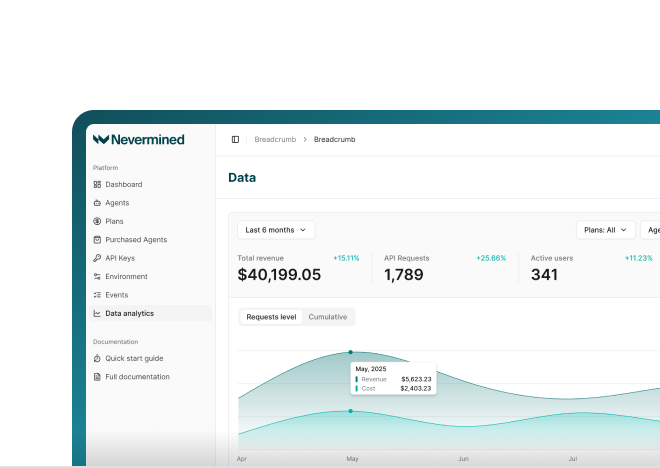
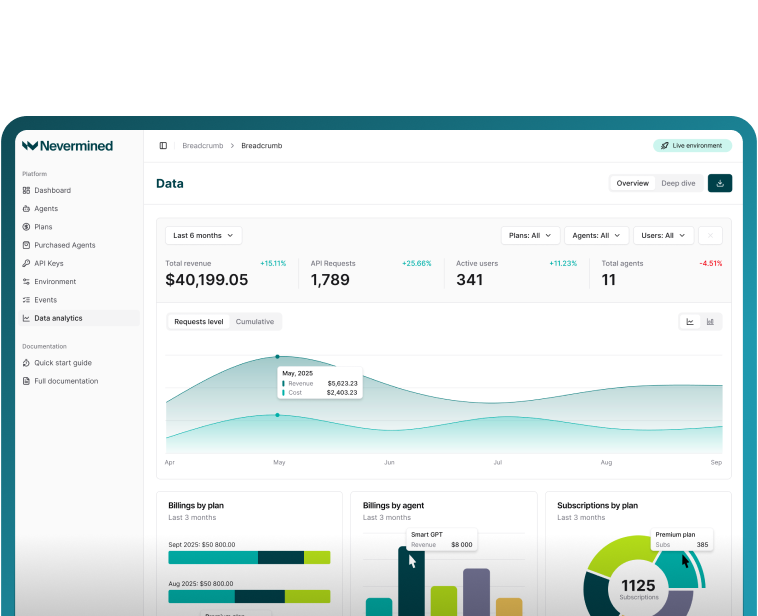
Observability dashboards provide critical insights into:
Real-time tracking enables instant response to anomalies while audit trails satisfy compliance requirements. Companies that adopt this model build businesses capable of running themselves and continually improving. As Dr. Biraja Ghoshal notes, "The competitive gap between adopters and laggards will widen significantly."
For companies building autonomous businesses, Nevermined provides the purpose-built payment infrastructure that traditional processors cannot offer.
Nevermined Pay delivers bank-grade enterprise-ready metering, compliance, and settlement so every model call turns into auditable revenue. The platform provides:
The platform supports native integration with interoperability protocols like Google's A2A and Model Context Protocol, as well as payments protocols like AP2 and x402, ensuring compatibility as standards evolve. Nevermined gets you from zero to a working payment integration in 5 minutes, with SDKs for both TypeScript and Python.
With only 1% of companies achieving AI maturity today, the window for competitive advantage remains wide open. Companies that build autonomous capabilities now, supported by infrastructure designed for agent-to-agent commerce, will lead their industries as this $3-5 trillion opportunity materializes.
Businesses with high transaction volumes, complex workflows, or operations that span multiple time zones benefit most from autonomous capabilities. E-commerce platforms, financial services firms, supply chain operators, and SaaS companies with AI-powered features are prime candidates. Any business where AI agents need to execute transactions, manage resources, or interact with other systems without constant human oversight can gain competitive advantages through autonomous operations.
Autonomous businesses implement multi-layered security frameworks including spend limits, velocity checks, whitelisted merchant controls, and real-time anomaly detection. Progressive trust models allow agents to earn greater autonomy by demonstrating reliable behavior over time. Cryptographically signed usage records and append-only audit logs ensure that every transaction is verifiable, while human-in-the-loop oversight remains available for high-stakes decisions.
The primary challenges include integrating legacy systems not designed for agent-to-agent communication, establishing agent identity and authentication frameworks, and building infrastructure that can handle the volume and speed of autonomous transactions. Additionally, companies must address data governance across jurisdictions, implement explainable AI for compliance requirements, and develop monitoring systems that can detect and respond to autonomous agent anomalies in real time.
Regulatory frameworks remain in flux across jurisdictions. The EU AI Act requires extensive documentation and human oversight for high-risk AI systems, while strong customer authentication requirements under PSD2 in Europe create tension with fully autonomous transactions. Agent liability remains unclear legally, with questions about responsibility when autonomous agents make erroneous transactions. Companies should implement audit trails, explainability features, and compliance checkpoints while monitoring regulatory developments in their operating jurisdictions.
Yes, modern payment infrastructure makes autonomous capabilities accessible to businesses of all sizes. Low-code SDKs and pre-built integrations reduce technical complexity, allowing testing and iteration without significant upfront investment. Small businesses can start with simple use cases like automated billing or subscription management and progressively add autonomy as they scale. The key is choosing infrastructure designed specifically for AI agents rather than retrofitting traditional payment processors.
See Nevermined
in Action
Real-time payments, flexible pricing, and outcome-based monetization—all in one platform.