MENU


Data-driven analysis revealing how AI agent monetization infrastructure drives revenue, accelerates deployment, and transforms autonomous workflows into profitable operations
The agentic AI market has reached a critical inflection point. While 79% of organizations have adopted AI agents, only 33% have successfully scaled beyond pilot programs. The gap between adoption and monetization represents billions in unrealized value. Organizations implementing purpose-built payment infrastructure through Nevermined Pay are closing this gap by turning every agent interaction into auditable, billable revenue with real-time metering and flexible settlement options.
The agentic AI market reached $7.55 billion in 2025, establishing a foundation for exponential growth. This valuation reflects enterprise investment in autonomous systems capable of independent decision-making and task execution. The market represents the convergence of AI capabilities with practical business applications requiring sophisticated payment infrastructure.
Projections show the agentic AI market expanding to $199.05 billion by 2034, representing a 26x increase in nine years. This growth trajectory demands payment infrastructure capable of handling exponentially increasing transaction volumes. Traditional payment processors lack the architecture to support the micro-transactions and real-time settlement that autonomous agents require.
The AI agents market is experiencing 45.82% compound annual growth from 2025 to 2034. This growth rate outpaces nearly every other technology sector, indicating urgent infrastructure needs. Organizations without purpose-built payment systems will struggle to capture revenue from this expansion.
The broader workflow automation market reached $23.77 billion in 2025. This market provides context for where autonomous AI workflows fit within enterprise technology spending. The intersection of workflow automation and AI agents creates specific monetization requirements that Nevermined's core concepts address directly.
Mordor Intelligence projects workflow automation will grow at 9.41% CAGR through 2031, reaching $40.77 billion. While slower than pure AI agent growth, this steady expansion represents a massive addressable market. The convergence of traditional workflow automation with AI agents creates hybrid monetization opportunities.
Research confirms that 62% of organizations expect their agentic AI investments to deliver over 100% return on investment. These expectations require pricing models that capture value proportional to outcomes delivered. Usage-based, outcome-based, and value-based pricing models enable organizations to align costs with the actual value generated by autonomous workflows.
American enterprises project an average 192% ROI from their agentic AI implementations. This substantial return expectation drives investment decisions and shapes pricing strategy requirements. Organizations need dynamic pricing engines capable of capturing this value through flexible billing models.
Organizations implementing AI-driven process automation report 240% average ROI within the first year. This rapid payback period demonstrates the immediate value of autonomous workflows. The key challenge lies in implementing billing infrastructure fast enough to capture this value before competitive pressure erodes margins.
Beyond averages, 60% of organizations achieve positive return on investment within 12 months of AI implementation. This majority success rate validates the business case for autonomous workflow investment. Rapid deployment of monetization infrastructure determines whether organizations capture this value or lose it to operational friction.
Forrester research documents 210% three-year ROI with initial payback occurring in under six months. This favorable timeline creates urgency for immediate implementation. Organizations delaying payment infrastructure deployment forfeit months of potential revenue capture.
The majority of enterprises identify security and compliance issues as primary obstacles to AI adoption and scaling. Traditional payment systems cannot provide the audit trails required for regulatory compliance. Tamper-proof metering with cryptographically signed usage records addresses this barrier directly, enabling organizations to demonstrate compliance without manual reconciliation.
Beyond compliance, organizations identify cybersecurity as a concern when deploying autonomous systems. Payment infrastructure must incorporate security by design rather than as an afterthought. Append-only logging and immutable records protect against both external threats and internal manipulation.
Trust deficits affect 28% of organizations attempting to scale autonomous workflows. This trust gap extends to billing accuracy, where organizations question whether usage metrics match actual consumption. Zero-trust reconciliation models where developers, users, and auditors can independently verify billing data eliminate this concern.
More than half of organizations (51%) report negative consequences from their generative AI implementations. Many of these consequences stem from inadequate monitoring and billing transparency. Audit-ready traceability prevents the hidden costs and unexpected overruns that create negative outcomes.
Security research reveals 80% of companies have experienced AI applications operating beyond their intended scope. This boundary violation creates both operational and financial risks. Payment infrastructure with built-in usage limits and real-time monitoring prevents runaway costs from unbounded agent behavior.
A significant share of organizations (53%) have deployed AI agents that access sensitive information. This access level demands rigorous metering and audit capabilities. Every interaction must be logged and traceable to maintain data governance requirements while enabling monetization.
Real-time payment volume grew 40% year-over-year in 2024, signaling rapid adoption of digital payment infrastructure that underpins autonomous commerce patterns. This growth requires payment systems designed for machine-to-machine transactions rather than human-initiated purchases. Traditional payment processors requiring manual approval cannot support the transaction patterns that autonomous agents demand.
More than half of organizations (51%) now operate AI agents in production environments. This production deployment creates immediate monetization requirements. The Google A2A integration enables these production agents to transact autonomously using standardized protocols.
Beyond current production deployments, 78% of organizations plan to move agents into deployment in the near term. This pending deployment wave will dramatically increase demand for agent-native payment infrastructure. Organizations implementing payment systems now will be positioned to monetize this expansion.
Nearly universal expansion plans (96%) indicate that AI agent deployment is accelerating across enterprises. This expansion will multiply the volume of agent-to-agent transactions requiring settlement. x402 protocol support enables these transactions without requiring human intervention for each payment.
Valory cut deployment time of their payments and billing infrastructure for the Olas AI agent marketplace from 6 weeks to 6 hours using Nevermined, clawing back $1000s in engineering costs. This 98% reduction in deployment time demonstrates the efficiency advantage of purpose-built infrastructure over custom development.
Nevermined gets you from zero to a working payment integration in 5 minutes, with SDKs for both TypeScript and Python. This rapid onboarding eliminates the traditional weeks of integration work required for payment systems. Developers can focus on building agent capabilities rather than payment plumbing.
Despite widespread investment, 69% of organizations have AI projects that never reached operational deployment. Many failures stem from infrastructure complexity rather than AI capability limitations. Reducing deployment friction through pre-built payment infrastructure increases project success rates.
McKinsey research reveals fewer than 10% of organizations have successfully scaled AI agents across any business function. This scaling failure often results from inability to demonstrate ROI through proper billing and metering. Clear revenue attribution through comprehensive billing infrastructure enables the business case required for scale.
Executive commitment remains strong, with 88% planning budget increases for AI in the coming year. This budget availability creates opportunity for organizations with monetization infrastructure ready to deploy. The gap between budget allocation and successful monetization represents the implementation challenge that purpose-built payment systems solve.
Cloud deployment models capture 62.15% of workflow automation market revenue in 2025. This cloud dominance requires payment infrastructure capable of operating across distributed environments. Multi-chain support across Polygon, Gnosis Chain, and Ethereum enables settlement wherever agents operate.
While cloud leads, hybrid deployment grows fastest at 10.08% CAGR through 2031. Organizations require payment infrastructure flexible enough to operate in both cloud and on-premise environments. Smart contract settlement provides this flexibility through blockchain-agnostic architecture.
Software platforms represent 66.55% of workflow automation revenue, indicating where monetization opportunities concentrate. Platform operators need built-in billing capabilities to capture revenue from third-party agents and services. The payment models documentation details how platforms implement these capabilities.
Single agent deployments account for 59.24% of agent revenue in 2025. While multi-agent systems attract attention, single agents dominate current deployments. Payment infrastructure must support both simple single-agent billing and complex multi-agent revenue splits.
Enterprises implementing agentic AI report that 69% cite cost reductions through visibility and control. These savings come from eliminating hidden costs and preventing runaway spending. Credit-based systems provide the budget controls that enable these reductions.
Budget concentration is accelerating, with 75% of enterprises now spending over $1 million on AI agents. This significant investment requires equally robust billing infrastructure. Prepaid credit systems align consumption with budget cycles, enabling finance teams to manage AI spending like any other operational expense.
Near-universal funding expansion (92%) indicates sustained investment momentum. Organizations need billing systems that scale with this funding expansion. Credit systems that track burn rate in real-time prevent the budget surprises that derail expansion plans.
AI-driven automation delivers 25% cost reductions in customer service through intelligent triage and resolution. Capturing this value requires billing infrastructure that attributes savings to specific agent actions. Usage-based billing tied to customer service outcomes creates clear ROI visibility.
AI implementations achieve payback within 6-9 months on average. This rapid payback depends on proper revenue recognition and cost attribution. Credit systems with real-time tracking enable accurate payback calculations that justify continued investment.
Gartner projects 33% of enterprise software will incorporate agentic AI by 2028, up from less than 1% in 2024. This explosive growth requires payment infrastructure supporting multiple protocols and standards. Protocol-first architecture ensures compatibility as the ecosystem evolves.
By 2028, 15% of work decisions will be made by autonomous systems without human involvement. These autonomous decisions will trigger payments, require billing, and need audit trails. Native support for x402, Google A2A, Model Context Protocol, and Agent Payments Protocol ensures infrastructure readiness.
The 79% adoption rate confirms AI agents have reached mainstream enterprise deployment. This adoption level creates network effects where agents must interoperate and transact with each other. Protocol-agnostic payment infrastructure enables these cross-platform transactions.
Grand View Research projects the AI agents market reaching $182.97 billion by 2033. This massive market requires infrastructure designed for scale from the beginning. Organizations building on extensible, protocol-compliant platforms will capture disproportionate value as the market expands.
Successfully monetizing autonomous workflows requires focused implementation across several dimensions:
Infrastructure Fundamentals:
Integration Considerations:
Operational Requirements:
The Nevermined documentation provides implementation guides addressing each of these priorities, enabling organizations to move from evaluation to production deployment rapidly.
Fully-autonomous workflows generate earnings through three primary models: usage-based pricing that charges per token, API call, or compute unit; outcome-based pricing that bills for completed tasks like booked meetings or resolved tickets; and value-based pricing that captures a percentage of the ROI generated. Organizations achieve 240% average ROI within 12 months by implementing billing infrastructure that captures value across all three models. The key is matching the pricing model to the specific value delivered by each workflow.
AI agents require purpose-built payment infrastructure capable of handling micro-transactions, real-time metering, and agent-to-agent settlements without human intervention. Traditional payment processors cannot support the sub-cent transactions and high-frequency billing that autonomous workflows generate. Infrastructure must include tamper-proof metering, flexible pricing engines, and multi-currency settlement across both fiat and cryptocurrency rails, which is why 79% of organizations adopting AI agents need specialized billing systems.
Yes, AI agents can transact autonomously using smart accounts with session keys and delegated permissions. Users authorize payment policies once, establishing boundaries within which agents can interact freely. The 40% payment volume growth in 2024 demonstrates that the infrastructure supporting autonomous transactions is already scaling rapidly. ERC-4337 smart accounts enable these transactions while maintaining security through programmable authorization logic.
Tamper-proof metering builds trust by ensuring every usage record is cryptographically signed and stored in append-only logs, making manipulation impossible. This addresses the 28% of organizations that cite lack of trust as a top challenge with autonomous systems. Zero-trust reconciliation allows developers, users, auditors, and agents to independently verify that usage totals match billed amounts per line item, eliminating billing disputes and enabling regulatory compliance without manual audits.
Smart contracts automate the settlement layer for autonomous workflow transactions, enabling atomic "pay and execute" operations where payment and service delivery happen simultaneously. They support stateful billing for subscriptions and metering, escrow with conditional release for outcome-based pricing, revenue splits across multiple parties in multi-agent workflows, and programmable receipts through minted access credits. This automation eliminates the manual reconciliation that creates delays and errors in traditional billing systems.
Join the Autonomous Business Hackathon on March 5 to 6, 2026 in downtown San Francisco to build autonomous businesses where agents make real economic decisions, transact with each other, and run with minimal human oversight.
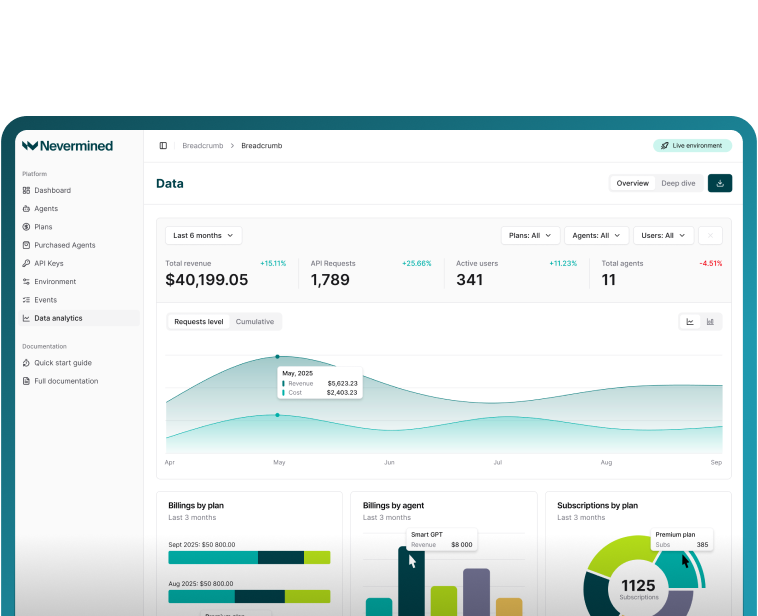
See Nevermined
in Action
Real-time payments, flexible pricing, and outcome-based monetization—all in one platform.